Noise
ISSUE NO. 06: ALBA LARSEN
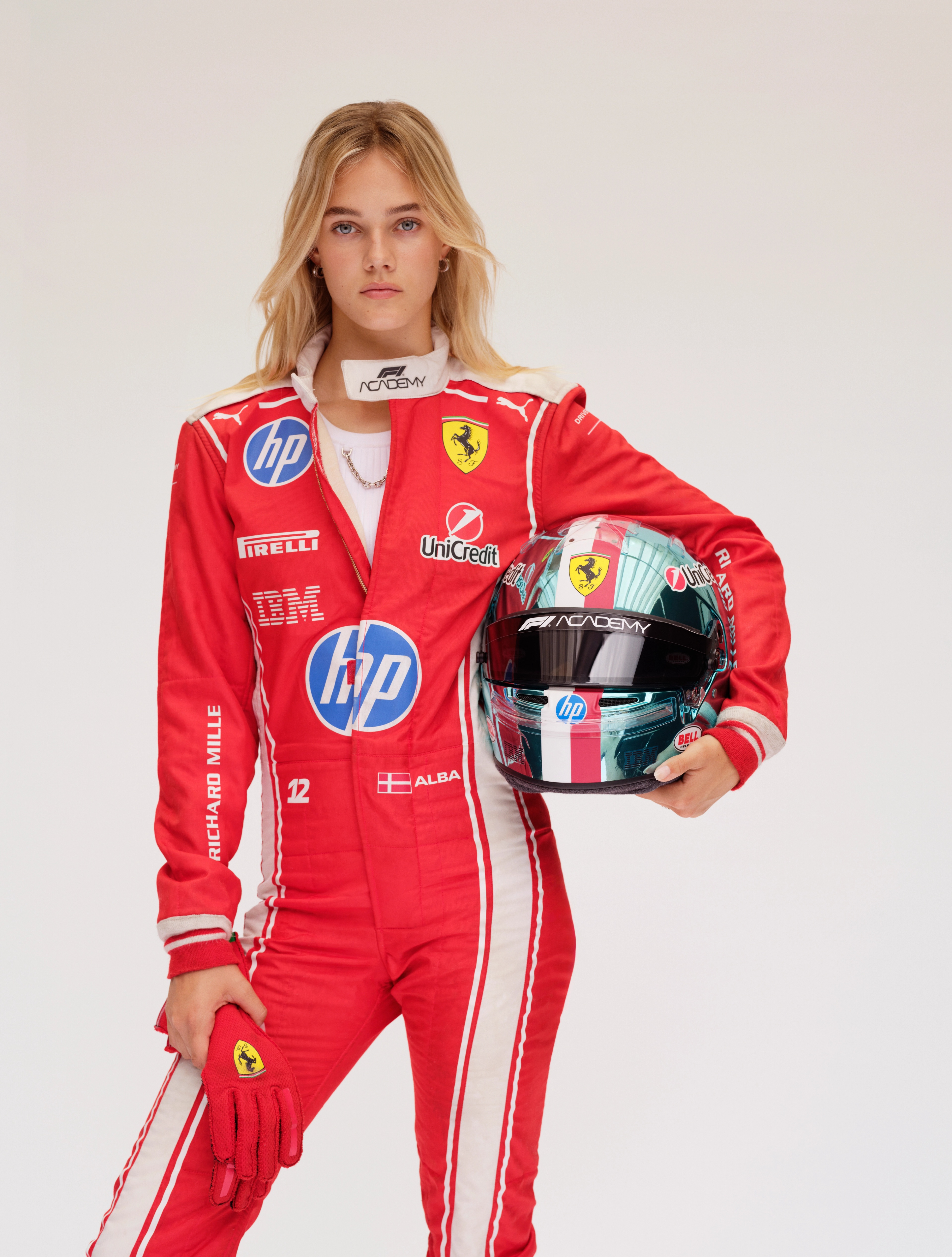
Top and shoes by LOUIS VUITTON. Earrings by BVLGARI. Race suit, helmet and gloves TALENT'S OWN.
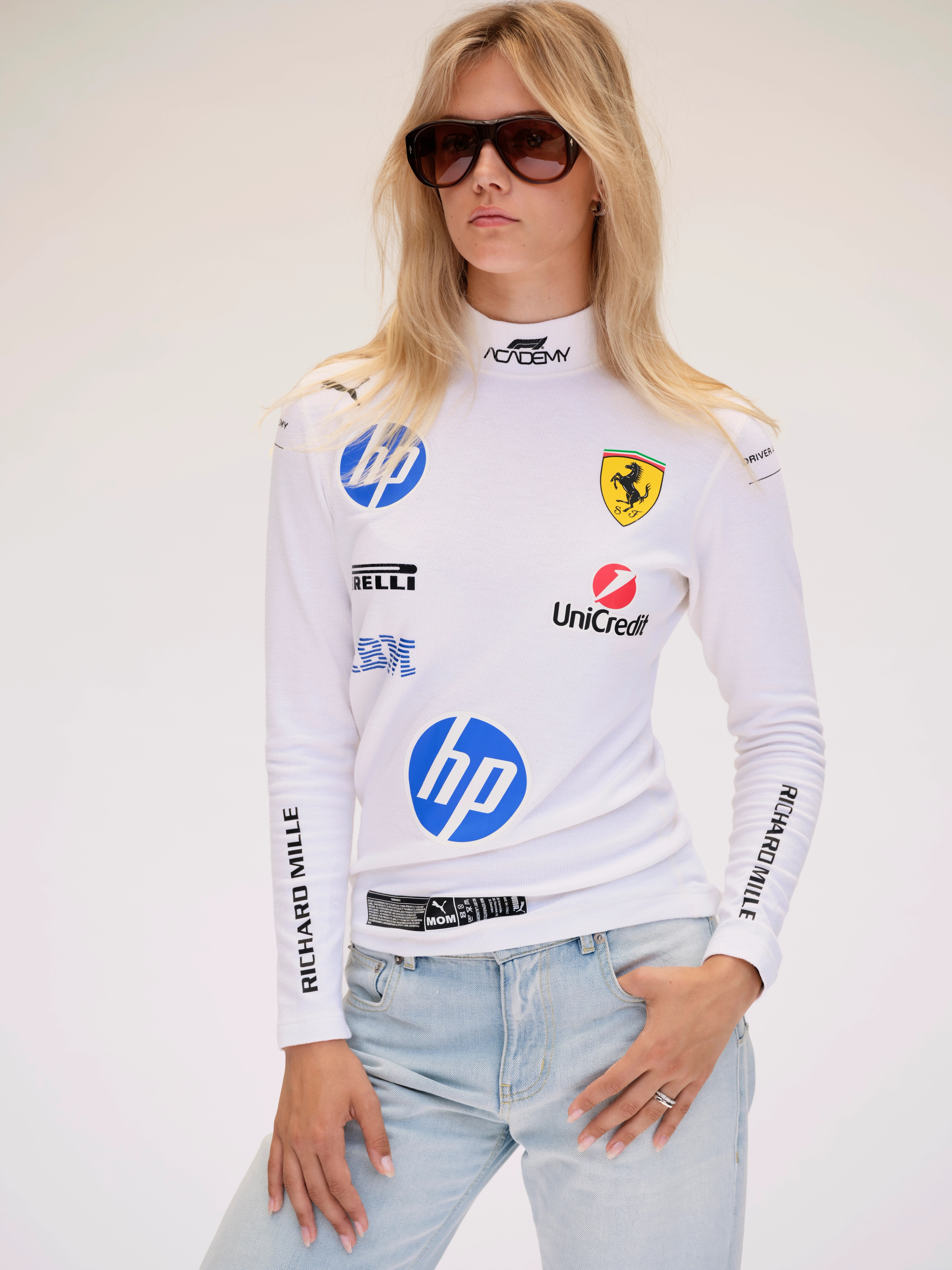
Jeans by DIOR. Earrings and rings by BVLGARI. Sunglasses by JACQUES MARIE MAGE. Race jersey top TALENT'S OWN.
JOY AND DISCOVERY
Words: 2319
Estimated reading time: 13M
Alba Larsen, a young trailblazer in motorsports, meets poet, actress and filmmaker Greta Bellamacina.
By Zoe Whitfield
Prior to the pandemic, motorsports largely remained background noise for Alba Larsen. When lockdown shuttered her beloved handball courts in 2020, a schoolfriend’s invitation to try go-karting changed everything: eleven years old at the time, the adrenaline rush would totally reconfigure her trajectory. Today Alba is widely considered a frontrunner for becoming the first woman to compete and win points in F1 since the Italian driver, Lella Lombardi in the 1970s.
By industry standards, Alba was relatively late when she arrived at the sport – Ferrari stablemate Lewis Hamilton began go-karting at six, while Susie Wolff, the former F1 test driver now heading up F1 Academy, was three when she tried a mini-quad and eight when she started go-karting – but the Danish 17-year-old has enjoyed a rapid ascent since the world reopened. In 2023 alone she won four of her five rounds in the Zealand Championship, later embarking on her first race in an F4 car (a vehicle of near double the speed of any high performance go-kart) at FIA Girls on Track – Rising Stars, winning the senior category.
Since 2025 she has competed in F1 Academy, a unique championship established to help develop and prepare young women for the higher ranks of competition – and ultimately, one presumes, mirror Lombardi’s achievements – where she drove initially with Tommy Hilfiger, before being tapped by Ferrari at the end of last year. Amidst all of her personal wins, of which being recognized by Ferrari and donning the team’s signature rosso corsa was a notable high, Alba has been fiercely attuned to the need for further transformation within the sport, specifically with regard to gender and disrupting the boys club mentality that typically permeates the track: aged 15 she set up Girls International Racing Lab (G.I.R.L.) to do just that.
In near stark contrast is the British actress, poet and filmmaker Greta Bellamacina, who explains that she does not drive and has, so far, never attended a race (something she is keen to rectify). Meeting Alba for the first time, however, she is privy to the shared characteristics of sports and the arts. Here, they discuss what it means to perform for an audience, the associated pressures and the difficulties in shaking off what happened at work, be it on stage or on the track, when returning to daily life.
GRETA BELLAMACINA: Earlier this year I met the gardener Monty Don and we were talking about weather apps and how his whole life is around the best weather apps, and so I was thinking about how the mood of weather could affect your approach to racing. Do you feel emotional towards the weather in that way?
ALBA LARSEN: I approach every race differently and don’t have a preference, but I really enjoy driving in the wet. It makes it super interesting, and I’m usually very fast. The worst weather is when we don’t know what it’s going to be, and whether we should use wet tires or slick tires. Then it’s a gamble.
GB: I don’t drive, but when I was younger I loved the sense of freedom with skateboarding. When I eventually got the confidence and went to a skate park, it was full of boys and I got intimidated. Have you experienced anything similar?
AL: I was lucky to have a sister who started racing at the same time as me, so I already had a friend – and I started because one of my good guy friends was driving – so I had a very safe space. But it’s a very male-dominated world and can be intimidating. You sit in a kart that drives super fast, and it’s scary in a way, if you’ve never tried it before it can feel very overwhelming, especially if there’s no one who you can talk to. Girls feel they should choose other sports. That’s why we started Girls International Racing Lab (G.I.R.L.), inviting girls to try racing together, so, in that way, they have a safe space when they get into it.
GB: It’s fascinating how you discovered motorsport. I guess at the beginning it came from a sense of joy and discovery, and now you’ve achieved so much. Do you still keep a sense of those early experiences, or do you find that your approach is completely different now?
AL: When you start it’s fun, it’s new, and I really try to have that joy still when I’m on track; if it gets too serious, I try to go back to that. We put a lot of time and effort in, so if you’re not having fun there’s not really a reason to keep doing it. The good thing is there’s still new stuff all the time – like from last year to now and driving at F1 Academy. Obviously, it’s the same series, but it’s new tracks, new people, a different team... When we do events with G.I.R.L., and I see the joy in the girls’ eyes when they try it for the first time, I remember how it was.
GB: What have you learned from the girls?
AL: It comes back to seeing the light in their eyes, it really brings me a lot of joy and helps me feel motivated. Both at G.I.R.L. and when I’m driving, when people come up to me and say they feel inspired, it helps me to work even harder, and I think it teaches me different perspectives, because the girls come from all different worlds. They’ve been told they couldn’t drive, and then they get this opportunity.
GB: Yeah, I can imagine it keeps that sense of enjoyment and freshness. Do you celebrate all your achievements? I find it quite hard to, and I’ve realized, as time goes on, I’m often thinking about the next goal. But if you win something do you mark it, or are you thinking about the next thing?
AL: I know exactly what you mean, and I think as you keep raising the bar, you raise the expectations, and so when you achieve one goal you’re already thinking about the next. Two years ago I was just driving for fun – it was professional, but fun – and me and my team have really been working hard since, achieving some big things. Driving for Ferrari, that was once the big, big dream. It’s also important to celebrate the small moments, because I forget sometimes how far we’ve come in such a short amount of time.
GB: That’s very wise. I was reading about Susie Wolff and, as one of the first female drivers in that realm, she was talking about loneliness, which I thought was fascinating: when she got into a car, she was the only one to experience the journey. I wondered if you’d ever felt that sense of solitude?
AL: I don’t think I feel lonely in the car, I wouldn’t use that frame. But I understand what she’s talking about, because it’s only you. You have obviously the radio and engineer, but in the car you’re making the decisions. It’s a big responsibility and can feel like a lot of pressure, but I enjoy being able to make that decision, and having that pressure as well.
I love racing because you’re in control of everything that happens, you’re one with the car and you’re sitting in a seat made for you, that is fitted exactly into the car. Susie was the only woman, and with F1 Academy she’s created a space where we’re 18 women.
GB: I was thinking about your amazing achievement of being the fastest woman in your age group, and your sense of time and how we live in time generally. So much of time is not straightforward – it’s in our heads. When you’re in the car, how do you experience time? Obviously you’re going fast, but what’s that experience like?
AL: I’ve heard a lot of drivers explain driving as time slows down, which I understand. Time is moving very fast when you’re in the car, but you’re also in your own world, and everything is kind of moving slow. When I’m racing, which is sometimes half an hour, I’m so focused on that next corner, when I get out it can feel like it was only five minutes. But when you’re in the car, everything feels very in the moment. If that makes sense?
GB: It really does. I just finished doing a play and found at night I couldn’t switch off. I was dreaming about the character. I was thinking, there’s a similarity with the arts and sports, in that sense that you’re living in the present. When you finish a race, is there a big high? Does it take a day or two to sit with what’s happened, or is there a sense of relief?
AL: It’s kind of both. You’re so focused on the track, there’s so much going on – noise and people – and you’re in the car. But it’s also physical, so I think by the end of the day, if it’s been a good day, the two hours after we’re celebrating, but then I can really just crash and sleep well.
GB: That’s good. I recently read that Coco Chanel had lots of lucky talismans, and I wondered, do you believe in luck?
AL: I try not to be superstitious. I know some drivers have a very specific routine – they have to do this, touch that – but if you forget something, you can’t let that ruin your whole race. I usually do the same kind of warm up, listen to music, and always jump in the car from the left, but that’s more or less it. But I do believe in luck, and I think I’ve been very lucky throughout my whole racing journey. There’s been more ups than downs, but also in racing, there’s stuff that is out of your control. Like if you get hit from behind during the start and your race is over, there’s nothing you could have done because there’s other people on track.
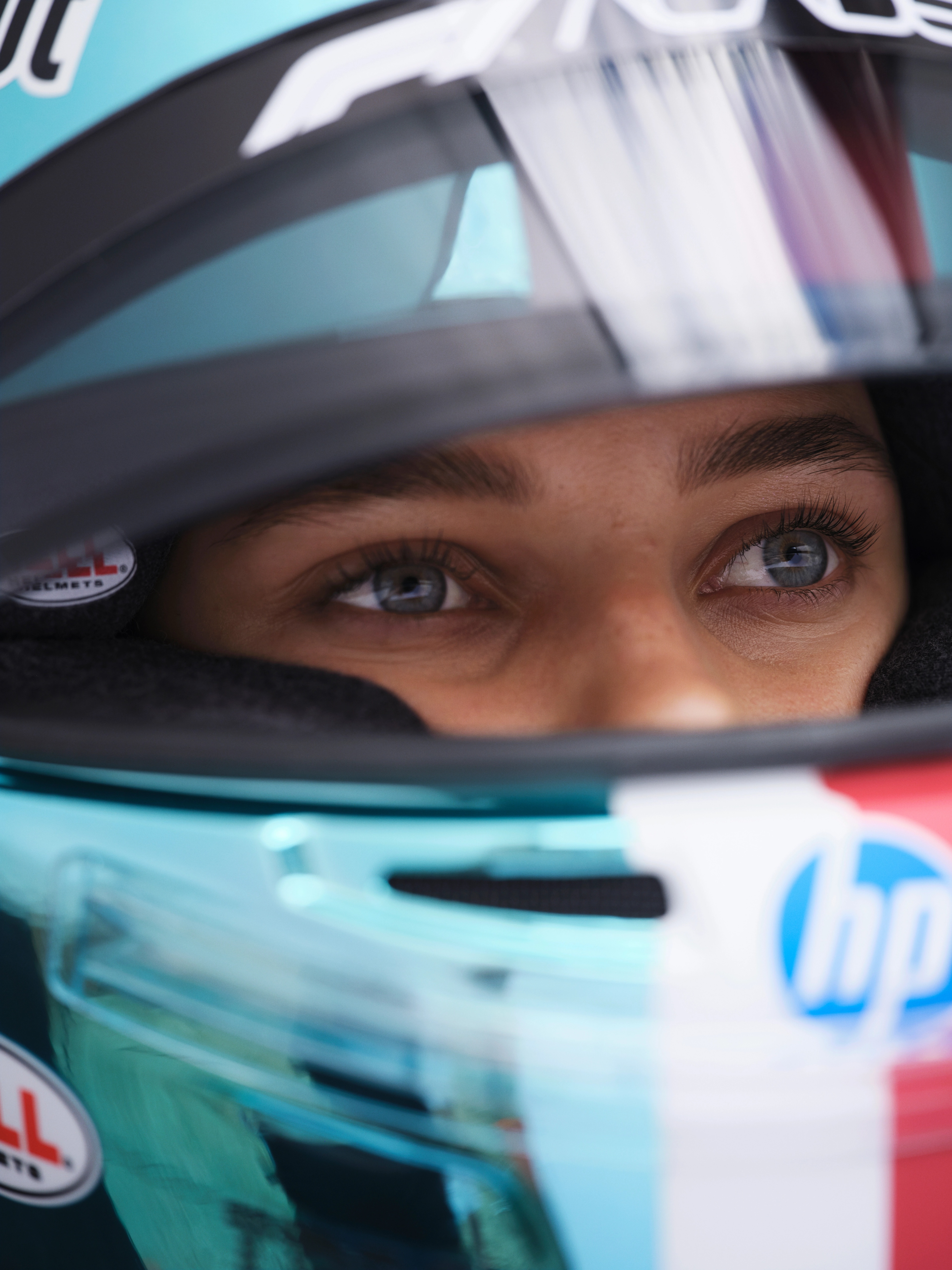
GB: That makes sense. I was also thinking about wearing a helmet – do you find there’s something quite freeing about that kind of... disguise? It’s like this idea of costume and wearing a mask. Do you think that changes the way you perform?
AL: Now I’m racing for Ferrari, I’m in a red suit. When I’m wearing that everyone knows what it is. I wear it with great pride, but there’s also a pressure. If I’ve done a bad race and I’m wearing my suit, everyone knows. But in the paddock there’s so many people, and when I’m not in my suit I kind of blend in. When I’m wearing my suit, I’m standing out. I’m a driver. People know that I race, and I really love that feeling.
GB: I’m so inspired by everything you’ve achieved, and I think it’s important to celebrate success, but also talk about the failings and the hard work. What’s one of the biggest failings you feel you’ve had to overcome, to paint a picture of how you got to this point?
AL: There’s been a lot of ups and downs throughout the whole journey. Recently I was in Shanghai, where I was leading the race, and then I made a mistake and I lost the win. That took time to work through, for the next race, having to reset and move on is a difficult thing, but it’s super important.
I try to tell myself you can be mad and annoyed for a short amount of time, like 24 hours, but then you need to move on. Something that helped me is thinking of the big F1 drivers – Lewis Hamilton, Kimi Antonelli and Max Verstappen – and how all of them have made mistakes as well.
GB: That’s very powerful to acknowledge. Have you found being at the F1 Academy with these other female drivers – your competitors – there’s camaraderie and a sense of community?
AL: Yeah, I think what is so special about F1 Academy, and it’s nothing against the boys, but when I drive against boys, it’s very competitive. When you have a win or a bad day, guys aren’t coming over and saying ‘good job’ or ‘better luck next time.’ While with the other women and girls, when someone is doing well, no matter if you have a bad day or something, I still can say ‘good job’ or ‘that was really great driving.’ Or if we’re having a big battle, whoever wins that battle, we can still say that was good. There are so many people watching, and we’re driving a big change to the sport, so we have to uplift each other.
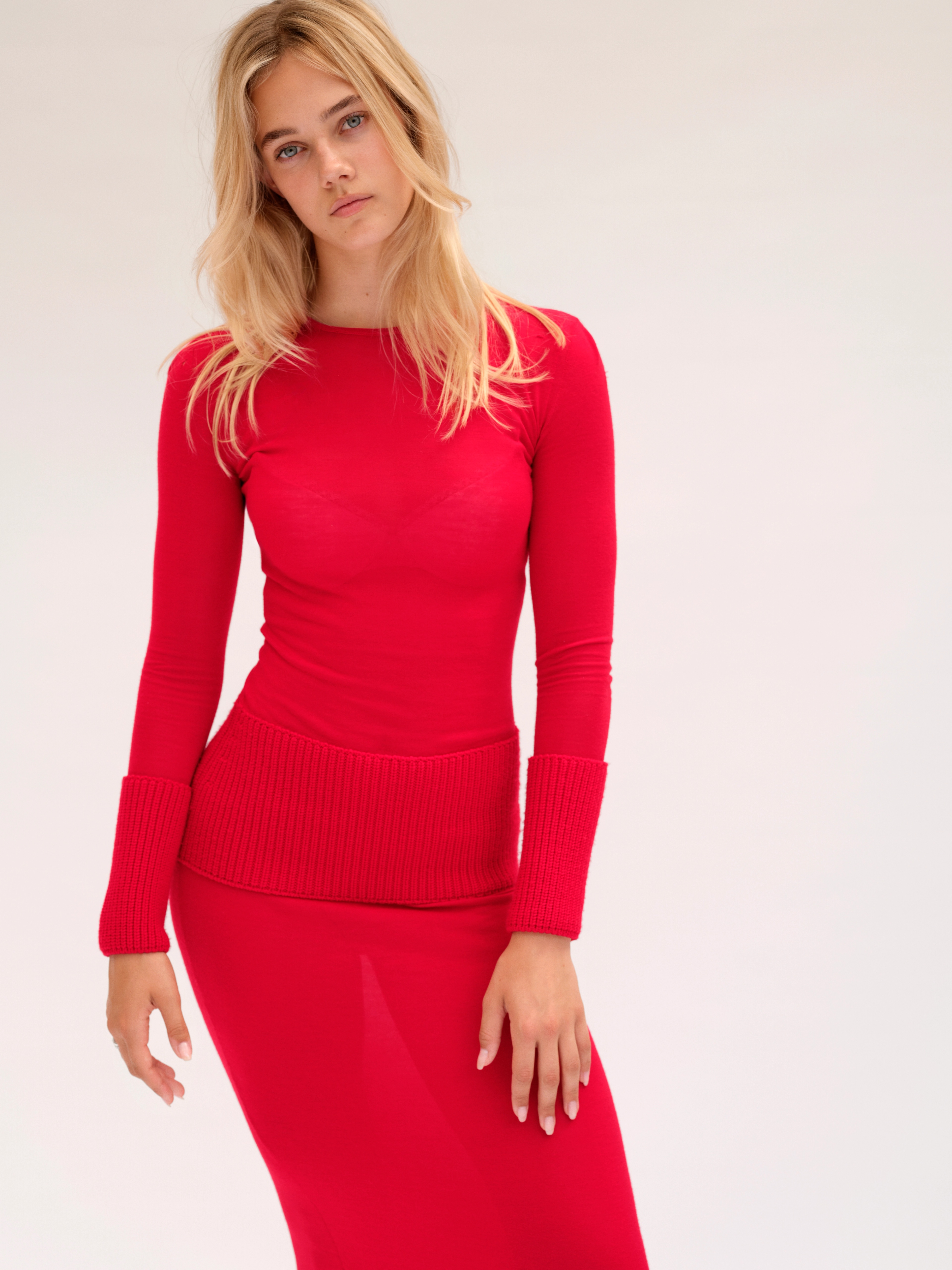
Dress by ALAÏA.
"WITH THE OTHER WOMEN AND GIRLS, WHEN SOMEONE IS DOING WELL, NO MATTER IF YOU HAVE A BAD DAY, I SAY, 'THAT WAS REALLY GREAT DRIVING.'"
EIC + FASHION
SARAH RICHARDSON
PHOTOGRAPHER
RICHARD BUSH
HAIR
Sayaka Otama
MAKE-UP
Lois Moorcroft
PHOTO ASSISTANTS
Rory Cole, Max Lancaster
DIGITAL TECHNICIAN
Nick Pearce
POST PRODUCTION
Andy Greig at Love Retouch
SPECIAL THANKS
Oscar Ericsson, Cosmo Perrett
Beyond Noise 2026
EIC + FASHION
SARAH RICHARDSON
PHOTOGRAPHER
RICHARD BUSH
HAIR
Sayaka Otama
MAKE-UP
Lois Moorcroft
PHOTO ASSISTANTS
Rory Cole, Max Lancaster
DIGITAL TECHNICIAN
Nick Pearce
POST PRODUCTION
Andy Greig at Love Retouch
SPECIAL THANKS
Oscar Ericsson, Cosmo Perrett
Beyond Noise 2026