Noise
ISSUE NO. 05: ROSE WYLIE

CULTURAL OBJECTS
Words: 3924
Estimated reading time: 22M
ROSE WYLIE IS AN ARTIST WHOSE WORK IS GROUNDED IN INDEPENDENCE, ATTENTIVENESS, AND THE ENDURING POWER OF THE IMAGE.
By Magnus Edensvard
Rose Wylie has long painted according to a simple yet quietly radical premise: the picture comes first. Before explanation, before theory, before the scaffolding of interpretation that so often surrounds contemporary art, there is the image itself — encountered directly, intuitively, sometimes unexpectedly. The idea lends its title to Wylie’s recent exhibition at the Royal Academy in London, The Picture Comes First, which marked the first time the institution’s Main Galleries were dedicated to a solo presentation by a woman artist. The phrase itself emerged almost casually in conversation with curator Katharine Stout, yet neatly captures the spirit of Wylie’s practice.
Working steadily for decades, Wylie has developed a painterly language that feels both immediate and deeply considered. Her canvases — often monumental yet intimate in tone — move fluidly between references drawn from art history, cinema, popular culture, and everyday observation. Figures from film, sport, and mass media appear alongside fragments of art history and personal memory, rendered in a style that resists academic polish while remaining unmistakably deliberate. Humor, irreverence, and visual play often surface, though Wylie insists these qualities are byproducts rather than intentions; beneath them lies a sustained engagement with the act of looking.
Central to Wylie’s work is what she calls “transtemporality”: a conversation between past and present where cave paintings, early frescoes, cinema stills, and contemporary media imagery can coexist on equal footing. In this sense, her paintings are less about novelty than continuity — part of a long lineage of artists depicting the things people see, recognize, and remember.
Recent paintings show how freely these references travel across time and culture. In new works, figures such as Bette Davis appear alongside unexpected echoes of artists like Henri Rousseau, while the visual language of early animation and popular culture — including characters like Betty Boop — slips into the painterly field. These unlikely combinations form part of the associative logic through which Wylie’s images evolve.
In the conversation with Beyond Noise that follows, Wylie reflects on her practice with characteristic candor and wit, discussing everything from film stars and medieval bears to the stubborn difficulty of painting heads. What emerges is a portrait of an artist whose work remains grounded in independence, attentiveness, and the enduring power of the image.
MAGNUS EDENSVARD: I love the title of your current exhibition at the Royal Academy in London, The Picture Comes First. Can you tell me a little about how that title came about, and the various themes explored in the show?
ROSE WYLIE: I’m glad you like it. I think Katharine Stout, who curated the exhibition, thought it could be thematic, it would work. You know, early life, film, my diary, that kind of thing. And the title just sort of came up — I said it. It’s about seeing an image first, not reading about it in a text for explanation. It happened in conversation, completely by chance. I could see the whole thing from her point of view, and everybody liked the title. So that’s how it came about. It’s not an exhibition with just one theme, nor quite a retrospective.
ME: Having worked as an artist for many decades, does the urgency you feel to exhibit remain the same?
RW: I think everything remains much the same. I have had times when I didn’t have any exhibitions, and I have had times when I have had exhibitions. Now I have the RA show, and then there’s another one coming up after, in Paris, Henri, Egypt... Bette, Bear [at David Zwirner Gallery], which is nice as each one reinforces the other, there’s a follow-on.
ME: Your work seems to hold humor and a certain absurdity, alongside a quiet irreverence. Is that something you consciously think about while painting?
RW: Humor and absurdity, I think, are a way in for some people. I mean, my paintings are both deadly serious, and they are also not deadly serious. I like contradictions. I think that my paintings may be funny in the context of some other paintings; it depends on the context. I never try to be funny, but I am irreverent sometimes. I think piety is a bit of a nuisance. If there are things which don’t quite go together, that could appear as funny. At the same time Magnus, as I said, if they are funny, they are also serious. They are hugely serious. If they’re funny, that’s just a byproduct. It’s not something which I’m aiming for.
ME: How do you choose your subjects?
RW: They are about cultural objects, and known subjects, but they’re also about my life and what’s around me. The key thing is what interests me, what I find visually exciting, enough that I want to record it. I use a camera to record the work I’ve done. In general, I’m not a photographer. I love photographs, but I only take pictures of my own work as it is in progress. As I come to a certain point in a work, I will take photographs, and then I look at them and see where to go from there, depending on what I see in the photographs. I don’t go around photographing sunsets and pretty flowers and stuff. Usually it’s connected to the work I’m doing. It’s part of the process.
ME: In terms of references, I understand you work from memory?
RW: Yes, I have quite a good visual memory, and I often draw from memory. But I don’t draw from memory all the time. Very often I draw from observation, what I’m looking at.
ME: Your work is clearly resonating across generations. Does it surprise you that a language you’ve sustained for decades now speaks to such a wide audience?
RW: I think you raise a pretty good point. I think that what I do is fundamental to what art has always been. It’s not just a blip of modern ‘new new new new’. My work is concerned with drawing and painting something which people already know, and I think maybe people respond to that. It’s not abstract. It’s rooted in things we already look at, but they have been transformed. It’s not just repetition, it’s not just pastiche. It’s been transformed, and, I hope, poetically transformed. Perhaps that allows a lot of people, including children and young people, to like it. I also work with what’s going on at the moment. I don’t just work with what I see in my kitchen. I work with films and newspaper clippings and footballers and film stars, so that people can connect to the work. It’s quite nice when people connect, but I don’t do it because they connect.
ME: On that idea of the familiar, when you paint recognizable figures from the media, how do you decide who to include, and when to paint them?
RW: I paint recognizable figures so that people can see the work and know the original, and therefore can see what’s happened, what I’ve done with it, and how it’s turned out. I mean, if I painted a blob of paint on the floor, people don’t actually know what they are looking at. It’s a connection to a point that I’m making. At the same time, I’m not painting people because they are celebrities.
ME: The interplay between the recognizable and the more sketched, anonymous figures creates part of the dynamic, doesn’t it?
RW: Yes I think it does. You need that dynamic. If your painting is about abstraction then that doesn’t occur. That’s one of the points of figurative art, or my paintings in particular, there is a connection.
ME: You’ve painted many different female figures over time. Who are you looking at now?
RW: Bette Davis. I think she’s got such presence, and she’s got a very interesting face. Her mouth is good, her eyelids are good, her expression is good. At the same time, I have been looking again at the paintings of Henri Rousseau. I think he’s a terrific painter, and although he’s sometimes been marginalized it seems that people are rethinking his work. I looked through all his paintings on the web, and I found a painting I’d never seen before; of a hunter shooting a bear, and beside the bear is a nude woman. It’s a terrific painting. I thought, ‘It’s a dark painting, and the nude woman is a light color. I’ve also done a dark painting, and I’ve put a bear in it. But I’m not going to have a nude, instead I’m going to have a Bette Davis.’ So that’s what I’ve done. So that relates to and connects to Henri Rousseau, which is nice, because it will also be showing in Paris.
Somebody also gave me a teenage cut-out book of Bette Davis, in which you could dress her up in different costumes that she’s worn in her films. It was a wonderful book. So I did some drawings from the book. I then used a combination of photographs of Betty Davis’ face, and Bette Davis’ poses and clothes from the teenage book. It’s a marvelous combination, with her, France, Henri Rousseau and the bear. I also looked up medieval bears on the web just to see if there was an interesting image, and funnily enough Rousseau’s bear was good enough in comparison, even similar, so I ended up using it. Sorry, that was an incredibly long answer to your question.
ME: Not at all, this is fantastic! Please go on.
RW: Well, I’ve done a lot of drawings of Bette Davis’ legs too. She’s got good legs, as well as her eyes. In my painting [Homage to Henri, Bette and Bear, 2026], the left eye looks like a fried egg with a blue yolk: an invention, a metaphor. I didn’t know what the color of her eyes was, but I painted them again and again, many times. Nothing worked. Next, I tried blue and I thought, ‘I’m not going to change it again now, they’re ok, they’re staying’. Then I looked up on the web, to see what color her eyes actually are, and hurrah, they were blue. I find that invigorating about art. It’s part of the process of trying to get the painting right, not the reality. I just didn’t know before what the colour of her eyes was, so it was a moment of exhilaration.
ME: Your work also seems quite independent of trends or the art market itself. Has that always been the way you look at and approach painting?
RW: Well, I don’t spend time thinking about the ups and downs in the market, but I do look at trends in fashion and style. As for current art trends, I know them too, but I also like the ancient early frescoes. I love early wall-paintings. They are figurative, and they are dealing with things like hunts, killing boars, fear, hell, all of that stuff. It’s always been going on. I’m just continuing it. I think that’s probably what I do. I mean, I don’t actually think about what I’m doing. It’s not my business to think about what I’m doing. I see something, so I make a note of it. I write and I make a drawing of it, and then I make a painting from the most interesting drawing that I’ve made. One thing follows another.
ME: Do ideas from one painting tend to carry over into others?
RW: Yes I think ideas go on. I don’t often work at the same time on several paintings, but as you said, one painting suggests another. It’s kind of organic, something that happens out of what you’ve done. Another thing is that I put all my current or recent paintings onto the computer screen, and have a look at them together. Then I think, ‘Maybe I need another color.’ That’s another way of going forward. It’s not forced. One thing happens because of what went before. Is the word consequential? It probably is. A visual consequence; one thing determines another.
ME: Do you still tend to work late into the night?
RW: Yes. I tend to put off painting. I’m laughing, as I don’t think painting is particularly easy, so I often spend time not doing it during the day, and then suddenly I get up and start. That can be quite late, and then I go on late. I find that I do work into the night quite often.
ME: It’s a kind of freedom, being able to go into the studio whenever you like. Or is it sometimes a place you turn to when you’re not quite sure where else to go?
RW: I like that I can go to the studio when I like, and that I can spend all day doing what I want. I can miss lunch, supper. It simply doesn’t matter. I usually work until three o’clock in the morning, and then I go to bed. There’s nothing to stop you. So yes it’s huge freedom and it really is very good.
ME: It sounds like you’re still very motivated. Do you, for the most part, wake up with that same drive to keep pushing?
RW: Yes. You wake up, you start, and there’s an obsession that happens when you start painting. You become very critically aware of what needs to happen to a painting. It can go badly, and then it gets worse, and then you have to get it better again. Suddenly it can start to be alright, and then it can go back again to being worse. It’s a constant backwards and forwards process of decision making really, from start to finish. Sometimes it’s much better at the beginning, where you should have left it, so you try to get it back to where it was.
ME: When is a painting finished? Do you ever abandon one if it just isn’t working?
RW: Usually I go on. I try not to discard anything. I think it’s something to do with waste. I’m Scottish and fairly frugal, and I don’t like throwing away something that I spent a lot of time and decision making on, and it still hasn’t worked. I tend to do it again, paint it out yet again. That’s the usual thing, I go on until I can’t see anything wrong with it. Then I stop.
ME: What’s the longest you can recall working on a painting to get it to where you wanted it?
RW: Hard to recall but I did do a painting across six panels, and that was difficult. They were six ft canvases, and it took me a lot of time, because I had to build ‘restraint’ into it too. I wanted to keep it unified, but there were six canvases so there was always the temptation to go into different areas and different colors and different attitudes in the painting. I had to stop doing that, because it had to come together as a manuscript. I wanted it to come together, not jump about. I can’t tell you how long it took, but it was a great big bother to do it. Anyways, I finished it.
ME: That’s impressive. What works are you most excited to show at the current and upcoming exhibitions?
RW: One of the works currently on show at the Royal Academy, called 3 Seating Plans and Seated Table (2025) [a two-part painting]. Those two paintings took some time to finish, because the heads were so demanding. There are about 13 heads on it, which is unusual for me. Humorously, you asked about humor in my work earlier, I called it Rothko and Rembrandt after The Night Watch (1642). The left-hand canvas is dense, layered paint, rich in saturation, and with both canvases there are a lot of heads. Anyway, the left-hand ‘saturation’ I refer to as Rothko and the whole painting, with many heads, is the reference to Rembrandt, so, in a way, it’s Rothko and Rembrandt. No one looking at it would think for a moment it’s anything to do with either Rothko or Rembrandt. You could call that humor. Anyways it makes me smile.
ME: It makes me smile, too. Tell us more about what happens in your work when you swing between classic and contemporary cultural references.
RW: I call it ‘transtemporality.’ I hope my paintings don’t belong in one particular century. They are now, contemporary, and if you think they’re going to look anything like Rembrandt you’d be very wrong, but it’s a sort of nodding acquaintance. Transtemporality isn’t about the high fashion ‘look’ of the moment, but instead is about depicting things we’re looking at. Depicting things, drawing and painting things, that we look at, has always been the case, I mean look at cave paintings. So my painting fits into that bracket. It connects with things we’ve always looked at. And as I said, heads are always difficult. They can look wrong. They’re difficult and can look creepy and unpleasant, or frankly dreary.
ME: Do you also reference sculpture in your paintings?
RW: Yes, I did that with Nicole Kidman. I was interested in an image of her wearing nothing but a skirt. Not wearing anything on her top, and you could only see her from the back. I felt that that could only belong, or happen in public, with a child. I related that image to early sculpture, which is why I made her look a bit like a Greek sculpture rather than Nicole Kidman. But there were still elements of Nicole Kidman in it, and also elements of early Greek sculpture, which is how I sensed her image at the very beginning. I thought it was very Kidman. I’m a big fan.
ME: That image of Nicole Kidman, is it from the opening scene of Stanley Kubrick’s Eyes Wide Shut (1999)?
RW: No, it was actually from the premier of another film, I think it was The Paperboy (2012). It’s not directly from a film, it’s just what she was wearing on the red carpet. It was stunning. She appeared to have just a pink skirt on.
ME: Nicole Kidman does look like a sculpture. I mean, her whole demeanor feels sculptural to me.
RW: Yes she’s detached isn’t she? I recently saw her film Babygirl (2024). People have mixed feelings about it. The irritating thing is, when you ask anybody about the film, all they say is that Nicole Kidman has had her face stitched up. They say it doesn’t look like Nicole Kidman, and this and that about women aging and Hollywood. That’s all you hear about. It’s got nothing to do with the film. It’s about female empowerment and humiliation and a kind of resurrection. I see it as a stylized film of recovery, she is the symbol for female empowerment. Another character is her therapist, and another character is a theatre director, who is her husband, and they sort of play out a pertinent story of interaction. There’s lots of sex at the beginning, and then there is blackmail, aggression, and reconciliation, followed by everything working out. Two contrasting parts. So it’s not uninteresting.
ME: These are fascinating themes, how real and fictional representations of women evolve, and the challenges audiences face in interpreting them.
RW: Yes, and that’s what no one gets about Snow White. She’s a character I’ve been interested in painting because I thought she had the wrong idea. She hoped that some prince would come along and save her from the drudgery of washing up, sweeping the floor for the seven dwarves. Obviously she should have been going for it herself, not relying on some man to come and rescue her, as she hoped he would. All my Snow White pictures are very feminist paintings. The thing is, they don’t look like feminist pictures, but that is, in fact, what they are. Snow White I thought, got hold of the wrong end of the stick, she was going in the wrong direction.
ME: What are you reading at the moment?
RW: There was a time when I read a lot. When I was not painting, I spent years just reading. But now I choose not to. I watch films, and I paint, I draw. I familiarize myself with other painters and their work, and everything that turns up in the history of art. I deliberately don’t read. I read reviews, the stuff in The Sunday Times and so on, but I don’t read novels anymore. The written word and philosophy are so absorbing that once you start getting into them, you stop looking. They become a distraction.
ME: What advice would you give to young artists, especially women, for staying focused and not succumbing to feeling sidelined?
RW: I usually say just keep going and don’t give up when nobody happens to be interested in it, or taking it up. It doesn’t matter. The work is the important thing. Visibility is a possible outcome. Just keep going, do the work.
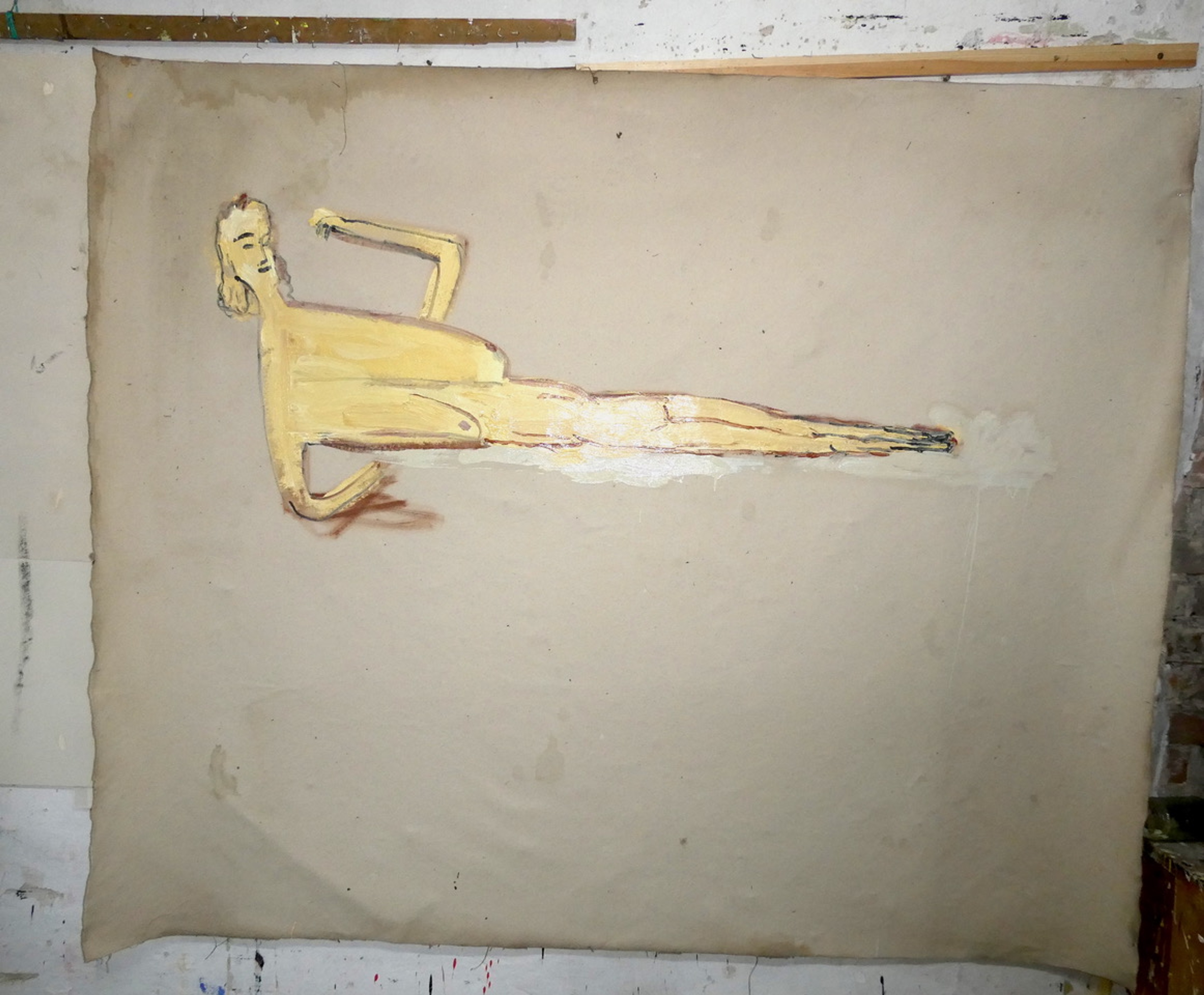
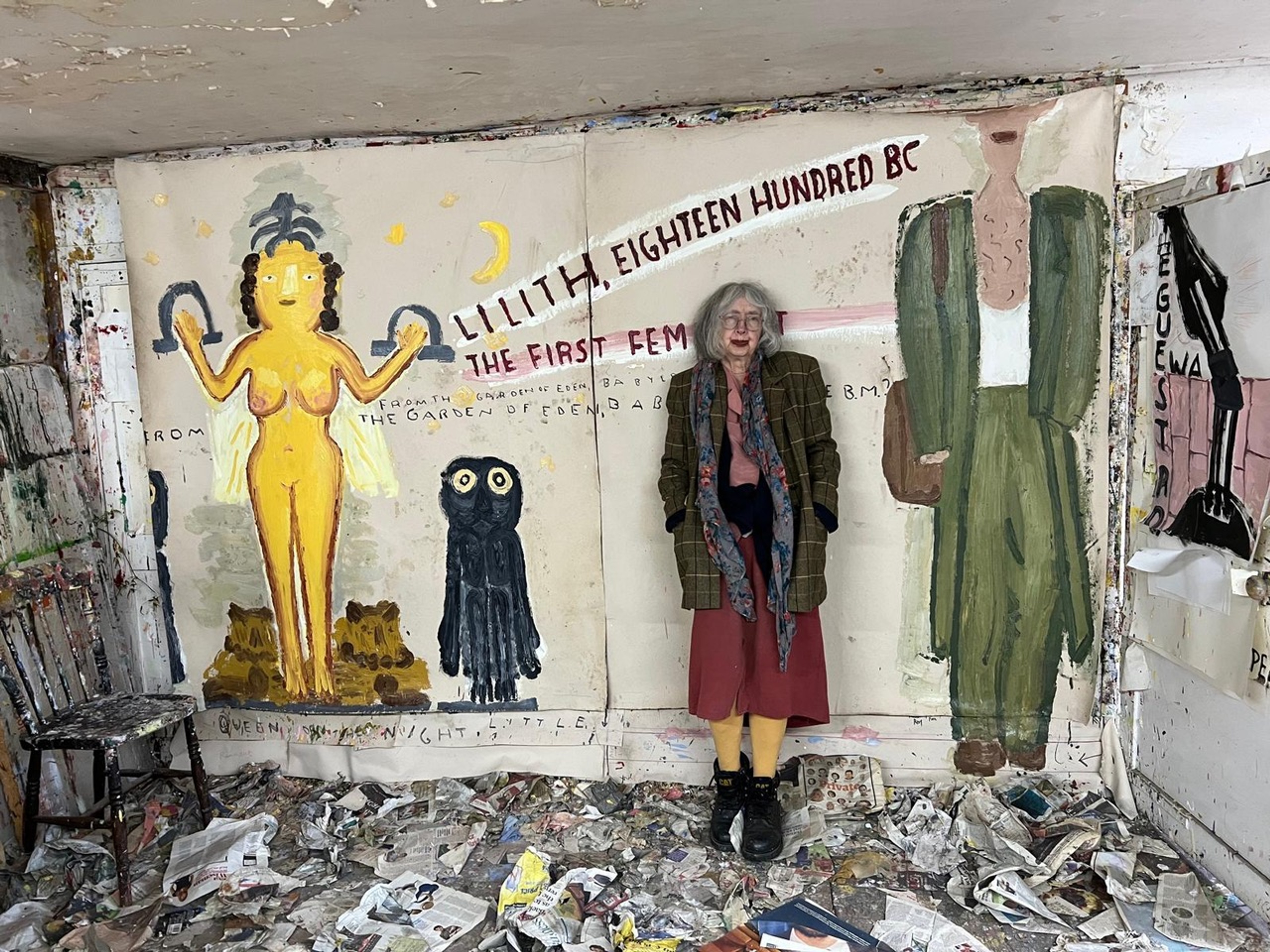
Rose Wylie Studio, taken by the artist. Faversham, UK, 2024.
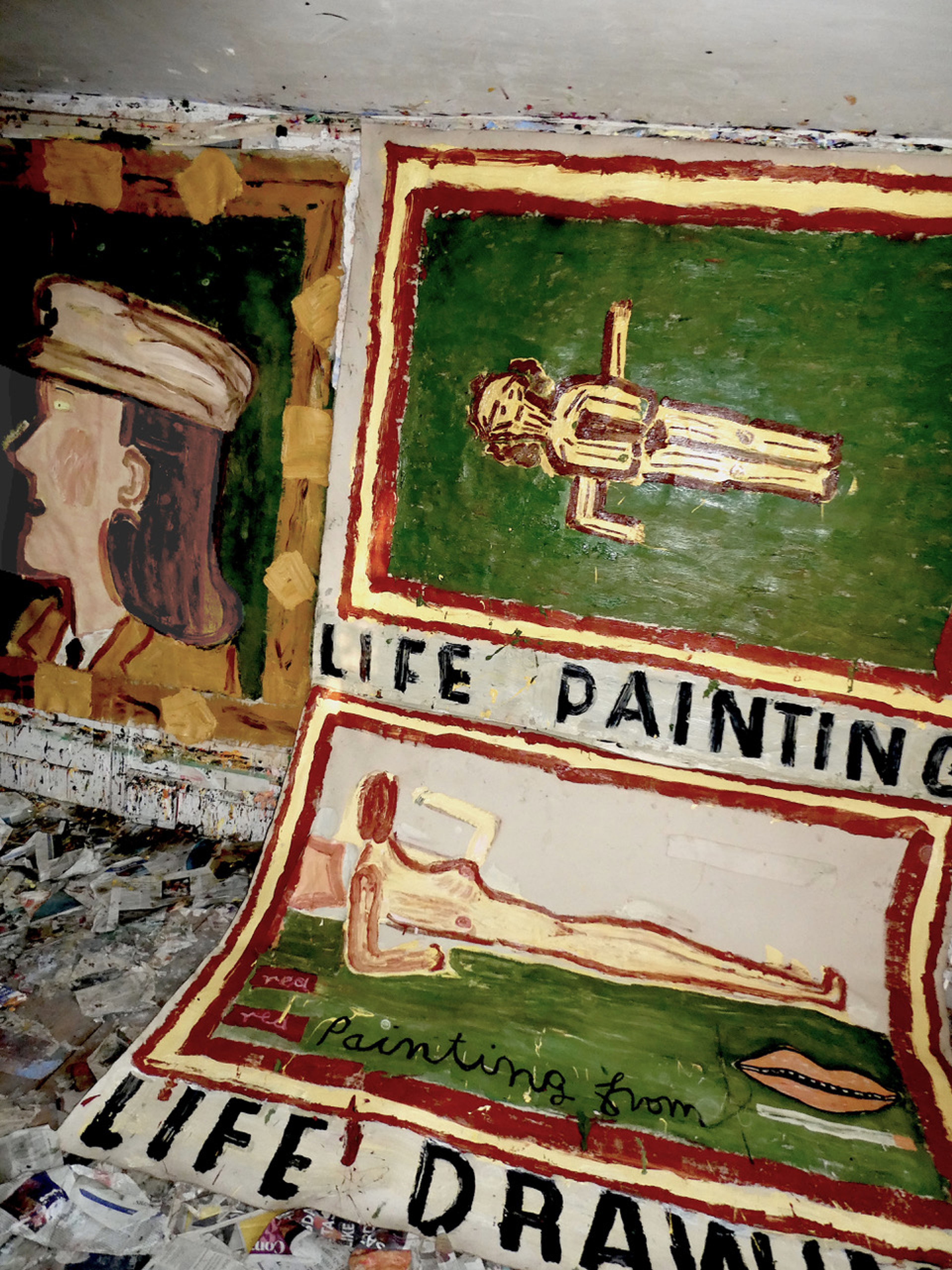
Rose Wylie Studio, taken by the artist. Faversham, UK, 2024.
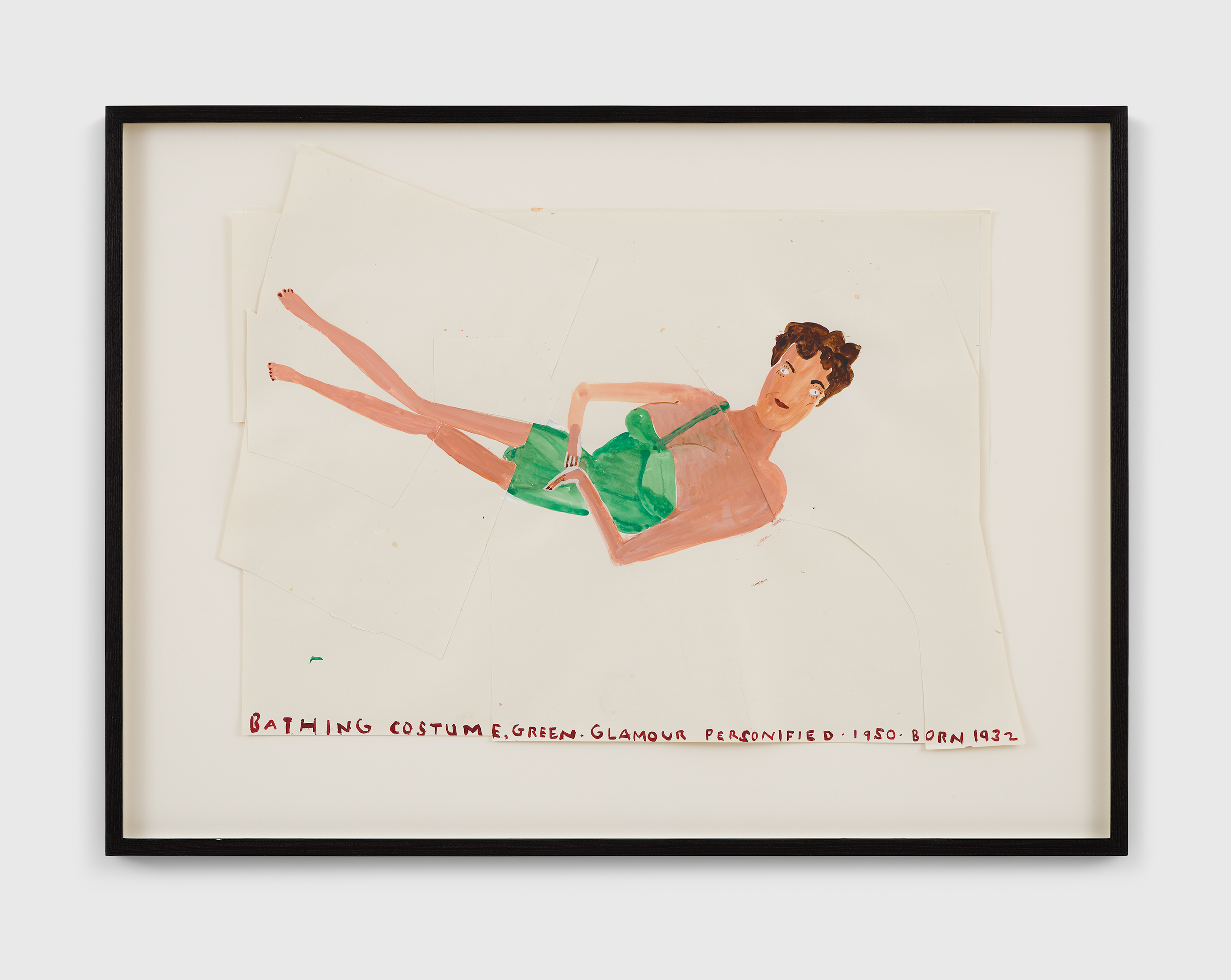
'Reclining Figure,' 2010 © Rose Wylie. Courtesy the artist and David Zwirner.
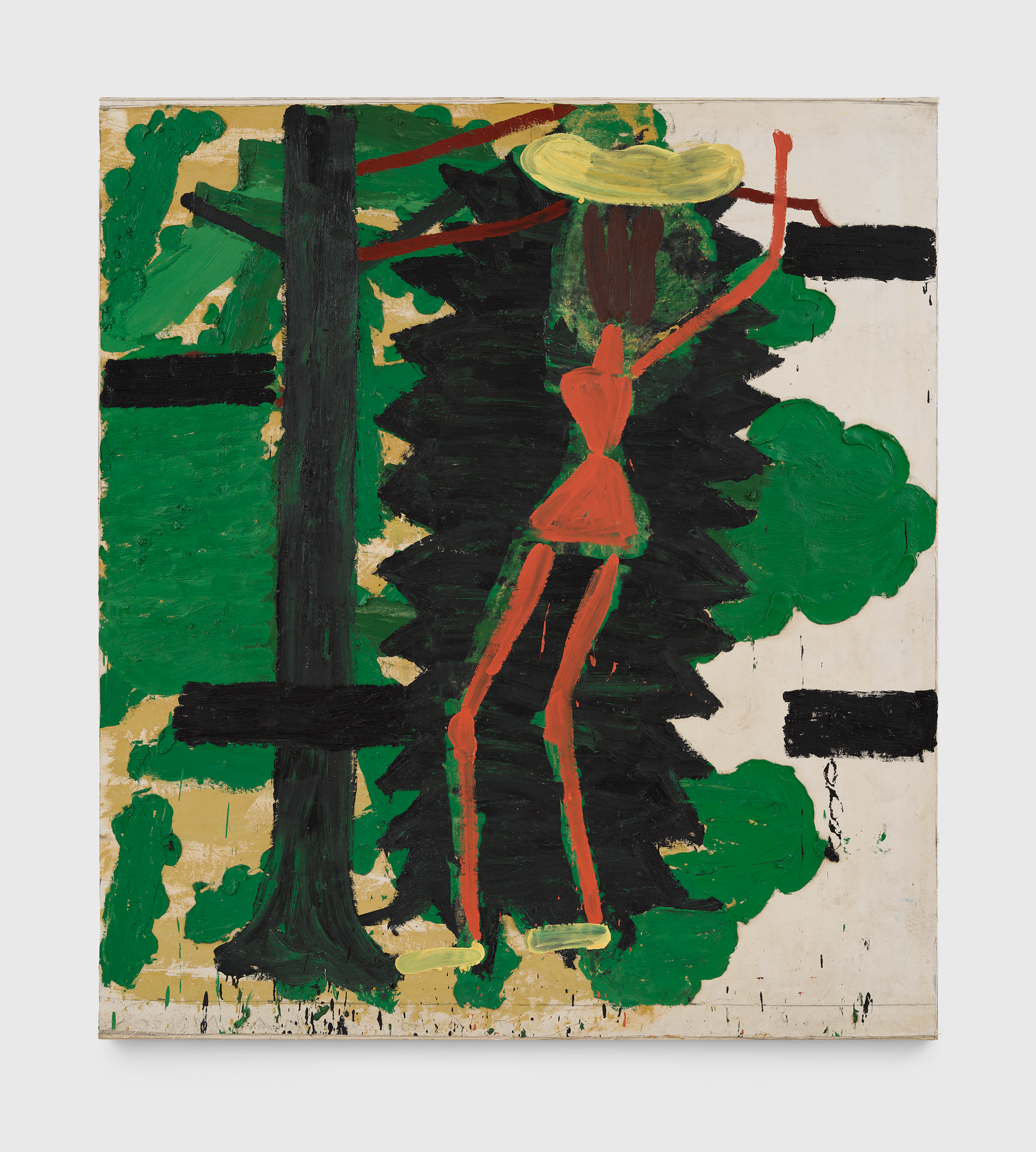
'German Hat,' 2003 © Rose Wylie. Courtesy the artist and David Zwirner.
"A visual consequence; one thing determines another."
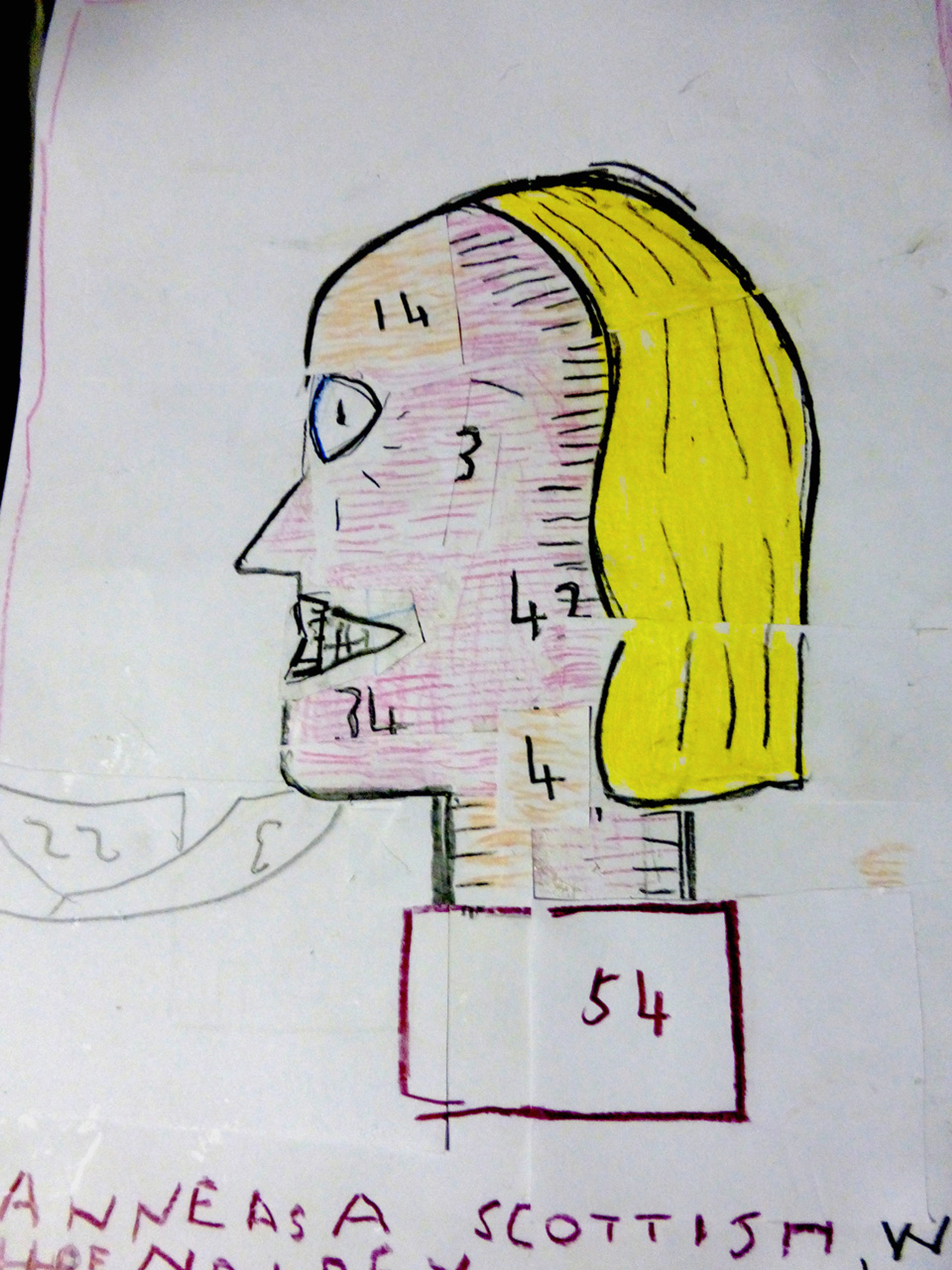
Rose Wylie Studio, taken by the artist. Faversham, UK, 2024.
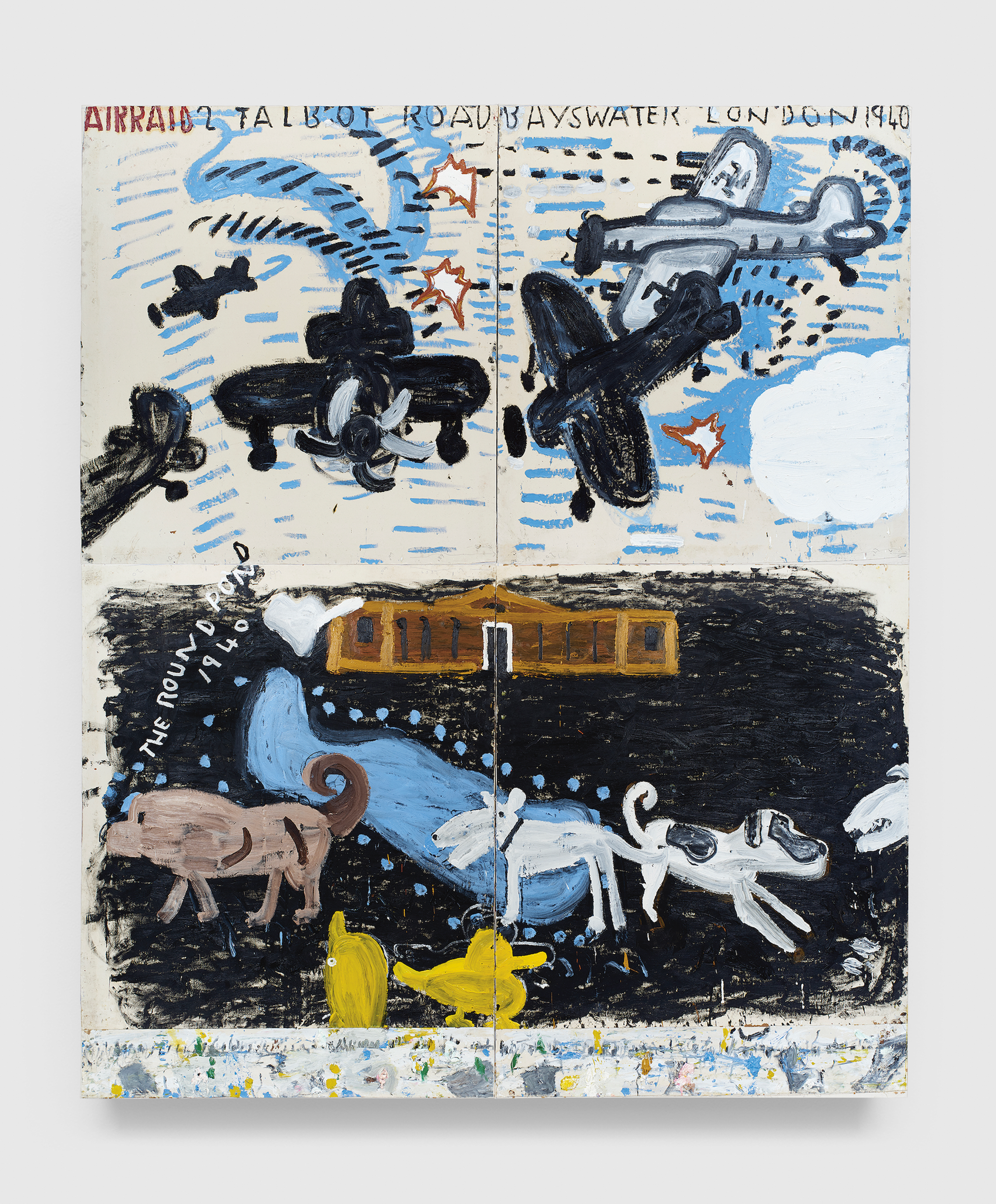
'Park Dogs & Air Raid,' 2017 © Rose Wylie. Courtesy the artist and David Zwirner.
ARTS EDITOR-AT-LARGE + TEXT
MAGNUS EDENSVARD
SPECIAL THANKS
DAVID ZWIRNER GALLERY
CREATIVE DIRECTOR + EIC
SARAH RICHARDSON
Beyond Noise 2026
ARTS EDITOR-AT-LARGE + TEXT
MAGNUS EDENSVARD
SPECIAL THANKS
DAVID ZWIRNER GALLERY
CREATIVE DIRECTOR + EIC
SARAH RICHARDSON
Beyond Noise 2026