Noise
ISSUE NO. 05: ISABELLE CORNARO
SUSPENSION OF DISBELIEF
Words: 3808
Estimated reading time: 21M
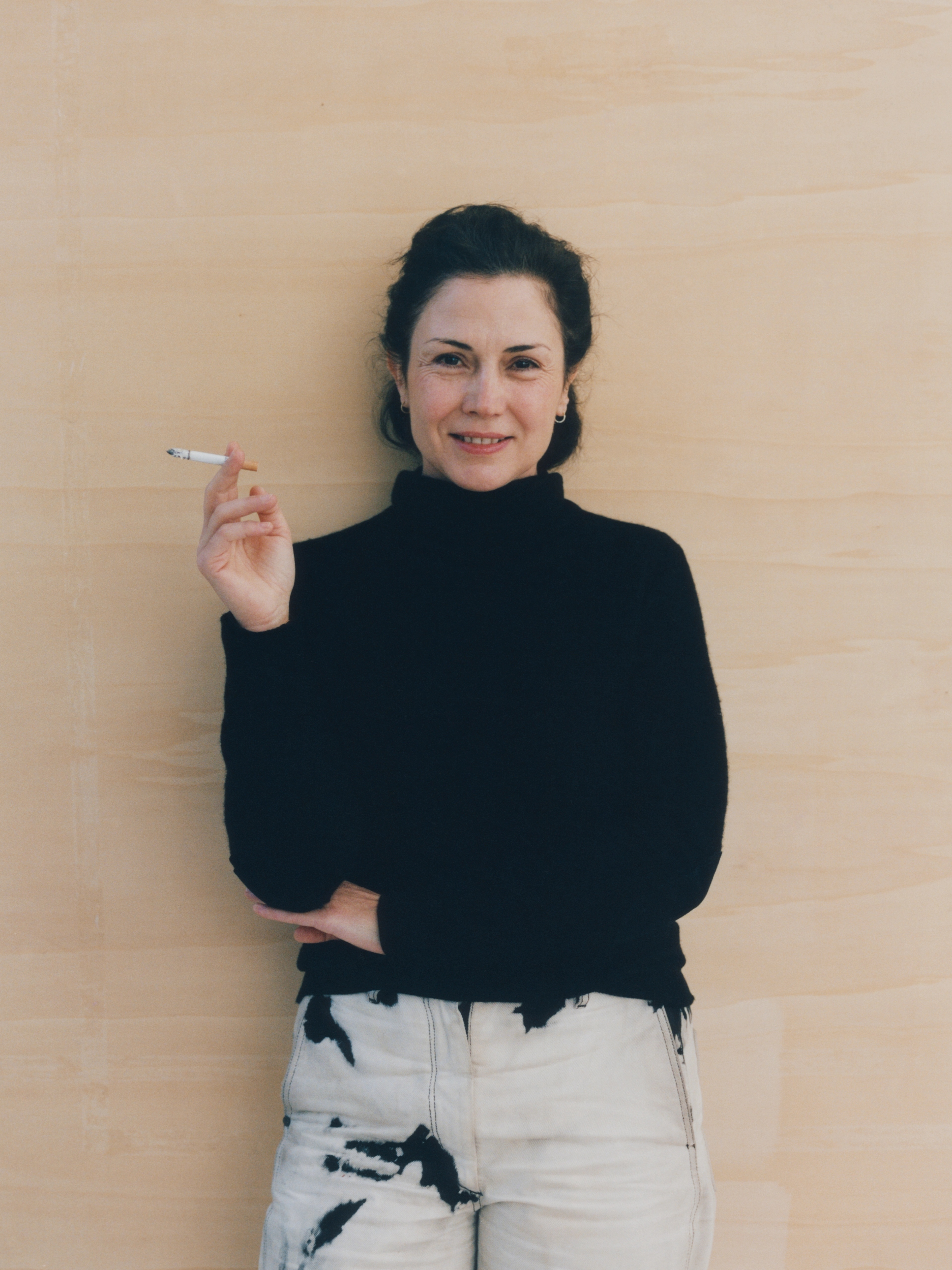
The artist Isabelle Cornaro and curator Salomé Burstein discuss fetish, shifting colonial perspectives, and how objects are staged to generate meaning across sculpture and film.
By Megan Liu
There’s an early work by the artist Isabelle Cornaro that she credits with helping inform her entire approach. Created in 2007, Savannah Surrounding Bangui and the River Utubangui saw the multimedia artist use different pieces of jewelry she had inherited from her mother to make a landscape scene, evocative of her childhood in Central Africa, on a piece of plywood. Imbued with the emotional weight of jewelry handed down from mother to daughter, in Cornaro’s piece these family heirlooms are simultaneously drawings and sculpture.
Deceptively simple, and even ‘childish’ by Isabelle’s own description, Savannah Surrounding Bangui marked the beginning of Cornaro’s decades-long consideration of the meanings that objects can carry, the ways in which perspective determines understanding, and the blurred lines between different mediums.
Born in France in the 1970s, Isabelle studied history of art before committing to a more practical study of her practice, first at London’s Royal College of Art and then at Paris’ École Nationale Supérieure des Beaux Arts. This training, as both art historian and curator as well as fine artist, can be read in her approach even today. Working fluidly across painting, sculpture, film and installation, Isabelle balances a deep consideration of individual objects alongside a rigorous attention to the way in which they are staged in spaces.
Now based in Paris, recent solo exhibitions of Isabelle’s work have included Loop and Wip at Le Portique (2025), 2024’s Mother, Laws, Matter at Fondazione Giuliani, and Infans at Fondation d’entreprise Pernod Ricard in 2021, where the curator Salomé Burstein first encountered her work. An emerging face in Paris’ new art vanguard, Salomé’s rise was firmly established with the launch of her own independent art space Shmorévaz, in 2021, in a former shoe shop.
MEGAN LIU: How did you two first get acquainted?
SALOMÉ BURSTEIN: The first time I saw your work was in 2021, in the show Infans at the Fondation d’entreprise Pernod Ricard, which was curated by Mouna Mekouar. It worked beautifully, and if I recall correctly, it was only films displayed, yes?
ISABELLE CORNARO: Yes. It was a selection of short films, and by walking through the space you could basically see all of them, both individually and at once. I think the first time I met you was when I came to your space, Shmorévaz, near Saint-Germain-des-Prés, for a show of [the photographer] Cammie Toloui’s work. This was a series of black and white photographs that Toloui had taken while working at a strip club. While she was stripping, she was photographing the men who were watching her.
SB: This was called the Lusty Lady series, as Lusty Lady was the name of the strip club where Toloui took these photographs between 1991 and 1993. In that period she was working as what they called an ‘exotic dancer’ to pay for her photojournalism studies, and she received an assignment from one of her teachers, asking the students to document their daily life. Touloui smuggled her camera into the club, because she wasn’t allowed to take pictures. The Lusty Lady had a reputation for being a woman-run, feminist strip club, where a lot of the other dancers were students and artists, but still it was very hardcore in terms of working conditions. She offered that, in exchange for the right to take her client’s photographs, they would get a free dildo show. This is how she started photographing the men, and basically inverting the gaze that she was the subject of. The series is beautiful, and it’s a rare depiction of masculinity. Some men hide their faces. You have a cop who is wearing lingerie. You have clients who are couples. You do have this kind of reversal mechanism. It’s about display, it’s about seduction. It’s also about labor because Touloui often frames the clock. Sometimes you see her reflection superimposed on her client’s. I think we talked about the series also because of touch, and the relationship between touching and not touching, which is also involved in your work.
IC: Yes. For many, many years I’ve been really interested in the notion of fetish, and how you look at something that is somehow at a distance. The Cammie Toloui exhibition was a very embodied way of reflecting on that. It reminded me of a text by the artist Mike Kelley, who I’ve loved for a long time. Kelley’s text is about a strip club situation in which the clients are completely frozen within a moment, by what they are looking at. It’s a moment of sideration, in which the clients are in a visual panic by what they are attracted to but cannot touch. This is something I’ve been thinking about a lot in my own work, in terms of trying to display objects which carry memories, fantasies, and histories that you see at a distance. These are objects that are both emotionally or historically charged, but they can also be considered a sort of treasure that you can fetishize, that you see just at a distance.
SB: Is there something in your work about being frozen as well?
IC: There is something about being completely captivated by what you look at, so that your whole body is committed to the act of watching. This is at play in a lot in the films that you saw at Fondation d’entreprise Pernod Ricard in 2021, but it also, I hope, works for my large-scale displays.
SB: Yes, where you have this feeling of your gaze being oriented, which creates, I think, a conflicting relationship to agency as a viewer.
IC: Absolutely. The placement of the objects feels orchestrated, like the installation is a scene in a film It’s all already almost a cinematic device. I was thinking a lot about this beautiful quote by Serge Daney, “Il exhibe ces trésors dans d’austères plans fixes, il les rend à leur destin de fétiches, qui est de briller à distance.” A French film critic in the ’80s—it’s about Parajanov from the film, Sayat Nova, where he explains that his characters are showing the objects that they have in their house in a very hieratic and static way, as if they were exhibiting their treasures. What he says is that somehow they render the object to the original status of fetish, which is being looked at from a distance. I was always considering this kind of thing.
SB: For sure. In Toloui’s series there are a few photographs in which the man has actually put their hand on the glass, so you see this imprint of their own body trying to touch a body they know they cannot touch because it’s inaccessible. I’m thinking about how imagination is also stimulated in what you display. For me, the placement of the display and the viewer’s distance both render the objects extremely alive, and at the same time, there’s a defying thing in the kind of display you do.
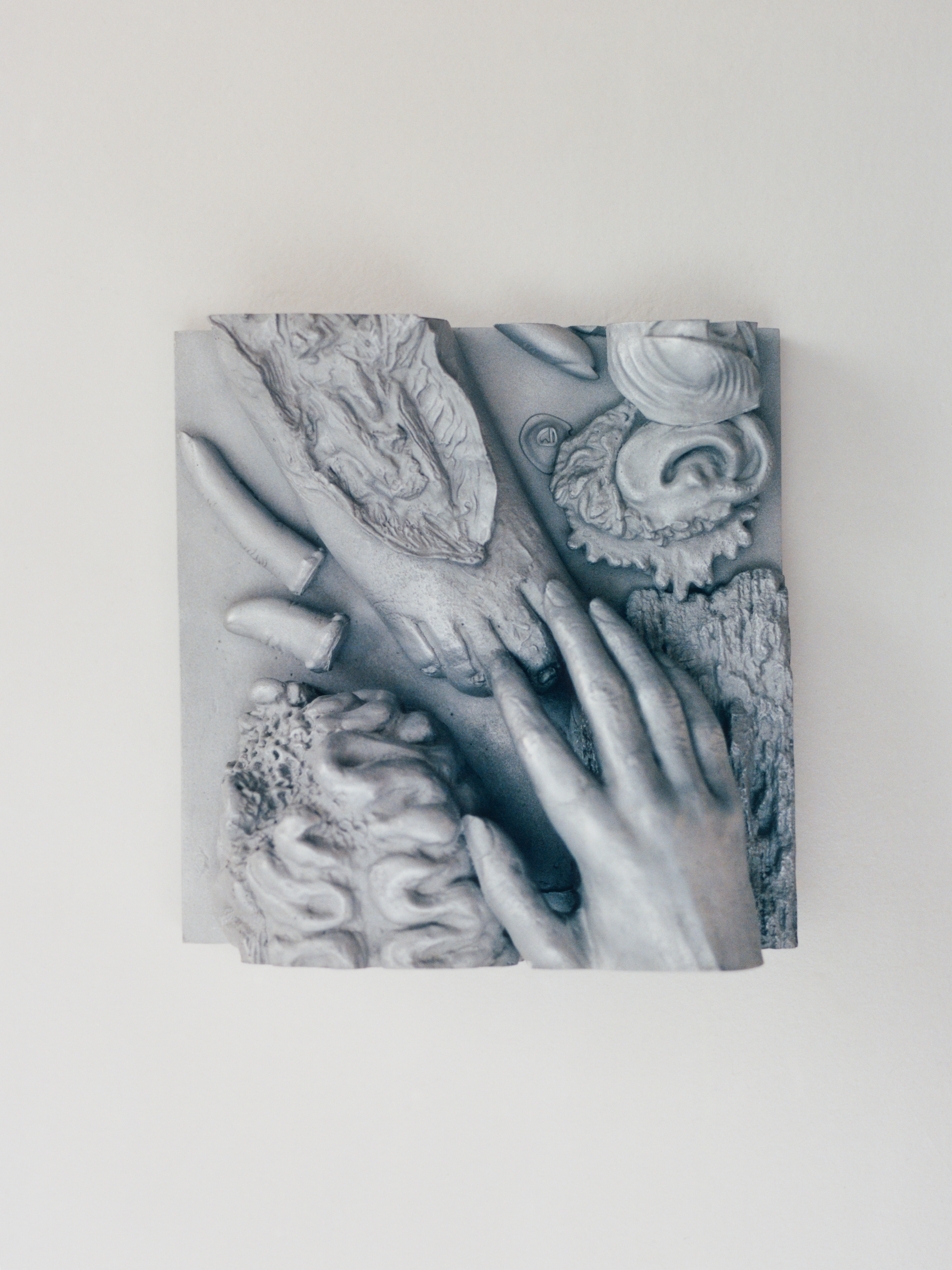
IC: I now tend to work more with objects that are not necessarily historically or socially charged. I used to focus on objects like Persian carpets or fake Chinese vases, things which are related to the colonial history of France. Now I work more with objects that are actually fake objects; plastic designed to look like crystals or diamonds, fake rocks, red liquid that looks like blood, fake body parts that come from Halloween shops. I’m very interested in these objects that are sold, in a way they are very powerful, at least for me, because they carry a whole fantasy around them that is related to what they mimic. The fact that these objects are fake somehow makes them even more powerful, because it reveals what we are attracted to in the thing that they mimic, such as a real body or real blood. These objects also interest me because they generate a form of visual panic.
SB: When you look at a work of art, there’s always a suspension of disbelief, right? You’re signing a fictional pact that you’re going to believe in what you see. I think your work plays with that fictionalization, and says, ‘Maybe the syntheticness is as important as the real value.’ There’s a replacement of value in that aspect.
IC: Absolutely. The Scottish artist Lucy McKenzie mentioned somewhere that any artwork is a form of trompe l’oeil, which I think really aligns with signing a fictional pact when you look at an artwork.
ML: What drew you to start working with objects?
IC: I started with drawing but in 2007 I did a very important series for myself called Savannah Surrounding Bangui, And The River Utubangui. To create this work I used photographs of jewelry that I had inherited from my mom, and displayed them on wood in such a way that they looked like the Central African landscapes I grew up in. The pieces are both drawings – very childish drawings in a way – but they are also sculptures because of the inclusion of objects. This piece helped me realize that I was particularly interested in working with emotionally and historically charged objects. And maybe there was a way of displaying objects as a landscape, or ‘drawing’ with objects, which would help the viewer understand that the image has to be read as a fiction. The object and the way that it’s displayed is both graphic and formal, but the object also becomes part of the art piece, while still remaining a real object.
SB: I don’t know if it’s something you have in mind, but what direction does the shifting or rearranging of objects take? You start working with charged objects, like heirlooms or things you’ve inherited. So I guess there is an element in this practice of putting these objects at a distance. How do the affects of this circulate after? Do you think they stay within the display? Does producing these works make you look at the original objects differently?
IC: For me, the objects remain charged with affects. By using them in pieces, my work allows people to have a public experience with something that is very intimate. It’s a way of creating a relationship between publicity and intimacy, common shared knowledge, feelings, and so on.
ML: How does your approach differ across sculpture, film, and installation?
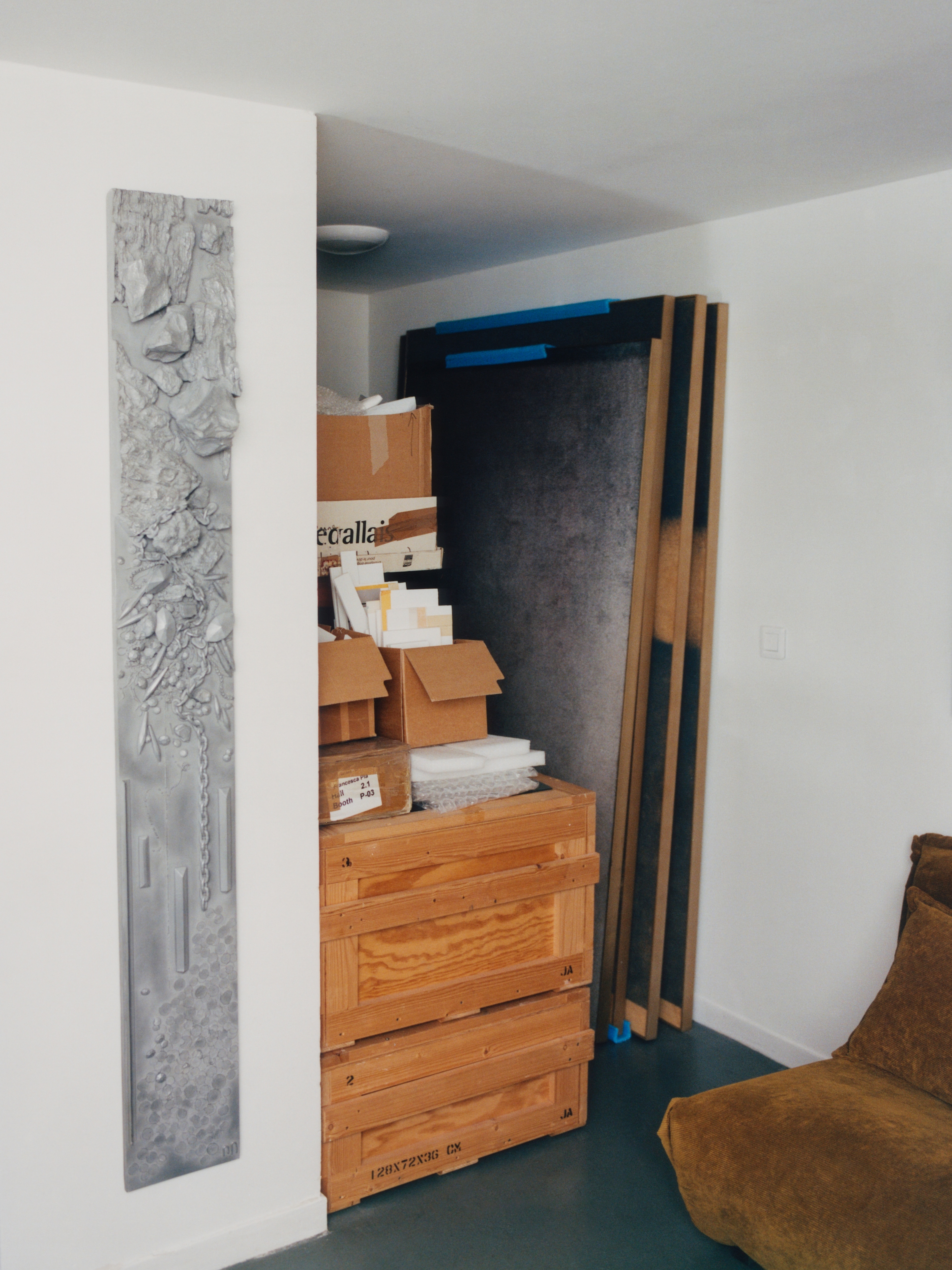
IC: There is a sort of circulation in my practice between mediums—from installation, to film, to cast objects like sculptures. For me, though, it all comes from film, in the way that, as I said before, the large installations are organized, like a space being set up, to present first a large view and then various close-ups. When the objects I use are cast, it’s as if they are recorded on film, because when objects are filmed, they are recorded on a flat surface. When it is cast, an object is recorded as a relief that includes the whole volume of the object—there is an equivalence between sculpture and film that is very strong. I like that by using different mediums, I can offer different points of view on the same questions. By seeing or understanding what the variations are, you get, I hope, a clearer and deeper understanding of what I’m trying to say.
SB: I was wondering if there is a question of reproduction in your film works, since you often assemble new film works from parts of your previous works. It’s this kind of replication or reproduction that’s happening. I was also intrigued that the words ‘cast’ or ‘casting’ also relate to the casting of a film. There’s a sense that you select your objects like a director would cast actors in a film.
IC: Also, both in casting from an object, or filming in which you shoot with a digital or 16 mm film camera, you’re recording a real object, so it’s indexed in reality. It’s not something digital that you have created from nowhere, so there is this relationship. Talking about the circulation of mediums, I want to talk about another show at Shmorévaz—The Full Package—by Hanna Rochereau. The show was about merchandising, and ideas around objects, products and commodities. This whole tension in art in terms of commodification and the bodily experience of objects that you can’t possess, or that you have to look at from afar. These considerations are very important to me.
SB: We mentioned Bertolt Brecht, who was a German playwright and hardcore Marxist. He revolutionized theater with his notion of epic theater— a rejection of what he termed ‘culinary’ theater; theatre that was really just where the bourgeois people came to digest their meal. Brecht’s whole logic of theater is about breaking the flow of the narrative that plays out on stage in order to exhibit the mechanism of the play itself. When you exhibit the mechanism, you realize that what you’re seeing is built and constructed, so you can deconstruct it. So theater becomes the first stage of political action. I was thinking about that, because there is this relationship in your work to staging and putting objects at a distance in order to question what the objects are, and the kind of craft and fictionalization that is embedded in an object.
IC: For a long time I was considering displaying these objects in such a way that would denaturalize them, so that we wouldn’t just take them for granted or assume their meaning. Instead I wanted to put them in a critical position, in which we deconstruct what they are, the way we look at them, and the whole system surrounding them. Large installations are often constructed with a perspective that can feel very authoritarian, a system that comes from the Renaissance, a way of rationalizing, embracing, and dominating the world. This was a very colonial European system that is both quite ideological but also completely formal. With this perspective, you have ideology embedded into a form.
SB: Do you think it’s about exhibiting, not replicating? About not only replicating the hypnotism but also looking at it and the mechanism of it in order to exhibit how it works?
IC: Yes, exhibiting the hypnosis system.
SB: You were talking about 16mm film—and how it recorded a certain place in time in reality. You also work with animation. I’m curious about that.
IC: I started working with animation a few years ago. I heard of an animator, someone who knows how to draw and animate drawings—Victorin Ripert—and he did two films for me, Eyesore (2019) and Eyesore II (2022). I gave him a script and some images to enable him to start drawing and to have a notion of colors and atmospheres. Also, I wanted him to consider the question of spaces as categories, like the social space, the intimate space, the shopping space, the working space, the media space. For the first time I wasn’t working from real objects, but inventing images from nothing. It all came from the idea that we have a tendency towards animating objects as we see them. We are used to seeing Disney movies, in which you have objects that have feelings; they can cry, laugh, dance, and so on. These objects are completely anthropomorphized, they come to life. In my films I was trying to see the reverse version of that, through a series of different sequences and spaces. I wanted to show people becoming objects. It’s a dystopian take on this idea of humanizing and anthropomorphizing everything.
SB: Thinking back to Toloui’s work and the processing principle, I don’t think her work turns the dancers into objects, because in her photographs they have agency. But there is something about how strip club culture makes labor invisible. For instance, the clients are like, “What do you do for a living?” while they are watching the dancers dance.
IC: It does the inverse in both cases: by animating objects, humans transform the objects, or the camera changes who is being watched. In this system the object, or the body that is typically being objectified, now takes power from the viewer.
ML: Talk to me about your process when it comes to sourcing objects.
IC: I tend to understand objects in scientific terms when I collect. I have built this system through the years, and now I have categories in mind. Categories like representations of the body, parts of bodies. Objects that are linked to representations of the self and of wealth, like jewelry, feathers, fans, things like that. Objects that mimic the industry of the souvenirs of the 19th century, which tend to be domestic objects with exotic patterns, which were created at the height of colonial Europe. I have categories in mind when I collect these objects, and then I edit them in a way that I would edit a film, with each object being either a shot, language, or sign that has to be combined with other signs in order to create formal or visual scenes. These visual scenes are completely abstract, and figurative too because they remain cryptic in their organization. All objects are commodities. In terms of sourcing, when I am looking for objects with a certain patina I will seek them out in flea markets, or for contemporary commodities I will go to modern shops to source them. It’s very simple, often I will go to hardware or party shops, the kinds of places where you find fancy dress costumes and fake body parts for Halloween.
SB: Do you see the cinematic image as a commodity too? I’m thinking of some of your more recent films that make different kinds of registers of images.
IC: I have a tendency to consider images as commodities. There is a circulation between the works, in my recent films I have used found images and footage. When I use found footage, I use it like it is a ready-made object. On the other hand, when I create sculptures, castings, or installations, I tend to look at them as images. So there is a relationship between the status of an object and the status of an image that’s quite intricate, and that can blur in my work.
SB: I’m thinking of the different taxonomies or categories that you bring together, it’s like the formation of a certain way of looking.
IC: When you make a film it’s about creating a syntax from existing elements, whether these elements are images or objects. It all relates to language and to nominalism; what it means to name a certain object and the meaning something has in relation to its name. The whole fantasy is carried by words. In that sense, I’m very interested in the work of the artist Haim Steinbach, who did a lot of displays with objects, but also written sentences on walls or written text. He really uses the text, truly, and words as found objects. You could recognize that a certain kind of aura is taken from commercial advertising.
SB: But like a cut up.
IC: Exactly.
ML: Isabelle, any upcoming works?
IC: I am now back in my studio with a lot of work around me. I’m in a phase of looking at previous works I’ve done and trying to extend them. So I went back to photography, which is what I was doing before 16mm films. I’m working on new, specialized slide projections in order to create a sort of flow of images, but not as fluid as it would be in a film. So I’m working on slide projections, and also very simple, almost childish drawings, which are a great pleasure to do. I’m going back to creating more intimate works.
SB: Nice. I’m looking forward to seeing that.
CREATIVE DIRECTOR + EIC
SARAH RICHARDSON
PHOTOGRAPHER
ANDREAS KNAUB
ART EDITOR-AT-LARGE
MAGNUS EDENSVARD
Beyond Noise 2026
CREATIVE DIRECTOR + EIC
SARAH RICHARDSON
PHOTOGRAPHER
ANDREAS KNAUB
ART EDITOR-AT-LARGE
MAGNUS EDENSVARD
Beyond Noise 2026