Noise
ISSUE NO. 05: AMMA ASANTE
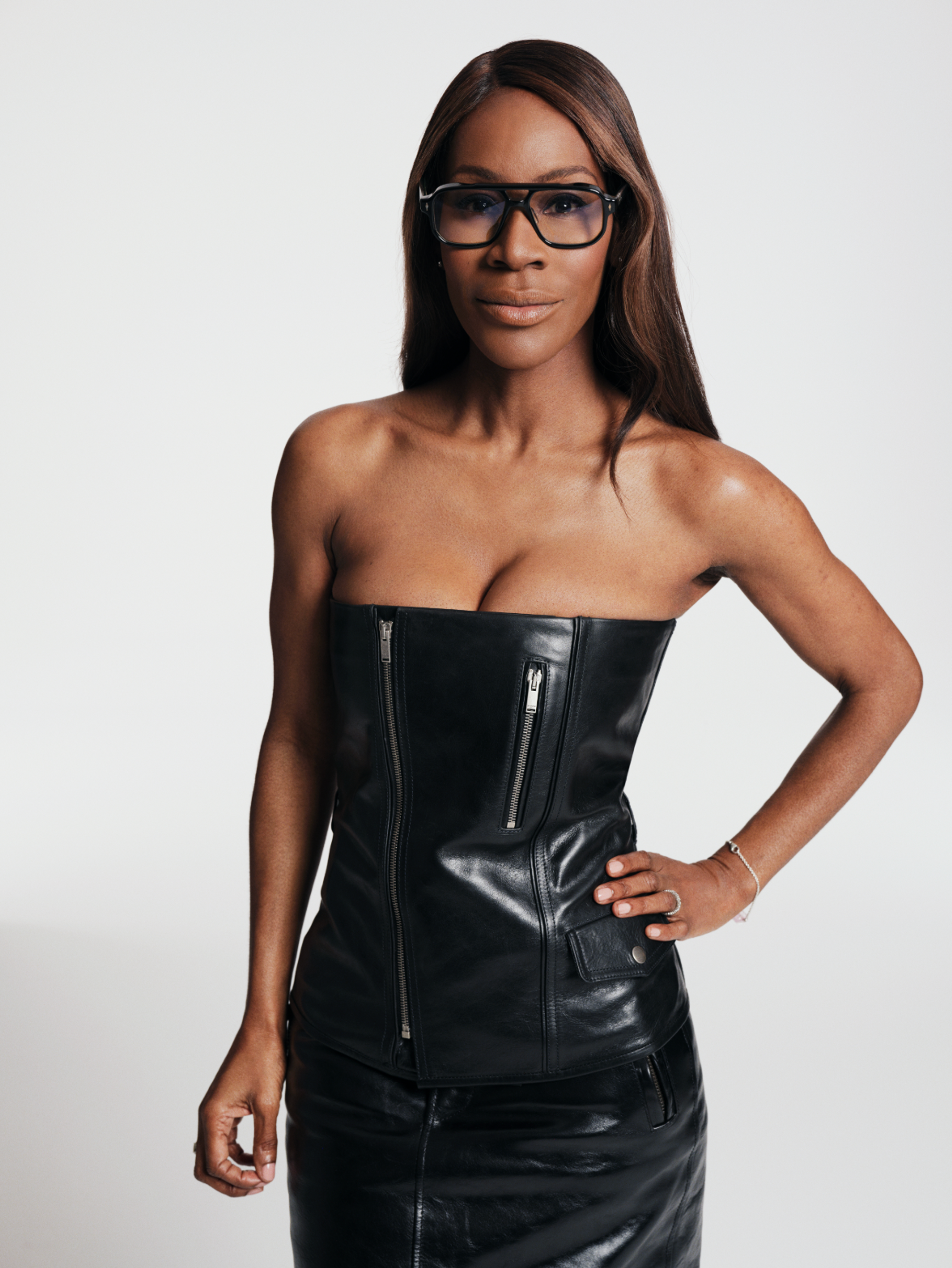
Top and skirt by SAINT LAURENT BY ANTHONY VACCARELLO. Glasses by JACQUES MARIE MAGE. Ring by DAVID MORRIS.
VISION OF THE PAST
Words: 2183
Estimated reading time: 12M
Pioneering filmmaker and screenwriter Amma Asante joins Sarah Richardson to discuss their formative days at stage school.
By Holly Connolly
In 2004, the filmmaker and screenwriter Amma Asante made her directorial debut with A Way of Life. An unflinching portrayal of poverty and racism, the film centered around a teenage single mother in Wales, and would make Amma the first Black director to win a BAFTA Film Award for writing and directing a feature film. Over the decades that followed, Amma would go on to make some of the most searching and nuanced films on race and gender to come out of Britain.
Working fluidly across genres, Amma’s films have included 2016’s historical drama A United Kingdom, the forthcoming thriller Billion Dollar Spy, and, perhaps most notably, 2013’s Belle. Born in London to Ghanaian parents, Amma’s pioneering, remarkable journey can be traced back to her earliest school days at the Barbara Speake Stage School. A performing arts school in East Acton, Amma’s classmates included the supermodel Naomi Campbell, and Beyond Noise’s Editor-in-Chief and founder Sarah Richardson. Together, Amma and Sarah sat down to discuss those formative years at the school, and to reflect on their journeys.
HOLLY CONNOLLY: You met very young, while attending the Barbara Speake Stage School as children. Do you remember your first impressions of each other?
AMMA ASANTE: I don’t remember the exact moment that we met, but Sarah was one of the first people who I really fell in love with at school. Everybody else had been there since they were five, and they were all super outgoing and loud. Sarah was really calm and gentle, she was like the stable base. That’s my oldest memory, really, of her.
SARAH RICHARDSON: I remember the moment I met Amma. She was really sparkly, warm and generous. A ray of sunshine. A lot of us were these really skinny kids who had been dancing all day, every day, since we were six years old. Amma came in and even at that young age she was womanly, sexy, and self-confident. I can remember thinking, ‘Wow, I want to be Amma.’ She was very sophisticated, even at such a young age, and had such a wise head on her shoulders. She was almost philosophical.
HC: The school itself sounds like a really dynamic place, without rigidly defined class boundaries. How do you feel its ethos shaped your journeys?
AA: Well, Sarah, I don’t know what you think about this, but I know that I see a lot of competition in the industry amongst equals. It’s always been interesting to me, because I feel that we were raised to be ambitious, but also to be really supportive of each other. I see, at times, competition within the industry. Often it seems to come from a feeling of, ‘There’s only ever one place.’
SR: I’ve never thought about it before, but as you started talking there I was thinking exactly the same thing. In my industry I’ve noticed it too. Before I was a stylist, and I was freelance. Now, as a woman with my own business, I have seen that competition. That’s been a shock for me, because I’ve always supported other women who were friends in my business. At school we were always, and still are, there for each other. There was this real understanding of how hard it is to be a creative, and that you support other creatives. It’s something that I’ve always felt was so natural, probably because of all our relationships at school between you, Justine, Alison, Michelle, Naomi. There was such a respect and love for each other.
HC: Belle was ahead of its time for being a period drama centered around a Black woman. I read a piece recently that said it laid the foundation for films and series like Bridgerton. Looking back, what do you think about that film now, over a decade later?
AA: With Belle, I made the film that I wanted to go and see and that I thought was missing in the canon. That and my first film are the two films that I made to satisfy something in me that was desperate. I haven’t watched the whole film for a really long time, but when I think of it now, and when I see clips of the film, I love it. I love it because I was really true to what I wanted to make.
I had little to no interference in what I was making, and I had really great producers who even gave me money to reshoot the ending because it didn’t quite turn out how I wanted it. It was tough, Sarah, because my dad died the night before we did the reshoots. He died at 11:00 at night, and I think it was about 06:30 a.m. that I had to rock up on set and shoot this final court scene. That film was about determining that there was no such thing as a slave, but it was also about a father and daughter, and their relationship. It was so hard because that scene was such a father/daughter scene, and some of the character of Lord Mansfield was really based on my father. So it was very, very hard, but we did the reshoots, and it turned out all the better because I was lucky enough to have had a solid relationship with my dad.
SR: Just to add to that, I remember your father so well, Amma. He always had the same curiosity, warmth of energy, and generosity that you have. So you definitely have a lot of that from your father. What stood out to me when I saw Belle is how brave it was. It broke glass ceilings, and it gave a very honest account of where England was with slavery.
AA: I really wanted to make a film that was about race and gender, that’s what the film is about. It’s about what it is to be at the intersection of both.
HC: Amma, have you felt a responsibility to create true portrayals of these themes of race and gender?
AA: I had a trilogy of films that I wanted to make, or I saw it as a trilogy – Belle, 2016’s A United Kingdom, and 2018’s Where Hands Touch – that were about race. I think I wanted to make films about the conversations that I would have had with my dad, and in a way, I think I had to get all of that out of my system. Those three films in particular, and my first film too, 2004’s A Way of Life. Then I felt I could really open myself up a little bit to other ideas. I’ve recently directed Smilla’s Sense of Snow, a six-hour film that I shot as a six-part series. It’s also about colonization, but it’s about post-colonization in Denmark, and its relationship with Greenland. I also wanted to tell a story about isolation and being lonely in a way that you choose, because I think that deserves a voice as well.
So I feel that I was able to open myself up, after I made those earlier films, to other things, really. But do I feel a responsibility? Not really. I do feel some people try to put that on me, and I do think that, particularly as a woman, you are boxed in, certainly in the industry I come from. There are certain things you’re allowed to do, ‘Oh you do the emotion very well Amma, but shall we get a second teammate to do the action for you?’
SR: The idea that we can only be one thing never really settled with me in any particular way. I see it as other people’s boundaries, but not mine. I think I had multiple conversations when I first started Beyond Noise, there were certain people who said, ‘How can you be an Editor-in-Chief? You’re a stylist.’ I’ve never really thought of myself as a stylist. I am who I am. I have multiple interests.
I think part of that comes from the sisterhood we had at school, and from our parents. I can remember my father never made me feel like a girl, and I don’t think your father ever made you feel like a girl either. I was just Sarah, and I could do what anyone did. It was a shock to me when I first experienced misogyny. Maybe when it came to you being a director, and such an incredible creative, you never felt you had limits because you were a woman. We were quite rebellious, all of us, and we would never have been put in a box, not one of us.
AA: I think that rebellion and rebelliousness are both really important words for us. I’ve never used that word in any conversation that I’ve had about myself, but I accept it today. I think that you’re absolutely right. I think the complication, what you describe, is that when you then go out into the big wide world, and you start to experience these things, it’s a shock.
I was prepared for racism. I was prepared for all of that stuff, but I wasn’t prepared for sexism. We never really had conversations about men being paid more than women for the same job. Or that men can do this, and there are people in the world who think that women can’t. It was always just, ‘You have to work hard and focus on what you want to do.’ My dad worked out what each of his kids was good at, and loved, and then he did everything he could to support us in the direction that he felt we wanted to go in. So I never grew a thick skin when it came to navigating misogyny or sexism.
SR: I wanted to ask you about your experiences of racism growing up. I have to say, being a Londoner, most of my friends were Ghanian, Nigerian, West Indian, Pakistani or Indian. There felt like an openness to discovery in terms of other people’s cultural backgrounds, but how did it feel for you growing up?
AA: I can remember the National Front had their headquarters just around the corner from where I lived. So yes, I did experience racism, but, it feels so strange to say it more than 40 years later, but it was just life. I think two things were true at once. I had exactly that mixed friendship experience, and racism existed. When you’re a young person it’s just something that you accept, because you don’t know any other life. So, on the one hand you’ve got this mixed, rich cultural world, and on the other hand you’ve got a bunch of people who don’t like you and people like you because of the color of your skin.
SR: Something that I think is also really important to say is, with all of our ambition, what also raised our self-belief in the world outside of Barbara Speake was the success of Naomi Campbell.
AA: Naomi was so important. She wasn’t just any old model, she was a supermodel who was from our ends. She was from Streatham. She was from south London. That definitely gave me the feeling that it was absolutely possible. Seeing Naomi fly and become so successful, it gave me the sense that all you had to do was focus on what you want to do, and keep those doors open. That’s not to say that it was easy for her. I’m sure that it wasn’t, but her success felt like our success.
HC: Looking back to that time at school, what advice would you both give to those young versions of yourselves?
AA: Worry less, it’s going to be okay. But the door doesn’t open from the outside, you’ve got to get out there. I’d have gotten out there even more if I knew what I know today.
SR: I think I’d tell my younger self to not be afraid to be myself, and to not try to be what other people wanted of me, which is a beautiful lesson you learn as you become a more mature woman. You think, ‘Well, this is me. I don’t care.’
“I think that rebellion and rebelliousness are both really important words for us.”
EIC + FASHION
SARAH RICHARDSON
PHOTOGRAPHER
RICHARD BUSH
HAIR
Neil Moodie at Bryant Artists
MAKE-UP
Petros Petrohilos at Streeters
MANICURE
Desi Lazarova
Beyond Noise 2026
EIC + FASHION
SARAH RICHARDSON
PHOTOGRAPHER
RICHARD BUSH
HAIR
Neil Moodie at Bryant Artists
MAKE-UP
Petros Petrohilos at Streeters
MANICURE
Desi Lazarova
Beyond Noise 2026