Noise
ISSUE NO. 05: STEPHANIE DINKINS

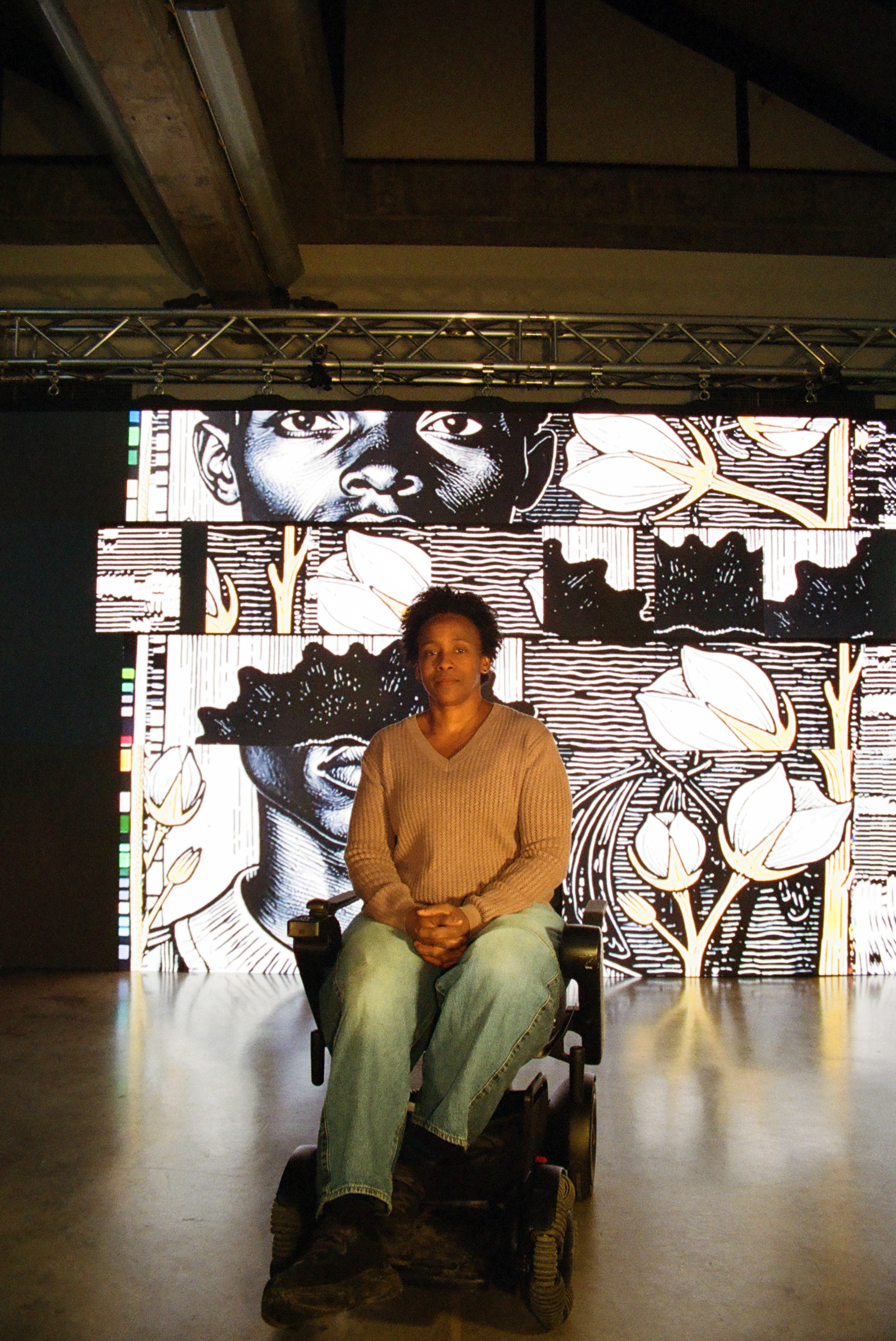
Stephanie Dinkins by Sabrina Santiago
STEPHANIE DINKINS
Words: 1123
Estimated reading time: 6M
Over a decade ago, the transdisciplinary artist Stephanie Dinkins began talking to Bina48, a ‘humanoid social robot’ modeled after Bina Aspen. One of the first public uses of AI technology, Bina48 was also groundbreaking for being designed to look like a Black woman. From their very first meeting – in which Stephanie asked Bina48, “Who are your people?” – their sprawling conversations have danced across themes including relationships, race, consciousness, and the nuances of the ethics behind these kinds of technologies. A project that’s still ongoing, today Conversations with Bina48 feels like an extraordinarily prescient consideration of the ways certain technologies would start to shape and interface with our lives, and the questions that would emerge as a result. Through her expansive practice – which encompasses sculpture, coding, installations and community collaboration – Stephanie continues to challenge dominant narratives and interrogate emerging technologies. As well as this, she is a public advocate for inclusive AI.
BN: In 2014 you started Conversations With Bina48. How do you feel about that project now looking back over a decade since it started?
STEPHANIE DINKINS: That project opened so many lines of questioning, for me, about where we’re going, the technologies that are emerging in our lives, and how we share space with them. Over the ten years that I’ve been working with this technology, things have changed drastically. For example, maybe six or seven years ago I would put into a generative system, say, something about a Black woman crying, just to see what it would generate, and the image that I got back at that point was horrible. Now you can put in the same statement and get high fidelity, almost indistinguishable from reality, versions of the image back. So I have to think, ‘Well, what does that mean?’ Because I’m still working with a technology that is not of my making, or my community’s making, even if it’s now producing things that look more correct. The question of truth becomes a deep one, because how do you distinguish reality when this technology can produce videos of people doing things that are quite possible in the real world that look almost perfect?
BN: One of the central themes of your work with AI is the lack of diversity in the tech industry, the biases that result as a lack of said diversity, and the dangers of these technologies then being deployed globally. Do you think this has been getting better?
SD: There are a lot of people who have been doing a lot of work to say, “These systems are biased, you need to change X, Y and Z.” If you look at the trajectory, you can see that things have changed, and that the work is doing something different. The question, though, of whether that’s better, is a hard one. What is ‘better’?
Often, when I see that there are changes, or they’re taking out biases, I’ll notice there are holes. As one example, as part of something I was working on recently, I was trying to generate a slave ship, but the technology wouldn’t let me do it because it’s about enslavement. That means it’s creating a hole in history, so then are we making systems that just ignore parts of history? The easiest thing to do is chop certain information out, or even hatchet it out, but that gets us into another loop of trouble. We have to find ways to parse the fact that certain biases do exist, that there is historic value to some of this information.
So better is a hard word, it’s definitely different. But I think that the bigger question becomes: What is our foundational thinking? Something I talk a lot about is: Can we create systems of care and generosity? And can we develop technology in which, from the beginning, we’re thinking about supporting the global majority, not just making money?
BN: Already there has been such an influx of money into technology like this. What would need to happen to change the value system of these technologies?
SD: We have to think about it in terms of changing the whole ethos, and where we’re working from, which brings me to education. We have to educate people to think bigger, and more in terms of society. What I’m saying is crazy, in a way, but at the same time I think we have to say it, because if we don’t say it, we’re never going to get there. If we don’t start to think about how we’re bringing people into systems with different methods, or working from different perspectives, the criticality will never get there. What I’ve noticed is, even when people are educated well, even when they’re really well-meaning, when they get into larger institutional settings anything that they really want to do is curtailed by the idea of being efficient and making money. Changing that is a big cultural shift, it’s an institutional shift.
BN: It feels like part of your role as an artist is to show what the limits of these technologies are, or what hasn’t been considered. Are these considerations for you?
SD: Yes, what it can do and what it can’t do, and then I always think of it as modeling what it might do. I can’t do a great job of using this stuff, as an artist who’s not trained in any of this, but I can make something that’s a good enough approximation to say, “Hey, this is a possibility.” I hear from people of color a lot, “Well, this wasn’t made for us. So how can we use it?” Well a lot of things weren’t made for us, but then we take them and make them our own in some way. So how do you guide these technologies to be something that is useful for you? Because to be without them, I think, is going to put you way behind in the long run.
CREATIVE DIRECTOR + EIC
SARAH RICHARDSON
Beyond Noise 2026
CREATIVE DIRECTOR + EIC
SARAH RICHARDSON
Beyond Noise 2026