Noise
ISSUE NO. 05: ANIMA ANANDKUMAR

ANIMA ANANDKUMAR
Words: 1232
Estimated reading time: 7M
Today a leading voice in AI, Amina Anandkumar’s passion for technology started early; you could even say it was in her blood. Originally from Mysuru, India, Amina’s earliest memories include reading from her parent’s vast library of books or doing puzzles with her grandfather, who was a mathematician. It’s probably her parents, though, who were most influential, and particularly her mother. An engineer, who alongside Amina’s father was one of the first people to bring programmable manufacturing machines to Mysuru, Amina’s mother early on imbued the idea that no subjects were off-limits for girls. “It was not usual for women, especially in a smaller city in India, to be educated and fully involved in a business. I found that interesting,” says Amina. Studying first at the Indian Institute of Technology Madras, Amina received a PhD from Cornell University, and since 2018 she has been the Bren Professor of Computing at the world-renowned California Institute of Technology (Caltech). At Caltech, Amina’s pioneering work has included inventing neural operators – a class of AI that help model multi-scale processes, and which have already proved vital for advancements in weather forecasting, drug discovery and engineering.
BN: Your parents were some of the first people to bring programmable manufacturing machines into Mysore, how do you think your background influenced you?
ANIMA ANANDKUMAR: My parents had a really strong influence on me. Science, technology, engineering, and math were very much part of day-to-day conversations, and the fact that my mother was an engineer was especially formative. In early childhood I never had any sense that, ‘These subjects are not for girls.’ I would say that the single most important factor for my career was to have somebody early on who inspired me, motivated me, and made it normal that women could love these topics.
BN: How do you think it’s changed from her era to your era in terms of representation?
AA: It’s certainly gotten a lot better in terms of representation. I think about both my mother, but also so many of my female mentors over the years, and especially now at Caltech. I look up to many senior women here, including the chemical engineer Frances Arnold, who is a Nobel Laureate. They went through so many battles, but they opened the doors for us, and they made it a bit easier. That’s not to say there isn’t still a lot of work to be done. My hope is that we are normalizing women and people from diverse backgrounds to have these kinds of roles. I think that’s what I’m hoping for, that it gets normalized more than anything.
BN: You’re particularly renowned for inventing neural operators, the specific class of AI. What led you to this part of science?
AA: Caltech was a dream job, because I spent my teenage years reading [the theoretical physicist] Richard Feynman’s lectures, and really trying to understand the deep mysteries of the universe, from particle to cosmological level. Physics was always my first love, but I did electrical engineering, computer science, and machine learning, and so when I came to Caltech I really wanted to come full circle and ask, ‘How can we use AI to impact science?’
A lot of the faculty here at Caltech were very skeptical, because when it comes to science the emphasis is on very careful experiments, and there’s only limited data available. As I was having these conversations, I realized that, yes, we may not have a lot of data, but we know something about the physics of the world. We know how balls bounce, fluids move, and stars move, so can we teach AI all of that knowledge? By doing that we won’t have to rely just on the experimental data we collect, which is very limited, and we can train AI to be intelligent about the world.
When we create world models it’s not just the visible world that we take into account. Looking at atoms and molecules, and how they interact, can help us design better drugs, and looking at how fluids move across the planet can help us predict the weather. Neural operators are a class of AI that help us do that very effectively, because they have this ability to keep zooming in on all of the details of how, say, the particles of a fluid moves at different locations, and how they’re all interconnected.
BN: AI has become a huge source of public discourse in the last few years. What has it been like to work in this field for a long time, and then see it enter the mainstream? How do you think the perception of this technology relates to the reality of it?
There’s so much noise about AI, and a lot of misinformation, claims that it will have God-like qualities, for instance. I think all of this is very flawed, because we are teaching AI, and we are telling AI the objectives we want it to accomplish. I do worry about the concentration of power in terms of the humans who control this technology, though. That’s why I really push for democratization of AI, and for AI that is open source and transparent.
I do think, also, that what the public gets wrong about AI, apart from that it’s scary, is that it’s just large language models. People think of AI as something that talks to them, but we built the first AI-based model that can predict the weather. AI will help create better drugs, better medical devices. I think these aspects are what people don’t really realize.
BN: In another interview you had a lovely quote, that ‘curiosity is the quality that can’t be replaced by AI.’ How important has being curious been to your own journey?
AA: Critically important. In my early childhood, there was a lot of that curiosity factor. My parents had a very big library at home, including university-level textbooks, and even when I was a kid, I would read them. I didn’t fully understand what I was reading, but I wouldn’t give up. I’ve always liked solving puzzles. I think that’s what gets me excited, when I don’t understand something fully. AI can help us overcome this partly, because AI may give you some answers that are not already known. But when it comes to research problems, even AI doesn’t have the answers. So I think AI can help us in this journey of curiosity.
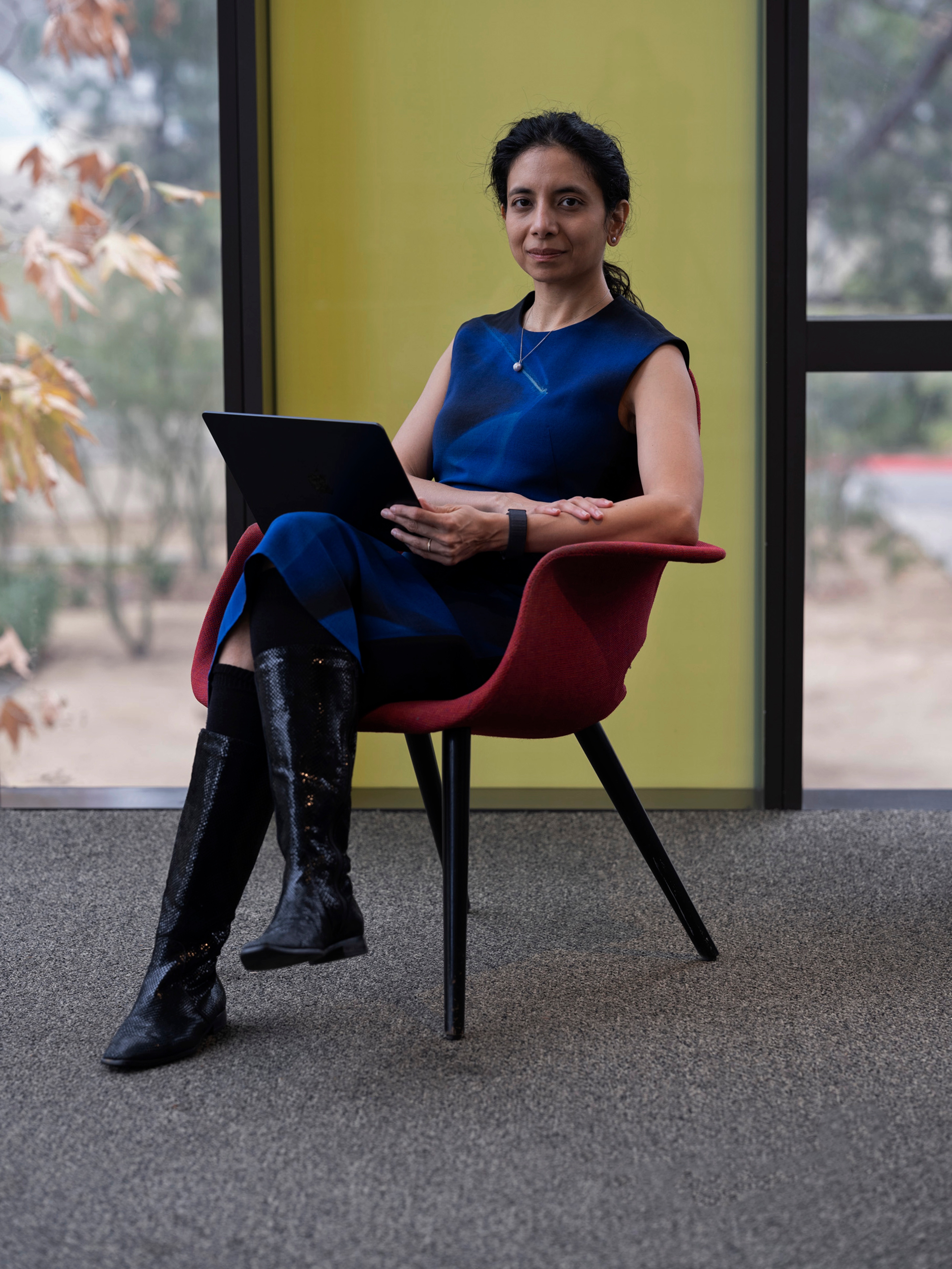
Anima Anandkumar by Carolyn Drake
CREATIVE DIRECTOR + EIC
SARAH RICHARDSON
Beyond Noise 2026
CREATIVE DIRECTOR + EIC
SARAH RICHARDSON
Beyond Noise 2026