Noise
ISSUE NO. 05: SIAN PROCTOR
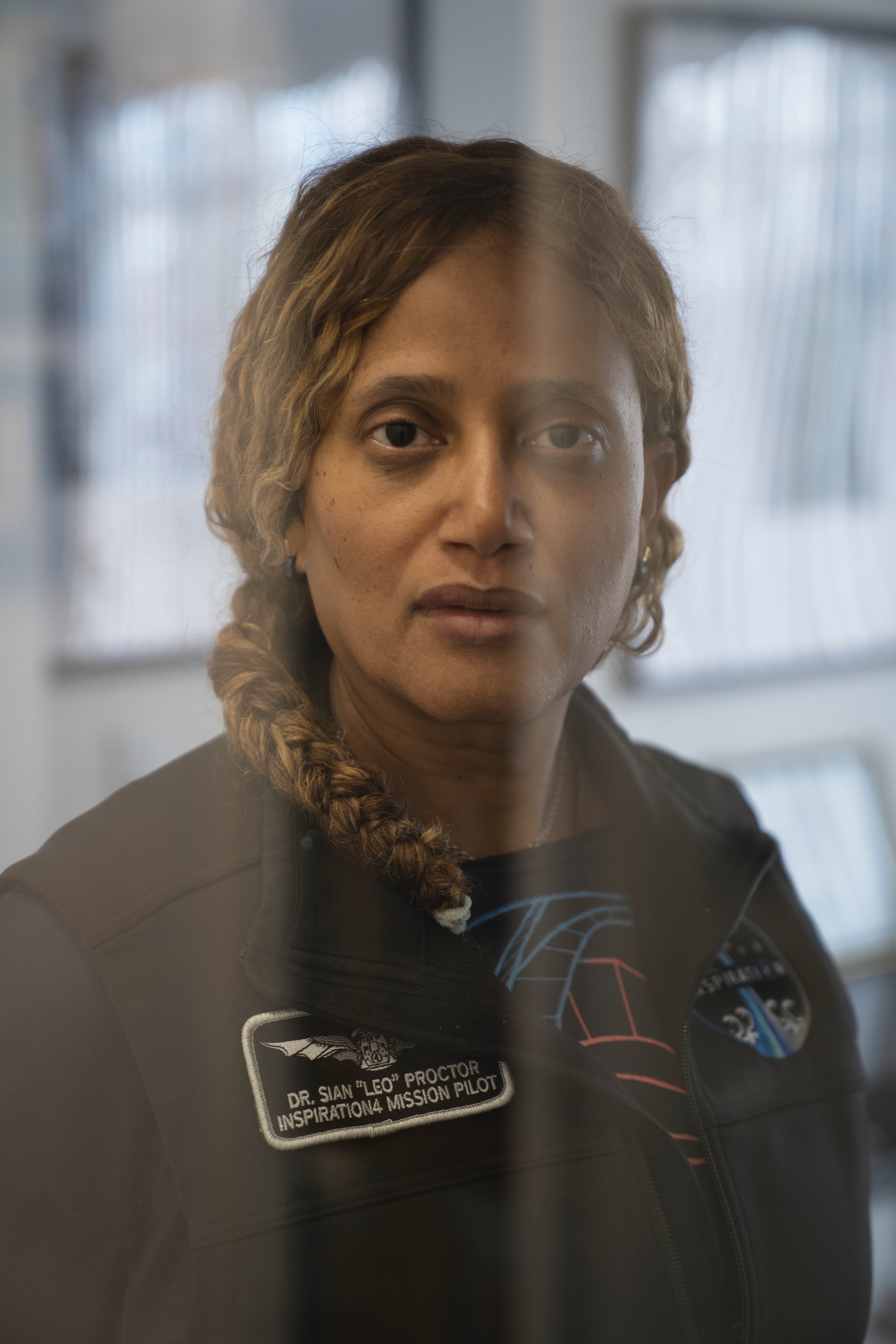
Sian Proctor by Kitra Cahana
SIAN PROCTOR
Words: 929
Estimated reading time: 5M
In September 2021, the geoscientist and astronaut Sian Proctor became the first African American woman to pilot a spacecraft, as well as the first African American commercial astronaut. For Sian, serving as the mission pilot for SpaceX Inspiration4, the first all-civilian orbital mission, fulfilled a lifetime dream to reach space. “I compare reaching space to Michelle Obama’s book Becoming,” Sian says. “It was this moment in which I had just achieved this near-impossible dream, and nobody could take it away from me.” Sian’s pioneering journey also makes a remarkable parallel with that of her own father. Working at NASA during the Apollo mission in the late 1960s and early 1970s, Sian’s father was a ‘hidden figure’, part of the generation of Black scientists and mathematicians whose vital contributions were overlooked. Alongside her commitment to space travel, Sian spent decades as a professor of geology, sustainability, and planetary science, and has recently been developing her practice as an Afrofuturist artist and poet too.
BEYOND NOISE: What led you to space?
SIAN PROCTOR: I’ve been chasing space my entire life. My dad worked at the NASA tracking station in Guam for the Apollo mission, and I was born eight and a half months after Neil Armstrong set foot on the moon. So I was a moon celebration baby. We left Guam and my dad left the space industry soon after I was born, but I grew up seeing all this NASA memorabilia on my dad’s office wall. I was always inspired by space and exploration.
BN: That must have been a really interesting time for your dad to be involved in space research.
SP: Yes, he was one of the ‘hidden figures’. There was a recent book, and then a film too, called Hidden Figures, about the Black scientists and mathematicians who worked at NASA from as early as the 1930s. These people didn’t always have college degrees, but they were incredibly skilled at maths and science, and they really contributed to the advancement of human space flight. They weren’t recognized at the time. Historically, they have been excluded from the narrative of space flight, and their role has been really sidelined.
Both of my parents had passed away by the time I went to space. But we had an autograph that Neil Armstrong had given to my dad. Neil Armstrong was known for not giving out his autograph, but he gave this note to my dad, thanking him for his contribution to advancing human spaceflight. That was kind of a family heirloom, so I brought that autograph into space with me.
BN: How important has curiosity been to your journey?
SP: I would say that I have the heart of an explorer. When I was a kid, I thought about explorers a lot, but I had this narrative that I could never be an explorer, because everything has already been discovered. Then I realized that exploration isn’t about discovering something new for humanity, it’s about discovering something new for yourself. So if I became a lifelong learner, then I would always be an explorer.
BN: What is it like to be in space?
SP: Nothing beats floating in space, it’s such a surreal experience. You don’t just work in space, you eat, drink and sleep there. There are even aspects like not needing a pillow, because there’s no gravity to pull your head. You’re in a constant state of, ‘This is amazing’. Things are floating, the Earth is above you, and you feel constant awe and wonder at the experience.
BN: What is it like to come back down?
SP: Coming back through the Earth’s atmosphere is a dynamic roller coaster. I found it exciting. Modern day rockets have a launch escape system. When you’re entering space, if something goes wrong, they’re designed to help you potentially survive. But when you’re coming back through the atmosphere, you’re cooking. It’s binary; you either survive or you don’t. So there’s a lot going on when you’re coming back, but you’re also filled with the excitement and anticipation of landing to a successful mission.
BN: What does that risk feel like?
SP: I didn’t even think about it. I was just excited about the entire journey. It really wasn’t weighing on my mind, the idea that any minute I could die. I was more captivated by everything that was going on, and I had reconciled myself to the chance that if something went wrong, that I was okay with it, because this was what I wanted to do. I would rather die doing something that I love than die doing something that I hate, and there are so many other worse ways to go. When you come to terms with that, then you’re able to set that risk aside, and just go and be present in the experience itself, without that fear overwhelming you.
CREATIVE DIRECTOR + EIC
SARAH RICHARDSON
Beyond Noise 2026
CREATIVE DIRECTOR + EIC
SARAH RICHARDSON
Beyond Noise 2026