Noise
CREATIVITY AND CIRCULARITY: LAURENCE ELLIS
CREATIVITY AND CIRCULARITY: LAURENCE ELLIS
Words: 543
Estimated reading time: 3M
THE PHOTOGRAPHER’S PORTFOLIO FOR BEYOND NOISE ISSUE NO.04 IS FEATURED IN VOLUMES, A NEW SHOW IN THE MARAIS
By Morgan Becker
Volumes, a group exhibition and discursive platform in Paris’s Marais, sheds light on the problem of Western overconsumption, taking Accra’s Kantamanto Market as a sort of case study.
Led by ERE—Sophie Strobele and Jordane Salomez’s collective dedicated to supporting social and environmental causes in the realms of art and fashion—and the US- and Ghana-based Or Foundation, the show rests on a central question: “What form would creation take if Parisian designers were limited to the volumes of discarded textiles that remain within France?”
The work on view comprises upcycled fashion pieces from emerging Ghanaian designers, first shown at Accra’s Obroni Wawu October Festival. Obroni Wawu, the local name of Kantamanto Market, translates to dead white man’s clothes—its primary stock is secondhand garments, sourced from the likes of H&M, Levi Strauss, and Primark. Near the start of 2025, the market burned down, decimating the livelihoods of tens of thousands of Ghanaians. It’s a tragedy that stems from a system of fast fashion, overconsumption, greed. These reborn garments serve as an antithesis—crafted from excess, symbolic of reclamation. Says Richard Asante Palmer, one of the featured designers: “Instead of allowing textile waste to choke our gutters or beaches or landfills, I decided to use it to create something.”
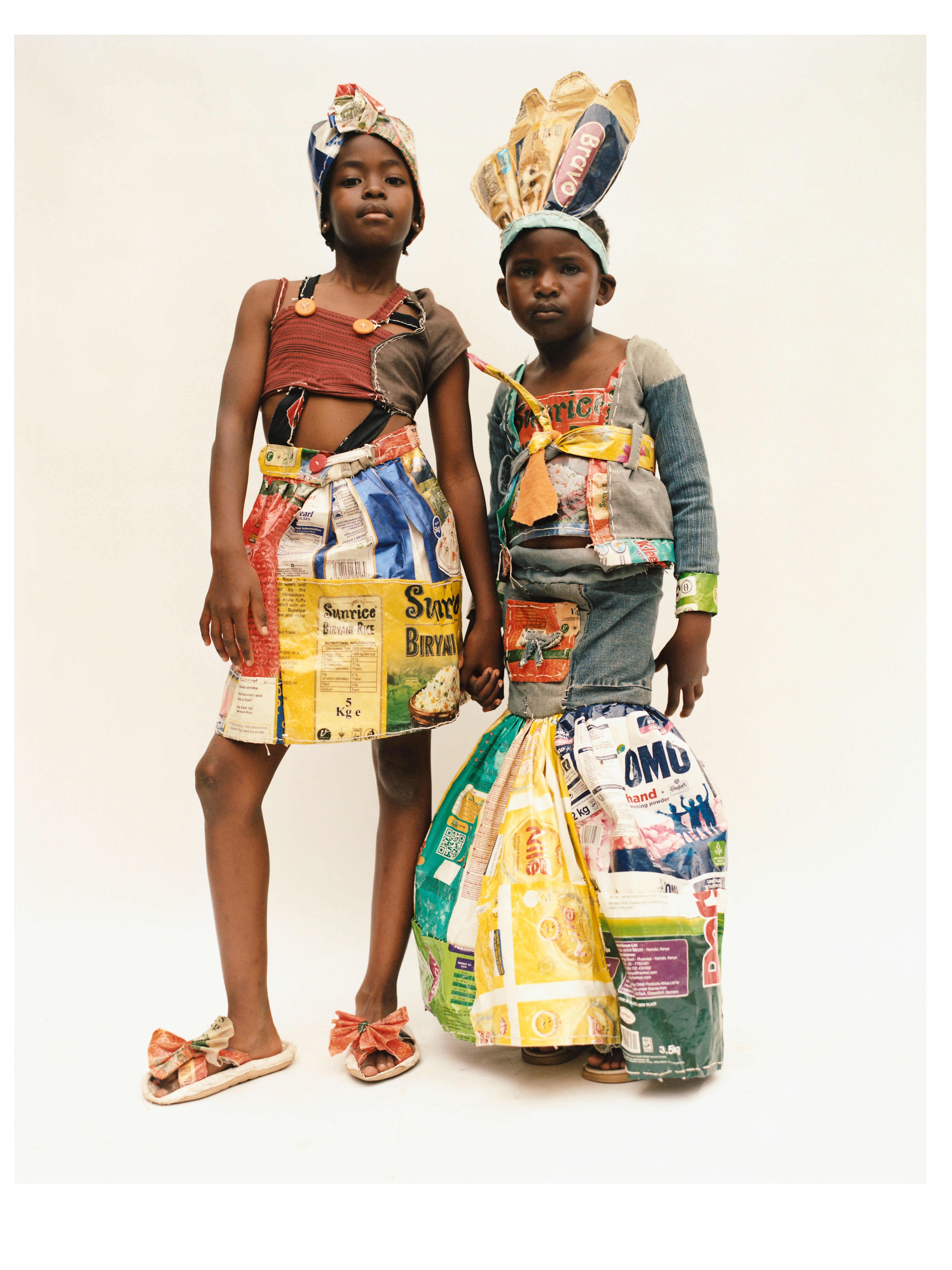
It’s a sentiment echoed by Joan Otieno and her female-run art studio Warembo Wasanii, which translates to the beautiful ones who are artists. Based in Nairobi, Kenya, the founder—a self-described “junk artist”—crafts striking dresses and accessories out of waste, championing an extraordinary creative resilience. She’s built Warembo Wasanii into a community center, where she mentors and provides refuge for 20 girls. Joan educates them on how to sustain themselves professionally, artistically, and practically, in terms of their health and well-being. Writes Makena Onjerika: “[Joan is] a person full of utu. This Swahili word means humanity, but also empathy—the kind of empathy that inspires a deep sense of responsibility. Joan felt that she had to do something for those girls.”
In Issue No.04, Laurence Ellis photographed Joan’s mentees, styled in her creations. A selection of these images adorn the walls of Volumes, in dialogue with the physical works on display: The Ghanaian designers focus on reworking textile surplus, and in turn, the women of Warembo Wasanii transform the discarded into a space for craft, self-expression, and coming-together. In tandem, they illustrate how creativity itself can become an act of circularity.
CREATIVE DIRECTOR + EIC
SARAH RICHARDSON
DIRECTOR
LAURENCE ELLIS
PRODUCTION
Ieva Kolupailaite
EDITOR
Sam Storey
RESEARCH + COORDINATION
Mia Scott, Amelia Kerr
Camera Operator
Ronald Omondi Jamuhuri
In Collaboration With
Warembo Wasanii Studio, Joan Otieno
Special Thanks
ERE Collective, Richard Asante Palmer, Louise Ford, Sophie Strobele, Richard Bush
Beyond Noise 2026
CREATIVE DIRECTOR + EIC
SARAH RICHARDSON
DIRECTOR
LAURENCE ELLIS
PRODUCTION
Ieva Kolupailaite
EDITOR
Sam Storey
RESEARCH + COORDINATION
Mia Scott, Amelia Kerr
Camera Operator
Ronald Omondi Jamuhuri
In Collaboration With
Warembo Wasanii Studio, Joan Otieno
Special Thanks
ERE Collective, Richard Asante Palmer, Louise Ford, Sophie Strobele, Richard Bush
Beyond Noise 2026