Noise
ISSUE NO. 04: GABRIELA ETCHEGARAY
GABRIELA ETCHEGARAY
GABRIELA ETCHEGARAY
Words: 965
Estimated reading time: 5M
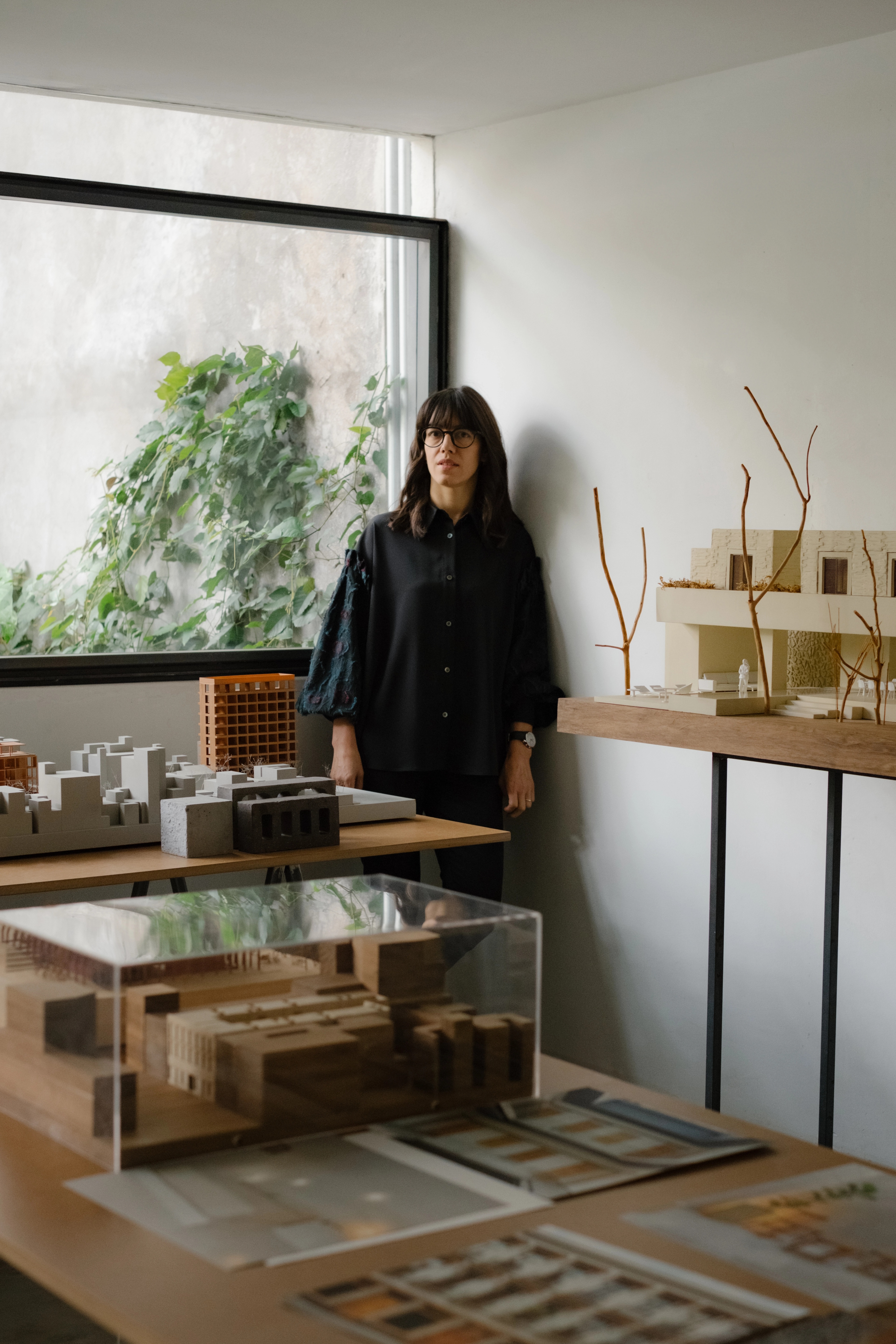
As many architects do, Gabriela Etchegaray began her career eager to see her designs fix themselves on the horizon of the built environment. Nearly two decades later, however, she has come to see architecture less as the production of objects and more as the cultivation of meaning. Her practice, Ambrosi Etchegaray, which she co-founded with partner Jorge Ambrosi in 2011, is known for quiet, site-responsive buildings that favor continuity over rupture and restraint over excess. Gabriela completed her graduate studies at Columbia University, where theory and criticism broadened her understanding of architecture as a discursive act. In 2018, she curated the Mexican pavilion at the Venice Biennale. Today, her work is a quiet rebuke of spectacle, often relying on gestures so subtle they nearly vanish into the landscape. What remains is an intention at once ethical and poetic. For Gabriela, architecture is a living inquiry into memory, place, and the possibility of constructing a better future.
What drew you to focusing on the more abstract or theoretical dimensions of your profession?
Looking back on when I started my career, I recall that my main interest was construction itself: seeing ideas take tangible form. That remains today, but it has undergone such a radical transformation. Engaging with conceptual practices has made me more open to forms that are not necessarily built: They can be documents, installations, museographies… That possibility allows me to understand architecture not as an aim or an object, but as a worldview, in which the question of how to inhabit a space becomes the question of how to live. The projects we take on at the studio now are attempts to pose certain questions and offer potential answers or solutions: How do we relate to each other? How do we relate to the environment? What do we decide to preserve or not? Though, of course, we remain interested in aesthetics, they are no longer our guiding axis.
You were born and raised in Mexico City and work there most of the time. What have you learned from it?
I think back to one of the first projects Ambrosi Etchegaray took on, which was an extension of the Papalote Children’s Museum located in the middle of the city, within the Chapultepec Forest. Our proposal ended up turning the museum’s exterior into spaces that represent the different landscapes and ecosystems of the surrounding territory. In retrospect, it informed our process, which always begins with observation: of a site, its landscape, its history, and patrimony. Many of our projects deal with preexisting structures and we always prefer to keep something of the past. This sense of nostalgia is inherent to Mexico City. This region used to be a lake, and there were pre-Hispanic buildings that seemed to be born of the earth, with this structural heaviness and so much symbolism in their ornamentation. It’s this heritage that Mexican architects can study and incorporate into more contemporary work. Today, I think our focus is less on the aesthetic dimension of a project and more on the ethical one; the questions we ask have more to do with sustainability and a sense of social justice: Who will this space include or exclude? To design a home or an entire environment is to take a stance that both proposes and enforces a certain way of living. And every way of life comes with rules, which impose hierarchies of gender, class, culture… Mexico City’s landscape is so vast, naturally and socially, that it demands constant new readings.
The fields you’ve focused your graduate studies on often explore the intersection of architecture and contemporary art. How do the two show up in your day-to-day work?
Ten years ago, our studio statement was something like “art and architecture.” But that intention to view architecture as art has faded. Architecture is its own thing. The process of questioning how it takes shape from a critical and ethical standpoint—that is what imbues it with artistic meaning. I’m very interested, for example, in the Land Art movement and the artists who used such resoundingly simple gestures. They took the work out of the white cube of the gallery and onto the earth itself, making the art speak of the environment by embodying the environment. In our work, I think of the projects where we’ve opted for a more austere solution, rather than something flashy or monumental. For a plant nursery in Puerto Escondido, we proposed an excavation for the worker to avoid having to bend over: Instead, the plants were at the height of his hands. It was a very subtle gesture, but it functions. I think our architecture understands luxury not as something ostentatious, but as ritual, poetry, the way light enters a space, the sense of journey and discovery that a user can feel as they make their way through it.
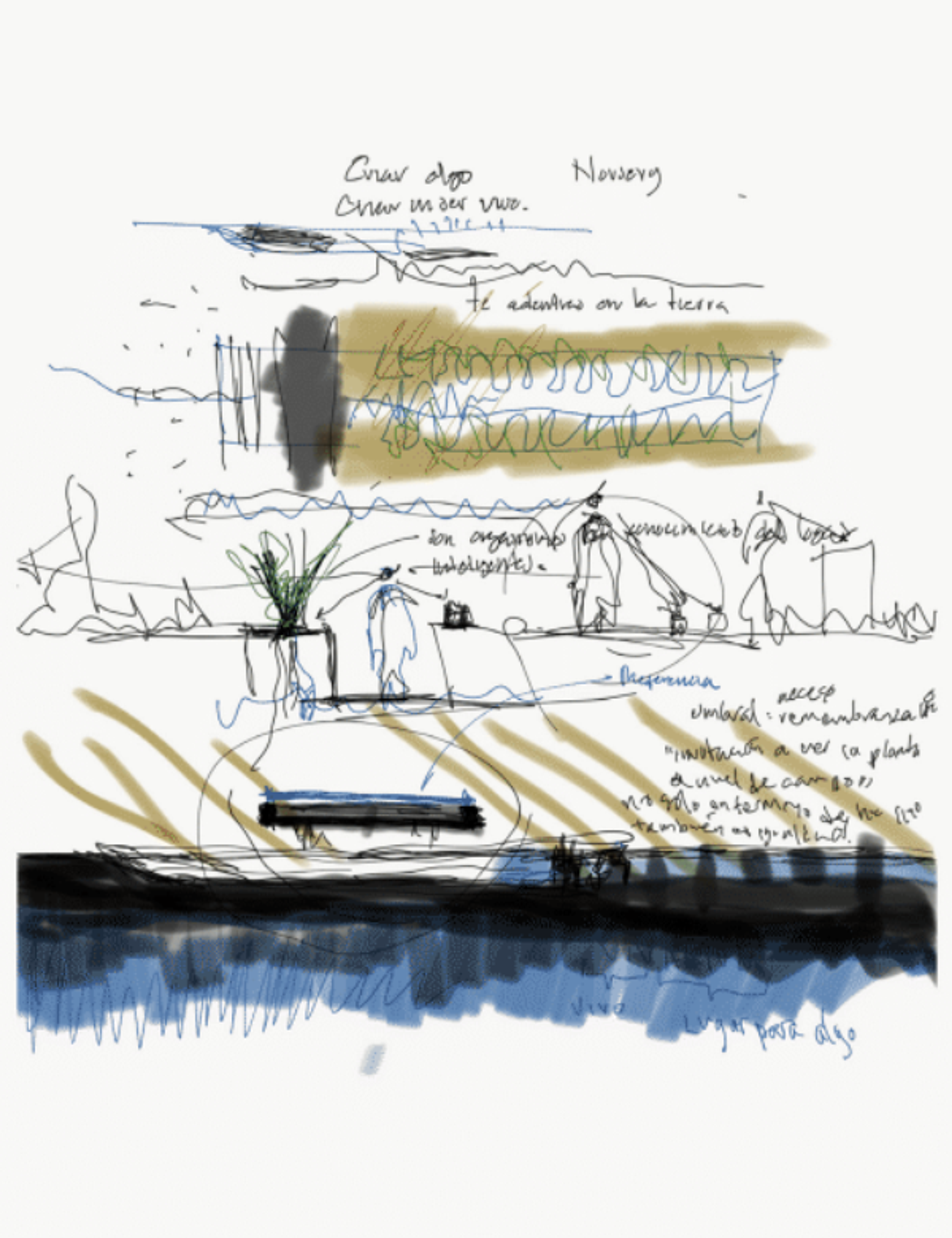
Guayacán Pavilion. Conceptual drawing by GABRIELA ETCHEGARAY. © Ambrosi Etchegaray, 2018.
PHOTOGRAPHY
Manuel Zúñiga
INTERVIEWS
ANA KARINA ZATARAIN
Beyond Noise 2026
PHOTOGRAPHY
Manuel Zúñiga
INTERVIEWS
ANA KARINA ZATARAIN
Beyond Noise 2026