Noise
ISSUE NO. 05: OPTIMIZED FACES
OPTIMIZED FACES
Words: 2702
Estimated reading time: 15M
Trained on biased datasets and built for engagement, generative AI is reshaping how young people measure their worth.
By Janelle Okwodu
Recently I was scrolling through Instagram when a pop-up ad appeared on my screen: a young woman with dark hair and glasses, transformed into a Shoujo manga heroine with bulging pastel eyes clad in a barely there school uniform. Normally I’d have just kept scrolling without giving it much thought. I’d seen this kind of imagery before, usually in ads for “build-a-bear” style AI companions, typically pushed out on tech forums and singularity-focused subreddits. When I saw those ads, I tended to laugh them off. Their overt sexism and uncanny valley depictions of “women” were off-putting, and seemed mostly to speak to the misogyny of their target demographic. But being firmly outside of said demographic, they were easy to ignore.
This ad was different. The before image was of a teenager, her face dotted with acne and train track braces on her teeth; the markers of awkward youth. The target demographic for this product wasn’t lonely, maladjusted men, but women grappling with the punishing standards of what it means to be ‘attractive.’ This was an advertisement for a filter app that promised more than Facetune or Photoshop, too. Feed your photo into its specialized AI and it wouldn’t just edit out your flaws; it would reimagine you as a being without any.
As a teenager who would have given anything to remove awkwardness and insecurity from my life, I understood the app’s appeal immediately. As an adult plugged into the development of generative artificial intelligence models, I also understood just how sinister it is. Gen AI isn’t new. The neural networks that underpin the technology, and give it the predictive skill that can make it feel so uncanny, have existed since the 1940s. The deep learning that enables large language models to mimic human conversation emerged in the early 2000s. In the last five years, however, the discourse around AI has exploded, as advancements in technology have led to the release of more evolved tools. Now models like OpenAI’s DALL-E, Stability AI’s Stable Diffusion, and Google’s internal system Imagen allow users to generate photorealistic images with a single line of text.
These tools are easy to use, and they tend to be inexpensive or free. As a result, Facebook, Google Image Search, and Pinterest have been flooded with false, AI generated images. As these images proliferate across the internet, they interweave with the existing troves of media that comprise their datasets. The new, ‘false’ images now existing alongside the original ‘true’ images.
Nowhere is this more evident than on Pinterest, where bot accounts populate the platform with images that defy logic. The falseness of these generated images is especially glaring when searching for beauty icons of the past, none of whom are immune to AI “improvements.” The quirkiness of real, 1990s-era Kate Moss is replaced by waifish approximations with capped teeth. Marilyn Monroe receives an anachronistic spray tan and exaggerated proportions. Angelina Jolie is warped into caricature. While the ‘improvements’ given to each individual woman are different, overall these ‘tweaks’ flatten the distinctive features the women are and were known for, smoothing out ‘imperfections’ to move towards an unreal standard of beauty.
Online, uniqueness is punished and praised in equal measure. Raised on the airbrushed aesthetic of early-2000s media and now subjected to the cold math of AI beauty, young people increasingly measure themselves against standards no real person could meet. This is not exclusive to women either; young men are increasingly falling prey to communities like looksmaxxing, reducing their bodies to a series of problems barely visible to the naked eye. On forums, discussions of philtrum length and cheekbone prominence merge eugenic pseudoscience with incel ideology, reducing a person’s value to their facial measurements. Even the supposed benchmarks of male beauty, models like Jordan Barrett and Sean O’Pry are increasingly presented through AI-enhanced images whose acid-blue eyes and blocky jawlines resemble action figures.
Research has long shown that social media can help instill unrealistic ideals, and generative AI has only intensified the harm. The corporations currently responsible for developing and marketing these AI tools seem uninterested in building meaningful guardrails. Image-generation tools also amplify bias through their reliance on pattern recognition. Trained on image-text pairs to create probabilistic associations, they are guided by averages. Each image is a blend of everything that came before it, devoid of uniqueness unless those traits are deliberately programmed in. Even detailed prompts leave no room for imperfection when generating from pre-approved reference points. You can ask DALL-E for “realistic pores and gamine features,” but the result still reflects the blandness of a median.
DALL-E doesn’t understand beauty, but it can mine datasets for repeated depictions, tagged features, and statistical commonalities. Because it is built on human inputs, AI mirrors human bias, favoring youth, thinness, symmetry, and European features. Ask ChatGPT to generate a beautiful woman and it will likely produce a soft-focus Barbie-like face. Unless explicitly instructed otherwise, it omits the “flaws” that make faces interesting: pores, discoloration, asymmetry.
This new AI-generated beauty recalls the Instagram face that dominated the late 2000s. Infinite scroll rewarded uniformity, and the Kardashian-Jenner sisters marketed beauty as a product, something that could be easily attainable with the right doctors and products. Their aesthetic, a melange of cultural appropriation and cherry-picked traits, became the new standard, whether pursued through cosmetic surgery or a Kylie-branded lip kit.
Instagram face, while extreme, was still tethered to reality. Even the most filtered influencers were real people beneath Clarendon and Valencia. Today, humanity is optional. AI-generated influencers, models, and celebrities are pushed front and center, while marquee figures like Kendall Jenner and Paris Hilton license their likenesses to Meta. On TikTok, “virtual talents” like Aitana Lopez, a pink-haired fitness influencer, and Radhika Subramaniam, a travel creator who “doesn’t need a passport,” promote hotels, workouts, and restaurants. No one explains how a block of code can vouch for Maison Matcha or the best places to visit in Kerala, yet the accounts rack up real followers.
The appeal of these AI influencers lies in their commercial-ready beauty. What they lack in originality they make up for in inoffensive prettiness, ideal for sponsored posts and thirst-trap selfies. They represent a beauty that cannot be picked apart, but that also doesn’t require any real consideration. These AI influencers may not be challenging, or interesting, to look at, but this smooth, averaged-out beauty perhaps appeals to a cultural moment that struggles with originality or difference. Just as the Kardashian-Jenner sisters were the 2000s standard, now plastic surgeons report more patients bringing in AI-edited images as references.
I first considered how deeply AI might reshape beauty during a Big Tech meeting while I worked as a consultant. Silicon Valley is imagined as a land of coders and founders, but in reality it’s layers of middle management whose work often seems closer to marketing and developing products. Corporate talking heads pitch ideas that aim to extract more value from employees and consumers alike. During our meeting, the latest innovation being discussed was the concept of replacing human models with customizable AI avatars. The novelty that would sell this was the idea of easy personalization, but the true appeal was the money that could be saved by reducing labor.
“We won’t have to waste time with casting,” one manager said. “That’s going to save us a lot.” “Think of the budgets,” another added. “No photoshoots, no hair and makeup, not even retouching.” “And it’ll increase diversity.”
This is where I pushed back. AI fashion models struck me as ghoulish, but the penny-pinching logic was undeniable. Still, replacing real people of color with avatars built from their features was the opposite of diversity. As a consultant, my role was to raise these concerns before they became public initiatives. Diversity requires humans. Feeding cultures into an algorithm to avoid paying the people they belong to felt ethically bankrupt, especially for a profitable company. “You don’t understand,” I was told. “AI models will mean more diversity.”
The Valley thrives on compliance disguised as progress. Once the right person endorses an idea, dissent becomes obstruction. As one of the few minorities in the room, my objections were met with skepticism. Being told that diversity was beyond my understanding was surreal. I didn’t walk out. I raised an eyebrow and let the conversation continue as it drifted further from reality, each proposal centered around replacing workers with free labor. The idea was never fully implemented, and I ignored AI’s creep into fashion until it became unavoidable.
Beauty has always tethered itself to technology, in part because some of the promise of beauty, as a marketed product, lies in the future. The “better you” is never immediately attainable. It takes months of retinol, multiple injections, or at very least the wait for express shipping from Sephora. When brands invoke new technologies in relation to their products, they appeal to a sense of scientific advancement. AI facial analysis, foundation-matching tools, and golden-ratio measurements slot neatly into existing routines of optimization.
Increasingly, consumers are accustomed to inputting biometric data in pursuit of better skin, better diets, and better lives. These habits can be healthy or they can spiral. As beauty embraced technology, tech embraced beauty and wellness in return. Though start-up culture leans toward supplements and biohacking rather than manicures, the obsession with youth is the same.
No one embodies this more than Bryan Johnson, the venture capitalist behind Kernel, who documents his pursuit of immortality in granular detail. His routine ranges from creatine supplements to blood transfusions from his son. While Johnson has turned his fear of aging into a business and a Netflix documentary, his next project abandons the body entirely. Through Kernel, he is attempting to build an AI replica of himself. The idea is a science-fiction staple, appearing in everything from Neuromancer to Fallout, and it remains a recurring fantasy of the ultra-rich.
But is AI really about to revolutionize beauty?. Aside from a few tech bros evangelizing on r/singularity, it feels like most people don’t actually want the immortality of disembodied perfection. Most don’t even want artificial intelligence if the stakes are too high. As faith in the corporations behind the platforms and Big Tech’s disruption model starts to erode thanks to layoffs, surveillance, and a series of founder scandals, consumers are pushing back against tech encroachment. As corporations work overtime to apply AI to every part of life, increasingly people are questioning exactly how these technologies are being used, and whether they are necessary.
Instead of capitulating to a new era of big tech, people are reclaiming their digital lives with dumb phones, decrying generated images as slop, and boycotting the use of AI as false advertising. In beauty, this has resulted in brands like Dove pledging to ban generated images of women from their marketing by singling artificial intelligence out as a threat to true representation.
Dove’s policy aligns with a sentiment that’s building on and offline. Take Nina Park, the celebrity makeup artist whose K-beauty-infused looks highlight the individuality of her high-powered client roster. Park’s looks have included layers of blurred lip tint that drew attention to the actress Margaret Qualley’s signature gap, and playing up the actress and singer Jessie Buckley’s expressiveness with a candy red lip. There has also been a noticeable reemergence of bold, drag-inspired looks on the red carpet and social media after years of clean-girl minimalism, like Chappell Roan’s platinum pencil-thin eyebrows and harlequin face paint, and Zara Larsson’s Lisa Frank color palette. Online nostalgia for the 2016 beauty boom has prompted many videos centered on recreating the era’s shellacked glam and irreverent sense of fun.
The past wasn’t perfect, but the uniformity of aggregate beauty makes you appreciate real beauty’s variety—the pock marks and crow’s feet, teeth untouched by veneers or Invisalign. Yes, our perceptions of beauty and life have been altered by data sets and deep learning, but we’re still capable of choice. The next time a pop-up promises a version of yourself without flaws, try thinking about what you lose when you give flaws up. Lines are the remnants of laughter; freckles the markers of time spent basking in the sun, alive and aware, fully human. Even the self-doubt we feel about the way we look is grounding; it unites us with the millions of other people wrestling with their own insecurities. It’s messy and uncomfortable and can’t be edited out with a filter or cured with a supplement, but it binds us all together in reality.
CREATIVE DIRECTOR + EIC
SARAH RICHARDSON
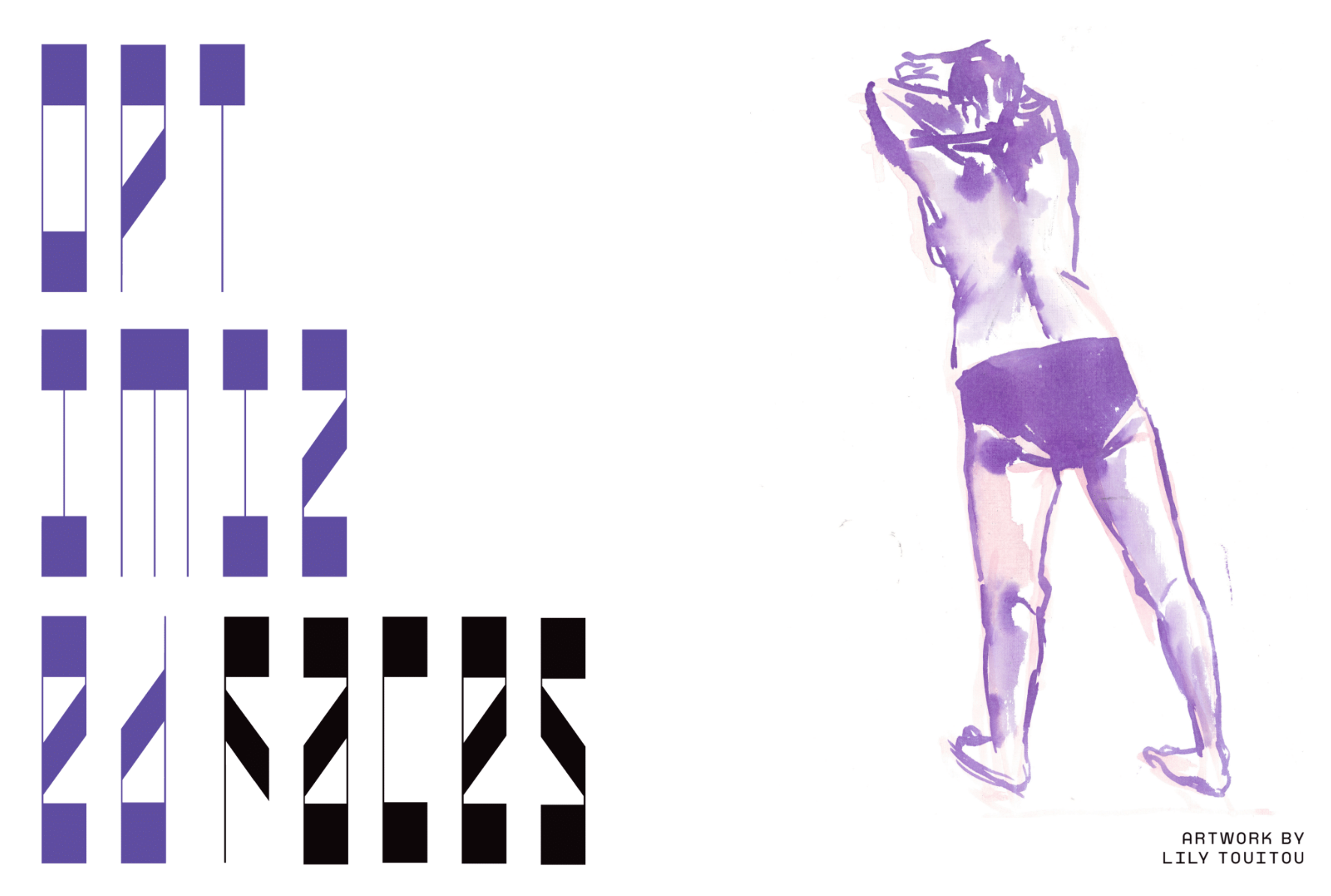
ARTWORK
LILY TOUITOU
Beyond Noise 2026
CREATIVE DIRECTOR + EIC
SARAH RICHARDSON
ARTWORK
LILY TOUITOU
Beyond Noise 2026