Noise
ISSUE NO. 04: FACE VALUE

FACE VALUE
Words: 2207
Estimated reading time: 12M
Beauty was never neutral—and as its logic splinters, it's become a language women inherit and invent
By Morgan Becker
The beauty premium says that if you’re physically attractive, you’ll make more money and you’ll garner more power. Just how much depends on your industry, how beautiful you are, and how well you hack it—but it’s reliably documented, averaging around a five percent bump per paycheck. The premium goes deeper than industry, a kind of quirk of the human brain. We reward good looks with assumptions of skill and good character, then categorize it as merit.
Daniel Hamermesh and Jeff Biddle came up with the term in 1994. It was also a big year for beauty execs, with the rollout of a handful of new brands and the early strokes of an aesthetic shift. They must’ve had the same insight: that good looks have real bearing on public perception and thus quality of life, and that there’s plenty of reason, vanity aside, to shell out for them.
What it meant to be beautiful in 1994, though, was at a tipping point. The culture was image-reliant like never before, thanks in part to a 24-hour TV news cycle; to compete in the ratings, networks went trashy. O.J. Simpson on trial! Kurt Cobain committed suicide! Tonya Harding in the thick of an Olympic scandal! Change the channel, and Madonna, Hole, and Marilyn Manson pushed boundaries on MTV. It all reflected a youth into the angsty, edgy, and sexy, versed in irony and media-savvy.
On the runway, Kate Moss was at her thinnest. Courtney Love trended in ripped-up babydoll dresses—“taking the most constraining parts of the feminine, good-girl aesthetic, inflating them to a cartoon level, and subverting them to kill any ingrained insecurities,” Mish Way wrote for <<i-D>>. Attractiveness, especially for teenage girls, was a site of barely controlled chaos. To look good to some was ugly to others. Anti-beauty was close to the mainstream.
In 2025, to be beautiful has become a sort of dance with context. Symmetry, polish, and a powdered nose used to signal the powerful woman, whether she be a housewife, a socialite, a lawyer, an actress, a politician, or a politician’s wife. Psychologists relate this to the “halo effect”—a cognitive bias where “good” traits like intelligence, kindness, and capability are conflated with attractiveness. It’s not wholly rational, but it is reliable, playing out early in life and often thereafter. Over time, these little signals accumulate into real-world advantages: higher confidence, better access, and a sense of belonging wherever looks might translate into currency.
Around the time when sunken eyes and smudged liner became the norm for supermodels—supposedly the pinnacle of good looks—we entered an era where every line of work and every social group formed its own complex and oftentimes conflicting standards. Nowhere is this clearer, these days, than along political lines, where likeability and authority ultimately have to coexist. Fox News anchors, it’s long been noted, are overwhelmingly bottle-blonde; they wring their hands over ‘blue-haired activists’ wreaking havoc at leftist protests. ‘Republican Girl’ make-up tutorials blew up this year on TikTok, satirically pushing liquid eyeliner, a nude lip, and too-light matte concealer as a GOP calling card. ‘Feminist’ make-up à la Glossier, or a lack thereof, is the reverse of that coin: freckly, dewey, low-coverage—accepting of fine lines and unplucked eyebrows, a slippery slope to unshaven legs.
On the right, there’s nostalgia for when ‘our women looked like women,’ the #MeToo-weary, Make America Hot Again wave. And on the left, a tiresome neoliberal market that promises beauty on your own terms, if you’d just lean in, babe! and buy that one last lip stain.
In 1994, punkier brands like NARS and Stila launched; MAC and Revlon ColorStay rolled out moody shades in contrast to the frosty pinks and corals of the ’80s. Everyone was touting a makeup-for-makeup’s-sake ethos that could work with an ugly-pretty, DIY-slanted beauty movement. Chanel’s Fall/Winter runway was manicured in Le Vernis Vamp, a black-purple polish Madonna called Karl Lagerfeld the next day to request. Uma Thurman wore it as Mia Wallace in Pulp Fiction. Teenagers all wanted a bottle, and their grandmothers too.
Melinda Davis wrote that Vamp was the fons et origo of “an entire generation of wily, sexy women, [using] a new category of ‘black widow spider’ cosmetics to express their sexual power.” It was digging into some idea of beauty as persona—as male-gaze-neutral affiliation—signed-off by the aspirational world of luxury.
Hillary Rodham Clinton was the First Lady then. “If I want to knock a story off the front page,” she joked during her tenure, “I just change my hairstyle.” This stretch of her political career was in the wake of 1991’s Anita Hill scandal—a major catalyst in the subsequent “Year of the Woman,” which saw four female senators elected. As tens of millions watched on cable, Hill alleged that Supreme Court nominee Clarence Thomas sexually harassed her back when they worked at the Equal Employment Opportunity Commission. She wore a double-breasted turquoise suit with shoulder pads, red lipstick, otherwise understated make-up, and her hair roller-set—tightroping girliness and the Capitol uniform, recounting her story calmly but firmly. In turn, she was derided as “a little bit nutty and a little bit slutty” by the writer David Brock; doubted under the question of whether a ‘real victim’ could be so poised; in the news, depicted as cold and clinical. “Are you a scorned woman? Do you have a martyr complex?” Senator Howell Heflin demanded from the bench.
Who the beauty premium services is always complicated by race, class, age, weight, sexuality, whatever. There’s no way to present that will work in every room, and no way to take looks off the table.
Beauty opens doors, and it sets up traps: The most conventionally attractive among us are likely to breeze through entry-level interviews. But there’s an overlooked double bind as advancement and leadership come into play. In male-dominated fields, the higher a beautiful woman climbs, the less seriously she’s taken. One 2019 study proposed a ‘femme fatale’ effect, where attractive businesswomen were judged as less truthful than their peers when tasked with delivering bad news. Hill, a Yale Law grad with good prospects in federal service, recalled what was on her mind ahead of taking the stand:
“I questioned my decision to wear bright blue linen… Look at what happens when someone thinks you don’t conform. Look at Marcia Clark, Hillary Rodham Clinton. Even when there are much more important things about to happen, there are these profound political judgments made about appearance: Do you look like someone who is credible?”
“There is no question that fashion has been used as a tool to dismiss women,” Vanessa Friedman wrote for the New York Times. “To associate them with frivolity rather than serious subjects—the superficial rather than the stuff of governance.” She was in defense of covering female politicians’ wardrobe choices, noting their legitimate role in campaign strategy and public relations; call it the costume department of the “pageantry of rule.”
The very same goes for how politicians want to look. It’s not sexist or vapid to note that a pantsuit communicates something different from a pencil skirt and heels. And in that vein, we ought to pay attention (as Friedman did in 2024) to Kristi Noem putting on Falsies, pumping her lips, and redoing her teeth as Donald Trump thought about a running mate. “You’re not allowed to say it, so I will not,” he said by her side to the crowd at an Ohio rally. “You’re not allowed to say she’s beautiful… So I’m not going to say it!”
Trump had approved; Noem fit nicely into his universe—quipped Friedman, “What could she do but smile?” Then again, she didn’t get the bid. You have to wonder whether J.D. Vance would’ve pulled ahead, had Eyeliner-gate already happened.
That beauty is a double-edged sword is nothing new. It wasn’t new amid anti-beauty’s surge, nor in BCE as Cleopatra primped for Caesar. What is new is that it’s less and less interesting to think about the ways pretty politics control us. Yes, Gen Z’s spending at Sephora climbs steadily year over year; the money going to their clothing—arguably, a more legible and potent means of self-expression—is slightly decreasing or staying in place. We engage in the labor of producing, protecting, and maintaining beauty because our culture values and enforces it… And because it’s a means of communication, confidence, and community that’s as compelling to subvert as it is to perfect.
Of course, the pursuit of beauty goes beyond what’s public-facing. It’s deeply psychological, tied to self-worth. Women in particular are socialized to internalize appearance as a measure of discipline. Beauty takes on a moral dimension. Even those who reject conventional standards feel pressure to perform some alternative aesthetic with equal care. The question becomes how we rewrite the rules, rather than simply playing the game.
Hill’s polish didn’t stop the confirmation of Clarence Thomas. Noem’s Yassification didn’t get her the White House. Clinton’s choice of headband did little in terms of the speculation that she got cheated on for her ‘frigidity’ and overambition. And Monica Lewinsky going fresh-faced, for that matter, couldn’t make a dent in her public humiliation.
That’s beauty in the field of politics, from which we might think about the ways beauty politics, a different beast, operate in the lives of those whose paychecks don’t depend on approval ratings—and, ultimately, who propose future visions of “mass appeal” that broaden who can run for office, or be in the boardroom, or walk a runway. There’s probably some weird link between Paris, Nicole, and Lindsay sticking with lip gloss and highlights while the headlines read “BIMBO SUMMIT,” and AOC filming Get Ready With Me’s for Vogue.com because she thinks it’ll help her career. Or between piercings-and-peroxide’s contentious surge out of punk and into the mainstream, and the complete and total normalization of plastic surgery and hair dye that the Young Right celebrates as natural and classic American beauty.
Cultural flashpoints and pop revolts are vital expressions of identity and resistance—real people negotiating with the establishment in real time. When what it meant to be beautiful conceptually splintered, the goalposts moved from popularity to precision. Deviating from the norm isn’t just acceptable; it’s widely legible, high-impact, and encouraged.
For better or worse, stratified culture collapsed a million definitions of desirable. That doesn’t mean beauty’s power has diminished. If anything, it’s more slippery, strategic, democratized, and surveilled. It’s being fluent in your references, audience, aesthetic, and agenda. If there’s a premium in that, it’s not on what you were born with, but on knowing what you’ll do with it.
“When what it meant to be beautiful conceptually splintered, the goalposts moved frompopularity toprecision.”
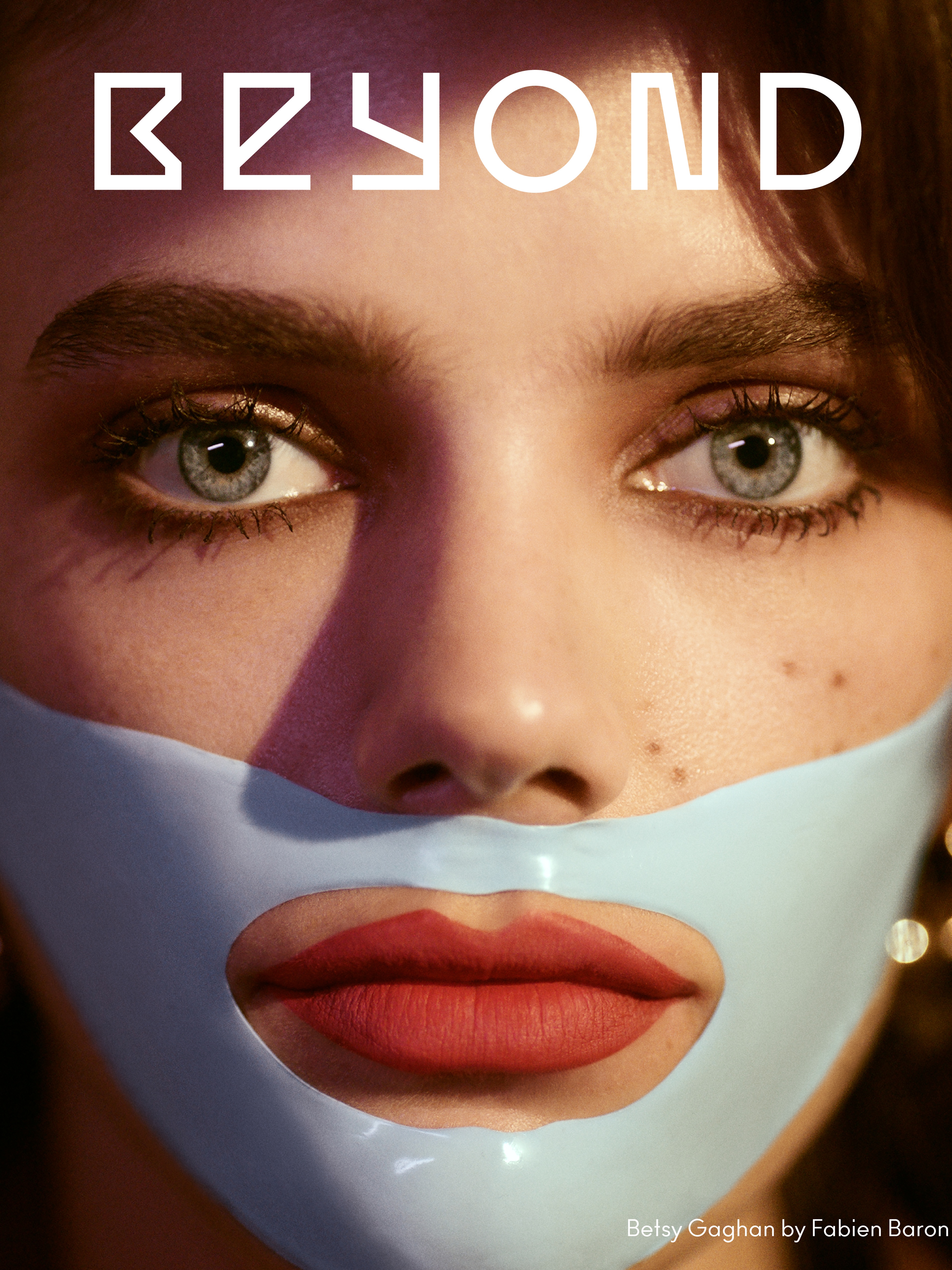
ARTWORK
FABIEN BARON
Beyond Noise 2026
ARTWORK
FABIEN BARON
Beyond Noise 2026