Noise
ISSUE NO.05: LILIANA CAVANI
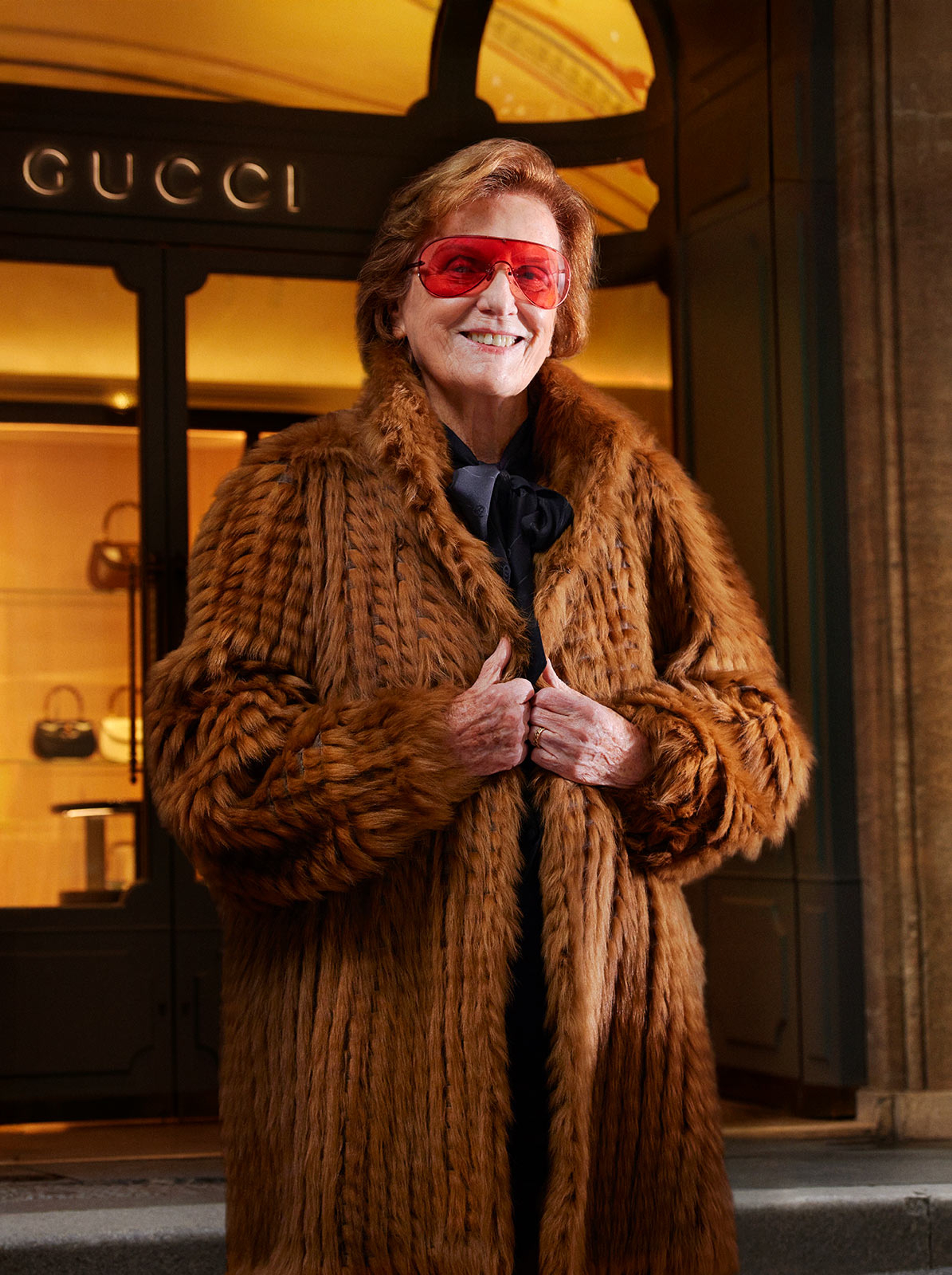
LILIANA wears shirt and coat by GUCCI.
A CINEMA OF EMOTION
Words: 2906
Estimated reading time: 16M
Liliana Cavani, titan of Italian cinema, and Gaetana Marrone, professor of Italian Studies at Princeton University, reflect on cinema, provocation, and a friendship that first began in the late 80S.
By Elissa Carassai
The Italian director Liliana Cavani’s seminal career in cinema was rooted in historical inquiry and intellectual provocation right from its very inception. Born in 1933 in Carpi, after graduating with a degree in Classics from the University of Bologna, Cavani moved to Rome to attend the Centro Sperimentale di Cinematografia. The only woman in her directing class, she quickly established herself as a resilient and strong-willed artist. A competition led to her taking a job directing historical documentaries at RAI-TV from 1961.
Through the early 1960s, Cavani continued to train as a filmmaker, while researching the archival footage for her seminal documentaries, including History of the Third Reich (1961-62), Women of the Resistance (1965), and Philippe Pétain: Trial at Vichy (1965). By using a normal 50mm lens and a meticulous reconstruction of real events, she addressed the visceral reality of violence that historical rhetoric often seeks to sanitize. This period was foundational; her historical and psychological investigation of Nazism and Fascism would become the basis for Cavani’s most controversial film,The Night Porter (1974), which explores a taboo bond between a concentration camp inmate and an SS officer.
Perhaps Liliana’s rigorous historical research and artistic freedom is best understood through her career-long obsession with Francis of Assisi. The only director to have dedicated a trilogy to Italy’s patron saint, in films and a television miniseries spanning nearly 50 years, she stripped away the saint’s legendary attributes to reveal a revolutionary individual who opposed the rituals of power.
This journey is mirrored in her long-standing collaboration with Gaetana Marrone, a Professor of Italian Studies at Princeton University. Their relationship began in the late 1980s when Gaetana, seeking to write a definitive study on a female director, was warned that Liliana was a ‘tough’ and ‘difficult’ artist. Instead, they found a seamless intellectual encounter. Marrone spent years carefully working on Liliana’s Roman archives, eventually publishing The Gaze and the Labyrinth: The Cinema of Liliana Cavani in 2000. The book became the benchmark for critical study on the director, who has often been misunderstood as an erotic filmmaker due to her challenging subject matter.
ELISA CARASSAI: How did you meet? And how did your collaboration begin?
GAETANA MARRONE: I had just arrived at Princeton and I was welcomed into the Film Studies Committee, and what was then called Women’s Studies, which counted among its faculty eminent figures like Toni Morrison. I was working on theater, but I also began teaching Italian and European cinema with an interdisciplinary cultural approach. I was encouraged to write a book on an Italian female director, and I found Liliana’s cinema more in line with my research interests. I was able to meet her thanks to the support of our embassy in Washington and the film historian Peter Bondanella, who gave me her telephone number.
When I arrived in Rome, some of my friends in the film business said,“Gaetana, you with Liliana? Liliana is tough.” They thought she was difficult, and I was too shy. I remember when I went to visit her with my husband, who is a cinematographer. Liliana lived near Piazza del Popolo. Her long-time assistant director, Paola Tallarigo, welcomed me, and then Liliana entered the room. I looked into her eyes and knew then that I would never have problems with her. At that moment, I decided that my next book would be about her. At the end of the meeting, she showed me her archives and invited me to work there. It was the Christmas before she was going to shoot her second film, 1989’s Francesco. My husband had long hair and a beard, and Liliana told him, “Gerardo, come play one of the friars.” He replied, “I can only come with a camera, I’m not worth much as an actor.”
She has given me the freedom to work. I spent several summers collecting and photocopying material. She never even asked what kind of book I was writing. That showed a great sense of trust. When the book was published by Princeton University Press, and I sent it to her, she called me. She said she’d had help with the English and liked it very much. Since then, we have seen each other every time I have been in Italy. She has come to Princeton several times. This year is the 800th anniversary of St. Francis’s death, Liliana is the only director with three films on him. We opened the celebrations a year ago with roundtables and film screenings at Princeton University and at the Italian Cultural Institute in New York, with Liliana in attendance. Liliana, I want to ask about your Francesco trilogy. You never used the word ‘saint’ in the titles. You even met Pope John Paul II, who wanted to see the second film. How did you encounter, with a classical and secular background, this religious figure? And what attracted you to Francis of Assisi?
LILIANA CAVANI: Two things. First, friends who went to Assisi once a year. I come from a secular family where no one went to Assisi. Second, Dante Alighieri. He dedicates almost the entire 11th canto of the Paradiso [the third part of his Divine Comedy] to Francis. I trust Dante; he’s the most intelligent man I’ve ever read. He speaks of Francis in a way we can understand, grasping his fundamental importance. Slowly, I became interested. I randomly found a book at the Bologna train station—a biography of Francis by the Swiss medievalist Paul Sabatier. This book, Life of St. Francis of Assisi, first published in 1893, was on the Vatican’s Index of Forbidden Books from 1896 until the Index ended in 1966. I read it on the train to Rome. I realized that Francis was an extraordinary character, ahead of his time, and the book was serious and compelling. I asked the head of [the television channel] Rai 3, Angelo Guglielmi, a prominent literary critic and an atheist, “Why don’t we make a film about Francis?” He said, “Why not?” And so, the first Rai fiction film was born, and was shot with very little money.
GM: Not only was it the first Rai feature film, but you were the only female director in the early ‘60s to compete with the likes of Fellini, Antonioni, and Rosi. Today, we take it for granted, but back then, it wasn’t easy to get a producer to trust a young female director. In the ‘66 film, you chose Lou Castel to play St. Francis. In ‘89, Mickey Rourke. In the 2014 miniseries, the Polish actor Mateusz Kościukiewicz. Why these foreign actors—a Swede, an American, and a Pole? Traditional iconography depicts Francis as frail and thin, but you placed great importance on the body and the Franciscan message of the body. What made you choose these actors?
LC: Other important directors made films about Francis, but he was always a ‘little guy’ jumping around. I studied history. In the Middle Ages, war was pure butchery. I saw ancient weapons in a museum in Florence, massive swords. Today, with gunpowder, you shoot and you don’t even see the person, but then it was terrifying butchery. This was shocking to Francis. I wasn’t looking for a ‘nice little guy,’ but someone credible for the era. He prepared for war like everyone else of his social status, but turned back after facing the Perugian army and being taken prisoner, because he realized the butchery was unbearable. That’s why he told his followers: “Peace, peace, peace.” I wanted a Francis who was powerful in his face and muscles, having trained for war.
GM: In your later versions, you added new historical elements. In the ‘89 film, there is the scene of the stigmata and, in the last one, the voyage to the Holy Land during the Fifth Crusade and the encounter with the Sultan of Egypt, Al-Malik Al-Kamil, who accepts Francis as a man of peace. It is the Vatican’s Papal Legate whore fuses a mission of peace because they want to “exterminate the infidels.” You brought a contemporary Francis to us. What about Chiara of Assisi? In ‘66, she was a mere reflected image. In ‘89, you cast Helena Bonham Carter in a prominent role. Chiara became central to storytelling as she narrates her encounter with Francis in flashback. How do you read Chiara’s character?
LC: Chiara is another person who chooses to be herself. As a noble’s daughter, she was destined for an arranged marriage to keep assets within the family. She sees this young man who has changed Assisi—he was considered an idle cavaliere, a ‘bad boy’ who liked women—and she understands his spiritual transfiguration. She says, “I want to be with him, I want to care for others.” It’s a small revolution.
I relied on studies by American medievalists. They looked at things often ignored: the state of the weapons, the meeting with the Sultan, and the reality of the ‘cadet sons’ who went to the Crusades to make money. Francis understood the power of violence. I wanted to tell the story of Francis as he really was.
GM: Stylistically, the first film is ‘chronicle’ but the ‘89 film is more classical, and the fiction series is almost a journey, in which the camera follows Francis. Did your early documentaries help define this style? Your cinema is one of images, light, and silence, which often says more than dialogue.
LC: The first film was a journey of discovery for me. The second film dives deeper into reality and Francis’s horror at violence. I made a documentary on the Third Reich. I saw footage from the Library of Congress that no one else had seen. The second Francesco was born from a need to explain why he was right to speak of peace. WWII had aspects, like extermination camps, that were previously unimaginable. I think I subconsciously wanted to deepen Francis’s ‘fixation’ with peace and the fraternity of all creatures.
GM: Speaking of Francis as a character who opened your path into feature films, your subsequent works addressed Galileo, Tiresias in 1969’s The Year of the Cannibals, Milarepa, and Nietzsche. Then there are the female characters: Chiara, Antigone, Lou Andreas-Salomé, Lucia, Louise, and Mitzuko in 1985’s The Berlin Affair. What leads you to this path that is both historical and cultural, but also philosophical and existential? Your characters have a great breadth of experience, but they are also ‘difficult’ for their times. I remember Galileo’s end, at the Inquisition trial, a moment of great defeat. What made you choose these figures who sought something beyond the easy, normal path?
LC: Perhaps it stems from my family origins. I grew up with an ethics that was very attentive to what was happening in the world, not just in my neighborhood. My grandfather was a socialist and an atheist; my grandmother was from an old Catholic family. I learned history at home. It felt very natural, just as it felt natural to make early documentaries like 1964’s La casa in Italia, which told the stories of the poor and the unemployed, works that were often heavily censored. After seeing so much material from World War II, I found Francis to be perhaps the only true ‘window’ onto another world. Francis, Dante—these people were ahead of their time. Christianity is a religion that requires intelligence; knowing means being stimulated to improve something, to change history because you are part of it. This search came naturally to me.
GM: You mentioned censorship. I recall reading that Francis of Assisi was initially blocked, and that Pasolini, who was your friend, even intervened, saying your Francis was so physical and contemporary that it lacked the traditional religious ‘magic.’ How do you work onset with your actors?
LC: I have found very intelligent actors. I always want to talk to the lead actors before starting because they need to understand my key approach and the film’s sense day by day. When I wanted Mickey Rourke for 1989’s Francesco, I had seen him in Michael Cimino’s 1985 Year of the Dragon and liked him very much. I met him in Long Island while he was filming another project. We met at 10:00 p.m. because he was working, and since the restaurant was closed, we sat on the floor of a small hotel room and shared a single pizza. We talked until midnight, as if we had known each other forever. I found a beautiful and moving soul in Mickey Rourke. He had just finished 1986’s 9 1/2 Weeks and was known as Hollywood’s great seducer, so everyone wondered how I could risk casting him as the Saint of Assisi. But you saw his depth in acting.
GM: I want to address a practical aspect of today: People don’t go to the cinema in the way they used to; they watch films on iPhones or computers. What do you think about watching films on very small screens compared to the immersive experience of a cinema?
LC: The television market has taken over and stolen much of the theater audience. I don’t understand why intellectuals haven’t insisted more on cinema being shown in theaters. Movies have been shown for a long time in dedicated spaces where you feel the breath of others and experience shared emotions. On a small screen, those emotions are diminished. When you watch a film on television, it gets lost in the background noise of everything else. You lose the impact of intelligence and communication. The big screen of the theater pulls you in. At home, the phone rings, the doorbell rings... There is no dedication. My mother used to take me to the cinema when I was five because she loved the shared emotion of being there with people.
GM: Is there a project that was never financed that you would still like to film today?
LC: I have actually managed to make most of my films. I don’t worry about whether a project will be a success; if I have a project, I try to make it regardless.
GM: But you had the Simone Weil project and another on Mozart that were never made.
LC: It’s possible I’d like to take those up again, but other things were born in the meantime. Now, I am in a moment where I must decide what my next—and perhaps last—film will be.
GM: We started with Francis, and we now end with him. What does he say to today’s youth, who are always rushing and attached to their iPhones?
LC: He says many things, even if he isn’t always heard. We have so many media tools today that we think we know everything, but perhaps we actually know less. The market is winning, but I don’t believe culture is winning
"I don't worry about whether a project will be a success; if I have a project, I try to make it regardless."
EDITOR-IN-CHIEF + FASHION
SARAH RICHARDSON
PHOTOGRAPHY
JEFF BARK
HAIR
MANUEL SUNDA AT JULIAN WATSON
MAKEUP
SIMONE GAMMINO AT JULIAN WATSON
SET DESIGN
ALESSANDRO IACOPELLI
TALENT DIRECTOR
TOM MACKLIN
LIGHTING DIRECTOR
CHRIS WHITE
PHOTO ASSISTANTS
ELIO ROSATO, CIRO MEGGIOLARO
STYLIST ASSISTANT
FRANCESCA MORETTI
PRODUCTION
MOFO
LOCAL PRODUCTION
ANNA COCCOLI
LOCAL PRODUCTION
MARIA CRISTINA DI STEFANO, CATERINA MORELLI
Beyond Noise 2026
EDITOR-IN-CHIEF + FASHION
SARAH RICHARDSON
PHOTOGRAPHY
JEFF BARK
HAIR
MANUEL SUNDA AT JULIAN WATSON
MAKEUP
SIMONE GAMMINO AT JULIAN WATSON
SET DESIGN
ALESSANDRO IACOPELLI
TALENT DIRECTOR
TOM MACKLIN
LIGHTING DIRECTOR
CHRIS WHITE
PHOTO ASSISTANTS
ELIO ROSATO, CIRO MEGGIOLARO
STYLIST ASSISTANT
FRANCESCA MORETTI
PRODUCTION
MOFO
LOCAL PRODUCTION
ANNA COCCOLI
LOCAL PRODUCTION
MARIA CRISTINA DI STEFANO, CATERINA MORELLI
Beyond Noise 2026