Noise
ISSUE NO. 06: CATHERINE OPIE
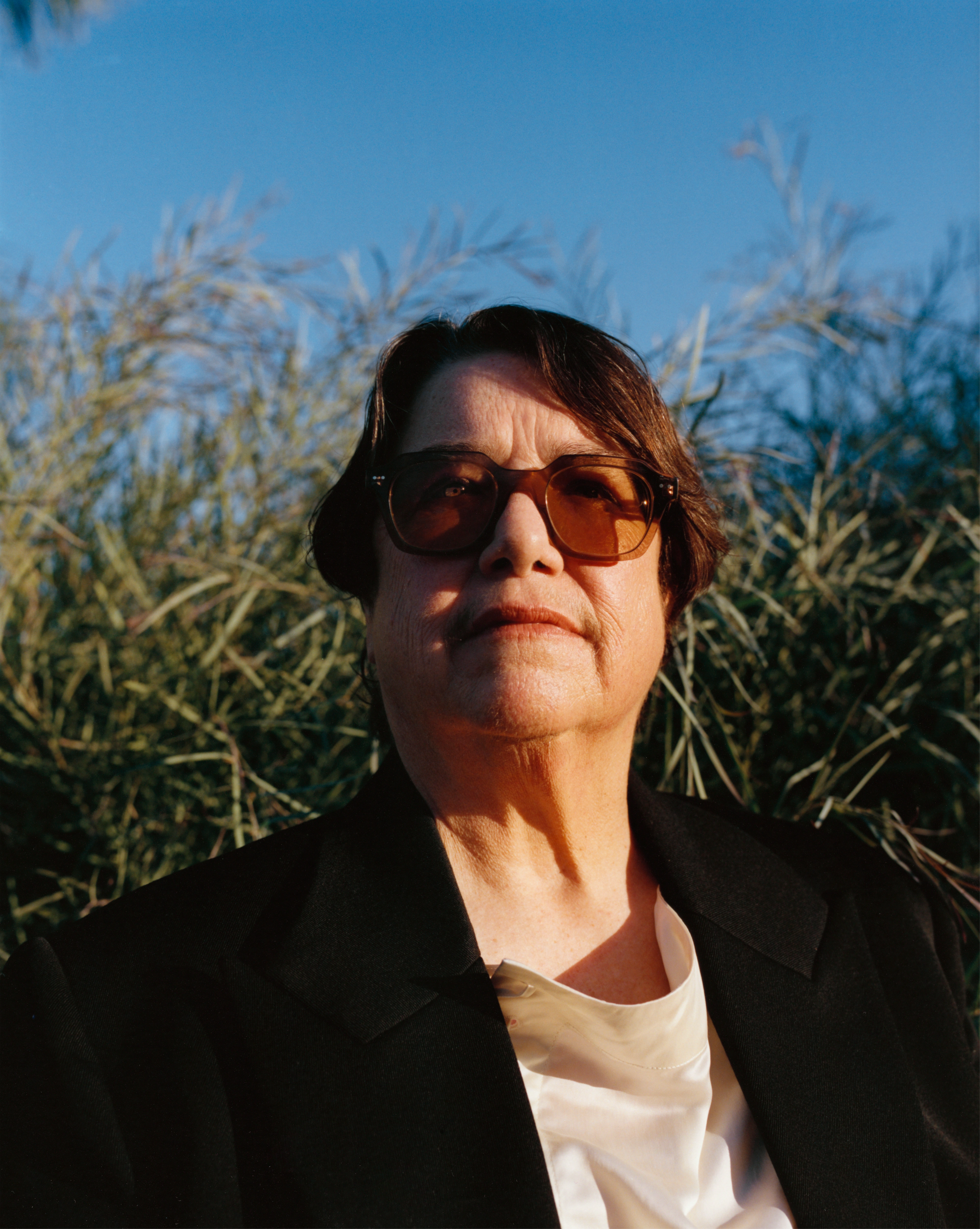
Top and jacket by FERRAGAMO.
SISTER SPIT
Words: 3398
Estimated reading time: 19M
The photographer Catherine Opie and writer Michelle Tea’s friendship dates back to a pivotal moment in queer history. The pair discuss the zigzagging journey to equality in America.
By Ryan White
Catherine Opie and Michelle Tea’s relationship dates back to the ‘90s, when both were living in San Francisco and actively involved in the queer groups once central to the city’s counter-cultural identity. For Catherine, fresh out of art school during the height of the AIDS crisis, it was all about ACT UP, the grass roots political group engaging in direct action, and Queer Nation, a splinter group formed in response to anti-gay violence. For Michelle it was all about Sister Spit, a lesbian-feminist spoken-word and performance art collective that traveled across the country (and she also spent a brief stint as part of the Pink Panthers, an outfit similarly concerned with gay safety on the streets).
These days both are based in Los Angeles, the focus of their work unwavering from the same themes of visibility, joy, anger, wisdom, and freedom. Meeting for Beyond Noise, Catherine and Michelle are animated and excited to catch up with one another, two veterans of a scene that has morphed over the years and long since abandoned San Fran as its nexus. Here, they discuss rifling through celebrity garbage cans, confused nostalgia for the ‘80s and ‘90s, and activism in the surveillance era, ending with Catherine revealing her freshly painted toenails over Zoom.
RYAN WHITE: Do you remember the first time you encountered the other’s work?
MICHELLE TEA: Cathy, I first heard about you in the ‘90s when there was that big party house on Capp Street, the Capp Street house with that dungeon in the basement, and my friend Kiki lived there. I met up with her for a drink and she said, “Oh yeah, Cathy Opie was over doing portraits.”
CATHERINE OPIE: Kiki was awesome. I found out about you because of Sister Spit. I was all about what you were doing going across the country because, being a part of ACT UP and Queer Nation, what it meant at that time for lesbian visibility was so interesting. Here we are helping our queer male friends basically try to survive an impossible situation. Back in the ‘80s for me in San Francisco, coming out in the leather community, it was Take Back the Night, not Sister Spit.
MT: I feel like you’re a little older than me, and I think everything was happening so intensely during that era with AIDS. Your generation was really in the trenches with folks, and were losing immediate people. My generation, just 10 years later, it wasn’t quite that. I remember moving to San Francisco and hearing about how people were traumatized, people had just been through a war. But it had stabilized by the time I got there, and I think it was that almost lack of acute trauma that allowed us to organize something like Sister Spit and do this thing that was fun because we hadn’t just spent the past 10 years burying our friends.
CO: I always wanted to ask you this question though, because it is curious in talking about this history, and I think that queer history is so important right now. Did Queer Nation and ACT UP [inform] your founding of Sister Spit?
MT: I’ve never related Sister Spit to ACT UP or Queer Nation, but I was involved in Queer Nation in Boston before I ever moved to San Francisco, and I was completely enlivened by this idea that you could just gather everybody together and fucking do something, do an action, do a die-in.
CO: That’s the kind of actions that we went to. Or Barney’s Beanery in West Hollywood to do kiss-ins.
MT: I was part of a group that went to some place where the Bush family had a vacation home in New England, Kennebunkport, and we all did a giant die-in. I think what it did is that it made me realize that this world is stupid. Queer people are geniuses, and we just have to do it ourselves. It was a very DIY era, and I feel like the ultimate DIY was ACT UP and Queer Nation, where the idea was, ‘Yeah, we’re going to do our healthcare ourselves, we’re going to do legality ourselves, we’re going to do public safety ourselves.’
I was doing, very briefly, a queer street patrol called the Pink Panthers in Boston. We’d walk around to just make sure no one was getting [hurt]. It was like Black Panthers meets the Guardian Angels, but with none of the style of either. We’d wear big boxy pink shirts. I don’t know if we were preventing gay bashings or inviting them. But how about you? How did all of this direct action end up funneling into the work that you were about to create, or were creating?
CO: I was going to art school and wasn’t out in art school. So even though I had a girlfriend in the ‘80s at San Francisco Art Institute, and even though I was part of the queer community, my art school life was very separate from my queer life, and I wanted to keep it separate. After I graduated from CalArts, and having had professors like Catherine Lord and Millie Wilson and these other radical dykes who were bringing other dykes forward, it was interesting. I started making the queer work afterwards. That’s when Capp Street came in. Those portraits were all about me deciding to be completely authentic within myself and within the politics of the time that we were living in. Who knew that right now in 2026 we would be back in the culture wars in the way that we are, for what we had fought for all through the ‘80s and ‘90s?
MT: It’s insane. It’s like we got a little breather that I didn’t realize how much I took for granted. I guess it just felt to me that obviously we were just going to keep moving forward. Because why wouldn’t we? I actually tried to revive Queer Nation in L.A., and there could be a queer comedy made about that attempt.
CO: Oh my God! You should try to pass a script. We need more scripts. I was saying the other day, “When is the script going to come out for Casa de Oestrogen?” We have this whole lesbian community in Koreatown in L.A. Because that’s what I’m finding that the young queers want, they want to know our generation.
MT: One million percent. It’s so cool, and I frickin’ love that about queers. I love that we care about our history, and I love this about younger generations. When I hear younger queers talk about the ‘90s, it’s how I talked about downtown New York in the ‘70s when I was younger.
RW: How do you both relate to nostalgia right now? The world is obsessed with the past, and all the culture that came out of it, but as you say, it was a dark period, too. Is our nostalgia misplaced?
CO: I think nostalgia is a very curious word. I was just in Scotland, and there were this whole row of little baby dykes for Del LaGrace [Volcano]’s talk and my talk. They kept showing up at every event in Scotland, this little row of baby dykes who looked exactly how I looked when I was in my 20s. Same kind of jewelry, same kind of facial piercings, the tattooing – all the markers of what my community was. Is that out of nostalgia, or is that out of ideas of identity and political awareness? I think those are really interesting things to parse in terms of language. Michelle, you’re the expert of language, so what do you think?
MT: I don’t like nostalgia. I get really prickly sometimes when, especially people of my own generation, say, “Those were the days.” Every day is the day. All we have is now. But I really appreciate this interest because I did have this urgent feeling during that time that we were doing something really important. And as somebody who’s always been interested in cultural scenes, we were ignored. Nobody was paying attention to us.
CO: I think that to talk about nostalgia, one has to talk about technology. When I photograph political marches, I have this thing that I do where I stand in the middle of the line of the road, and then I photograph all the activists passing me. So it’s one big moving portrait, and I’ve been doing this stylistically since the ‘80s. Now people get to me and they’re freaked out. They’re covering their faces with signs.
MT: When I was trying to do a Queer Nation revival to respond, that surveillance culture, which everyone is really scared of – and I’m not saying they shouldn’t be scared of it – really got in the way of making things happen. People were so afraid, and they wanted so much organization. I was saying, “No, the Proud Boys are going to be here. Let’s mobilize.” People would say, “Who’s going to walk people to their cars afterwards?” I thought, ‘You guys, no, we’re putting our bodies on the line. That’s what activism is. It isn’t safe.’
CO: It’s really changed things. I have a son, he’s 24. I asked him how often he’s taking to the streets of New York because New York has elected a historic mayor. Things are really changing. He said that he doesn’t want to be surveilled, and so he doesn’t protest. I think that’s why you see our generation still out on the streets protesting, and you see very little of a younger generation. I don’t want people to have to mask up because that’s exactly what ICE is doing. So it’s complicated. That’s nostalgia for you. What can we do with it?
RW: What’s your experience of big institutional support, for instance at the moment the platforming of your work? Catherine, for you, this is a huge year
in terms of museum shows.
CO: Yes, but not here in the United States. It’s a big banner year for me in Europe.
MT: Literally a banner. A giant banner of Vaginal Davis.
CO: Queen Mary on top of the building with the drag queen underneath. I mean, come on, you don’t get better than that.
MT: You really don’t. That was gorgeous. That gave me so much life. I was so happy for you. I was so happy for Scotland.
CO: When you put a tartan that’s made in the 15th century next to one of my portraits, what is that speaking to? Well, tartans are a way of weaving one’s politics within the fabric. That’s what Scotland does. They wove their history. There’s a tartan for witches. How cool is that?
MT: Oh my God! Thank you for giving me a new obsession because I’m going to find that and make a gown out of it.
CO: You into witches right now?
MT: I am a witch.
CO: I need to interview you on set, if you’ll sit for me, because I’m making a new piece called The Lesbian Cowboy. It’s a Venn diagram where one part of me is the witch, the other part of me is the lesbian cowboy, and we’re trying to bring that Venn diagram together about what it means to live under toxic masculinity in the United States right now. I like to have fun with the culture wars. Like when I carved “pervert” on my chest. You’re coming out with a new book. How do you develop your ideas?
MT: I started this novel that is hard to talk about because it’s so early, and I fear that when I talk about it, it ends up sounding like a wonky Marvel movie or something horrible like that.
CO: Aren’t we living in a wonky Marvel-like DC comic strip?
MT: Yes. I’ve actually done a lot of mystical work in the past few years. I’ve studied the tradition of Kundalini with a meditation teacher. I went to India. There’s this whole backdrop I’m obsessed with: we don’t even understand what this plane of reality and existence is. What is death? Who are we? I can get really out there with it. So the book is sort of backgrounded with this. Somebody is born, but where do we even come from when we’re born? There’s this idea of where that idea is fleshed out, and this person is born basically to murder a fascist who’s alive in the timeline. I think that this very simple quest, go kill the fascist, is actually going to become very complicated. Because, what is death? What is this reality?
CO: What’s the relationship in your mind to feminism, being a pacifist, and fascism? How do you weave those beginnings into something? What is the difference between feminist utopia and dystopia?
MT: Pacifism is so complicated to me because I feel like I know there’s so much power in it, right? And also, I feel really inspired by the Black Panthers. That’s just self-defense. Who are we protecting by not protecting ourselves? Or who does it really protect? I hate respectability politics. But I also understand that there’s a lot of power in keeping your own integrity intact in this horrible world that’s trying to shake it out of you and make you as vile as the world can be, or the culture can be. So I can see both sides. I don’t think I’m that much of a pacifist. I definitely have whacked men in the face with my purses when they bother me in the street.
CO: I’ve turned my car up onto curbs with men who are beating women and honked my horn and got on out and pretended that I was going to hit them with my vehicle. I will drive up on a curb with an angry man abusing a woman.
MT: That is pacifist, right? I’m not actually hurting you. I’m scaring the shit out of you.
CO: I need to scare people. I don’t want to hurt anybody, but I want to scare the shit out of them. I’ve always dreamt of a group of leather dykes walking, clinking down the street.
MT: I love that so much. I’m inspired by these stories about different Buddhist teachers that would sometimes take a stick and whack their student in the head. Buddhists are so famously nonviolent, but then even a Buddhist understands sometimes somebody just needs to get whacked in the head with a stick. There’s something in both of our work where we are documenting reality and we’re also creating fantasy at the same time. Just thinking of this lesbian cowboy witch. It’s such a beautiful fantasy, and it’s also real, but it’s also aspirational.
CO: What is fiction is also fact, and that’s why I’m such a voracious reader. Because guess what? When I’m reading Kim Stanley Robinson’s [novel] 2312, I know that they probably will be terraforming planets in 2312. That is actually real. New York will one day be underwater. So I’m interested in this futurist view – and I guess that’s the potential of utopia, even though there only seems to be dystopia in terms of what’s going to happen to our planet.
RW: Catherine, I was reminded of a quote from when you were talking about your film The Modernist: “I was playing with ideas of the utopic dream of modernism and the dystopic world in which we seem to live now.” That was 10 years ago. How do you relate to that quote now? And how does that make you feel?
CO: Well, I think The Modernist is really this piece that is what we’re living with in California – a trans protagonist who’s trying to be an artist, living in their little studio in the backyard of West Adams, and they can’t even afford a bedroom. Yet modernism was supposed to be created for all of us to afford these little jewel-box houses, right? In terms of what happened post-World War II. So using something like modernism to talk about the fact that it didn’t work, to a certain extent, is a way to really look at utopia and dystopia through the lens of an artist wanting to make.
MT: And you grew up in L.A? No, you grew up in Ohio!
CO: I moved to Poway, California, when I was 13 years old. Since I got my driver’s license, my 1976 Plymouth Valiant, then my friends and I would get stoned and drive to L.A. to basically go through the trash of the stars. We got one of those maps of the stars’ homes, and we would come up on Trash Day stoned just to look through and find personal letters.
MT: Did you find any scores?
CO: We got a letter from Marlo Thomas to Danny Thomas’s house one day. We thought we’d really scored big.
I didn’t think I’d ever live here, but when I left San Francisco to go to CalArts, San Fran didn’t become a possibility for me to be an artist in. It didn’t offer the same kind of community. It didn’t have the kind of artists that were down here that were pushing the envelope. It was much more of a convention. It still is. Look, they got rid of all their art schools. They have no art schools left. I mean, it’s one of the most radical cities that I came out in, such a cornerstone of my identity as a human being, and they couldn’t sustain an ability for the community to support somebody like me as an artist. Literally MoMA saying, “No, we’re not going to sell Dyke Deck.” Are you kidding me? SFMOMA refused to put it in their gift shop.
MT: Woah!
CO: The only time I ever showed in San Francisco was with Rick Jacobsen in the gallery, in Kiki Gallery next door. That is the only solo exhibition I’ve ever had in San Francisco, my hometown.
MT: To this day?
CO: To this day.
MT: That is shameful.
CO: Shameful that they have no more art schools either. Both the places that I got my honorary PhD from, both are closed. So, Michelle. Final question for you. Is the future female?
MT: Maybe the future is... femme.
CO: You know you’re talking to an old-school butch, right
MT: I know, I know!
CO: On Saturday, for the first time in my life I went and got a pedicure, and my nails are glittery purple right now on my toes.
MT: May I see?
CO: Yes, I will unveil for you. The most feminine you’re ever gonna get me
"WHAT IS FICTION IS ALSO FACT."
EIC + FASHION
SARAH RICHARDSON
PHOTOGRAPHY
LAURENCE ELLIS
HAIR
RAMSELL MARTINEZ AT MODE, BRIAN BORG AT MODE
MAKE-UP
LILLY POLLAN AT FRANK REPS, COURTNEY PERKINS AT FRANK REPS
CASTING
SHAY NIELSEN AT LALALAND ARTISTS
PHOTO ASSISTANT
LIAM BOOKER
STYLIST ASSISTANT
LARRY SIMMONS
TAILOR
HASMIK KOURINIAN
PRODUCTION
DAY INTERNATIONAL
Beyond Noise 2026