Noise
YOKO ONO: MUSIC OF THE MIND
YOKO ONO: MUSIC OF THE MIND
Words: 3849
Estimated reading time: 21M
A conversation between Sarah Loyer and Yuka Honda at The Broad, Los Angeles.
By Magnus Edensvard
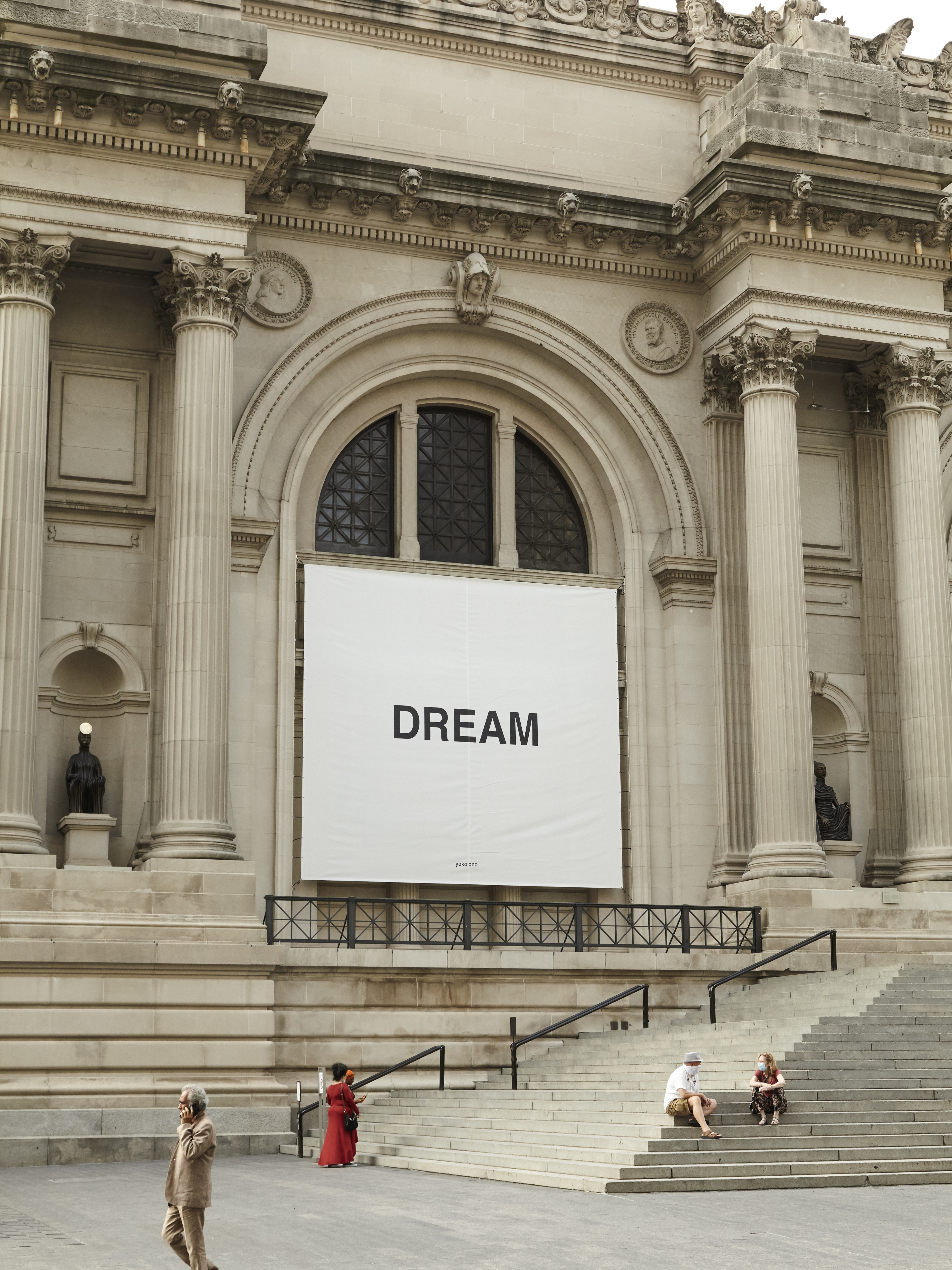
For more than seven decades, Yoko Ono has challenged conventional boundaries between art, music, and everyday life. At the heart of her practice is the belief that imagination can bring people together, transforming individual acts of participation into opportunities for collective reflection and shared understanding. By asking people to contribute, respond, and imagine alongside one another, Ono opens a space for exchange and recognition, creating the conditions in which peace can take form. This vision finds renewed urgency in Yoko Ono: Music of the Mind at The Broad in Los Angeles.
The exhibition extends beyond the museum walls, from Ono’s Wish Tree (1996–ongoing) project in the courtyard, where visitors can handwrite personal wishes and tie them to the low-hanging branches of olive trees, to a series of billboards spread across Los Angeles. This more public expression revisits Yoko and John Lennon’s 1969 WAR IS OVER! (If You Want It) campaign, which first appeared in cities around the world, including along the Sunset Strip.
From her instruction pieces, originally conceived in the 1950s, to Add Colour (Refugee Boat) (1960/2016), Ono invites audiences to consider their own agency. In the latter, visitors encounter a wooden boat and surrounding walls painted white. Using blue markers provided, they are invited to add words, drawings, and marks of their own, gradually transforming the installation over the course of the exhibition into a collective field of expression that also evokes displacement and the ongoing international refugee crisis.
Against this backdrop, and within the wider context of Yoko Ono’s artistic legacy, Beyond Noise invited curator Sarah Loyer and musician and longtime Ono collaborator Yuka Honda into conversation. Together, they reflect on the works assembled for the first-ever solo museum exhibition devoted to Yoko Ono in Southern California. They discuss the accompanying musical performance program, their respective relationships to Yoko and her practice, and how her experiences moving between the contrasting cultural and political worlds of Japan and the United States shaped an artistic vision that continues to resonate today.
Our conversation begins early one May morning in the exhibition’s first gallery—a darkened space where Film No. 1 (‘Match’) (1966), Ono’s filmed realization of her 1955 Lighting Piece, is projected across the room. From this starting point, Sarah and Yuka reflect on the exhibition’s conception and the immersive ideas that unfold throughout Yoko Ono: Music of the Mind.
SARAH LOYER: The exhibition is loosely chronological, so we start with one of the earliest “instruction pieces” that Yoko made, 1955’s Lighting Piece. This work is interesting because it’s a practice that she started privately when she moved to New York as a teenager to live with her parents in Scarsdale, and while she was attending Sarah Lawrence College she started doing this in her room. She would light the match and watch until it went out, which is what the instruction says. This text is from a typescript draft of her 1964 book Grapefruit. We see the idea iterated multiple times over decades, from the 1955 text, to a performance at Carnegie Recital Hall in the early 1960s, to a film in 1966.
YUKA HONDA: I find it moving, that a really simple thing has so much meaning. It’s a really great way to start the show, by igniting.
SL: Yes, and works like these make us slow down and pay attention. We see an idea repeating, and we’ll see that again and again. The more time you spend in the show, the more you’ll see patterns. Ideas are really the root of the practice. The use of humor and language can be really disarming, and can invite people in. Seriousness sometimes can be alienating, so I think she uses humor very smartly as a tool. For instance, her instruction piece, Painting to Shake Hands, has a kind of secondary title, Painting for Cowards—which I find so funny. To me, this work is also an example of her making us look at the world differently, by creating something disarming. It starts as an invitation and then it creates an unexpected connection with others.
YH: Connections with “others” seem to be a big theme for Yoko. For example, Bag Piece (1964), which is part of her peace movement. These works encourage you to connect with people you don’t know—to get in a bag with a stranger and see how that feels.
SL: And Cut Piece, which is scary to watch, and to think about having agency in. This work is from 1964. She performed it in Kyoto for the first time, then in Tokyo that same year, so it was very much originally situated in post-war Japan. The performance documented in the exhibition took place in New York the following year at Carnegie Recital Hall. It was radical then, and it remains radical today. Yoko did it many times, and others have performed it in the decades since. It’s a generous piece in that it can take on new meaning each time that it’s performed; it’s very open.
YH: A lot of these works are asking about the boundary between you and a stranger.
SL: Definitely, they are acts of radical trust. Also, she doesn’t move. Her eyes move, but her body is still, she’s kneeling, so the gestures are really on the audience. It’s up to the audience what direction they take it in. That’s trust, but it’s also a gift.
YH: Yes, “I give you a hundred percent freedom to do anything to me.” It’s powerful.
SL: Ono performed Cut Piece alongside two other performances in fall of 1964 at a farewell concert called Strip Tease Show. It wasn’t about stripping the body—instead, stripping the mind. In Strip Tease for Three, she brings out three chairs. Then she either leaves them there, and nothing happens, or eventually the stagehand comes out and removes them. I can imagine sitting there in the audience and seeing the chairs. The longer it goes on, with nothing happening onstage, [the more] you start to look around at all the other people. And then you realize, “We’re performing.” It’s that discomfort.
YH: She challenges us with discomfort a lot.
SL: Her work is also a lot of things together: performance, writing, ideas, physical objects, sometimes music. All these modes of expressing oneself.
YH: She doesn’t use anything too complex or hard to understand. It’s often stated very simply.
SL: Yes, for instance, with the scripts in her Grapefruit book… There’s this simplicity of language and ideas, but that’s a way of opening up our minds. She published this in 1964, the same year that she performed Cut Piece for the first time, and she had given birth to her daughter the year before. She was living in Japan and collaborating with so many artists in the country during that time. It’s interesting thinking about her experience at that moment. She was about 30 years old; she had been living in the States for about a decade. After being evacuated from Tokyo as a child, she returned to the city and lived there through her first year of college. And then she spends almost a decade in New York, before returning to Tokyo. When she goes back in the early 1960s, it’s becoming this booming metropolis, preparing for the 1964 Olympics. What a twisting experience, to have left a city decimated by war and then return at that stage. I’ve been thinking about how massive that must have felt. It was such a productive time for her, too, those two-and-a-half years in Japan between 1962 and 1964.
YH: So she grew up in Japan, then America, then Japan, then America. Supposedly, when you have that kind of experience, it’s called being a “third culture child.” What happens is, your brain is still developing, and you have to acquire your home country culture, and then another culture, and that creates a third culture in your mind. You realize that there are all these differences, and you start to see the world from a third person point of view. I see that in her work a lot—that she can talk about herself, that she becomes a third person.
SL: She thought of the grapefruit as this hybrid between a lemon and orange. She’s a person who, because of that experience of growing up in two places and two cultures, didn’t feel really at home in either place—and so she saw herself as a sort of hybrid. That’s why she named her book Grapefruit.
YH: She wasn’t accepted in America, and she wasn’t accepted in Japan, and [returning to Japan] was very difficult for her. That also generated this explosive creative energy—this weight on her. Kyoko, her daughter, was telling me recently that, growing up, she was really poor. They had no furniture. Yoko would cut furniture up for her installation Half-A-Room; Kyoko would try and sit on it, and Yoko would say, “Don’t touch the art.”
SL: What’s interesting is that Yoko was very wealthy as a child; her family had a lot of wealth. She sacrificed a lot to be able to make the work and live the life that she wanted.
In London, Indica Gallery was a hub for artists, musicians, and creatives at that time, in the mid-1960s. John Lennon heard about her show and came for a preview of it. That was their first encounter. I feel that that needs to be in the record, that he sought her out; he was finding his voice in the avant-garde, and she was one of the existing voices. She was part of the Destruction in Art Symposium that fall, and she was the only female artist invited to give a full presentation. That’s the level she was at. Anyway, at her show, he asked to hammer a nail into the painting, and she said, “Here’s the charge.” He said, “How about I give you imaginary money, and then I can imagine hammering an imaginary nail.” That was a moment of, “Oh, I’ve found you.” They saw each other.
Yuka, how did you start working on I Am Yoko?
YH: I was thinking of this project for years. I realized that everybody knows the name Yoko Ono, but most people have no idea of the full range of her work. She lived a very interesting, difficult life. There are these elements to her that are extraordinary and that make her a little bit alien, but there’s also a relatable side of her that’s very human, and I wanted to introduce this to people. Originally, I thought of creating nine pavilions and having multimedia pieces in each, so you could experience Yoko’s life by going through them. Of course, it’s impossible to build nine buildings and have multimedia shows in all of them, so at first I just put it away. Then I started to think of this project, and I began considering who could work on it.
I really wanted to do it with somebody who has experience with installations at big scales, because I’ve only done music. Glenn [Kaino] came to my mind slowly, and I really felt that he relates to Yoko. He has feelings about society that are very strong, but his work doesn’t express anger. It focuses a lot on the beauty of humanity, and that’s how he communicates his activism. I met him through a mutual friend and, luckily, he loved the concept. At first we were trying to figure out how to present this work. My idea was that I wanted to be very sensory. I wanted you to feel Yoko’s life from inside of her. Now we have arrived at doing a theater piece with music. I met Yoko in 1995 and I had the privilege of being pretty close to her. I traveled with her to many places. She would talk about her work and what she was thinking, and she would say so many amazing things that for me were incredible gifts—that I still think about in terms of my own life. I feel like my life has been different because of things that she told me, so I wanted to share that through this work.
SL: You’re also working with us on A Night Celebrating the Music of Yoko Ono in August. Tell us a little bit about the artists that you engaged for that project.
YH: I really wanted to bring together the community of people who were inspired and influenced by Yoko. She let Sean [Lennon] and me assist with producing her last two albums. It’s hard to describe her recording style in words. But what happens is that she brings in an idea, and we live with this idea. We kind of make it ours too and try to express it together. I don’t know how to describe it, but music has this quality where it’s not like everybody is in separate bags; it’s more like a water pool. We, the water, all come together and create our own wave. She inspired us in that way, and the waves are still going.
SL: I feel envious. It sounds incredible to be a part of it. Another of the works in the show is White Chess Set from 1966, as well as the billboard campaign that John and Yoko did together across late 1969 and 1970. It traveled to 12 international cities, including Los Angeles. It makes me think of the two of them together. She was very established in her career and her practice by the time that they met, and so was he. They leveraged their joint celebrity to bring forward these messages of peace and unity, and these anti-war messages. Together, they’re kind of building off her existing works and using mass media—while at the same time being very critical of mass media, creating works that are playful and inviting.
YH: I feel that they wanted to give the opportunity for people to think about peace, because I think peace is something that we have to achieve, it’s not just a lack of war.
SL: It’s not a passive thing, not at all. It’s not pacifism. It’s an action. And even her messages of “peace is power,” or “think peace,” “act peace,” “spread peace,” “imagine peace,” start in our minds—but then it’s an act that we must choose.
In terms of music, in the show, we see these moments when there’s an emphasis on the musicians that she’s around and connected with. For instance, music from the concert tour in Japan with John Cage and David Tudor. She was surrounded by incredible musicians, and they were influencing each other. That tour that she organized with Toshi Ichiyanagi is just another example of her being a conduit between the New York scene, the Tokyo scene, and the London scene. She really was a connector.
YH: And they were all supportive of her because they believed in her art. She was married to Toshi, but Toshi really supported her even after they broke up.
SL: They were true collaborators, you see that in the early works. They were also together when they were so young. She was 23 when they eloped. You could say she was maybe a musician first, even in terms of her education. She studied philosophy at Gakushūin University in Tokyo for a year, and then she went to Sarah Lawrence and did music composition and poetry. You see those elements in everything she does.
YH: Supposedly, her elementary teacher told her to imitate bird sounds, and I think that’s some of her first sound-making.
SL: And then you see someone like Cage doing that decades later. That idea of transcribing everyday sound, we see it in Grapefruit too. We see it in so many of the works—the everyday experience is part of the auditory experience of the work. As the decades go on, she moves into these gestures of humanitarianism, but we can trace the lineage all the way back to those wartime experiences. She really always used imagination as a tool and as a way to sustain herself.
One of her works in this show is called My Mommy is Beautiful. That’s a work that brings us to this common experience—whether you have a mother or not, you were born to this world—and it asks us to reflect on those relationships. At first, the title sounds like it’s going to be a very happy, positive expression, but she invites us to write our thoughts of our mothers. As it accumulates, you see that there’s despair, there’s anger, there’s joy, there’s love. There are a whole range of emotions. I think what’s so powerful about that work is the accumulation.
YH: You become one of many. Your very special, intense, maybe horrible, maybe good experience becomes one of many. It’s very beautiful.
SL: We have a film in the show, Whisper, where she is performing at the age of 80. How has it been, over the years you’ve known her, to see her perform live?
YH: She’s a very special performer. She doesn’t really believe in music in the way of, “I know this chord, I know this melody, and I can play really well.” She believes in music as a place to communicate emotions and feelings. So, in order to do that, she refused to practice with us, because rehearsal makes music become like muscle memory. We like to rehearse as musicians, because we want that feeling of muscle memory. Yoko didn’t want that; she wanted the show to be like the first step on the first snow. Nobody has walked on the snow, and you have this very special feeling about where you’re going. That step becomes very precious. Instead of rehearsing together, we said, “We’ll just run songs with you, so that we know what’s going to happen, and so it feels good for us.” She’d come and say, “Okay, you run the song, I’m just going to listen.” We would start playing, and next thing you know she’d be on the mic, singing 120 percent. She never really wanted to do something lightly, she only wanted to perform at 120 percent, and it was really incredible.We really absorbed that energy. It’s not about giving the perfect performance, it’s about giving yourself. She was the same in the recording studio, too. Usually we do a lot of fixing in there—we tend to aim for something that’s really finished. But she just wanted it to be alive. When we were in the studio, she would be rolling on the floor, singing. From what I understand, she did a lot of her earlier albums really quickly. She believed in working fast and not overthinking, and she wanted to have this intuitive energy that’s not manipulated.
SL: We began by thinking about how she returns to ideas again and again. Add Colour (Refugee Boat), which is from the 2010s, began as an idea that she had in 1960, with the Add Colour painting shown at AG Gallery. She invited people to add ink to the canvas to complete the work—then, many decades later, she’s giving it a title and asking us to think about the ongoing humanitarian refugee crisis.
YH: She chooses beautiful color instead of blood or waste. I really feel a lot of meaning in that.
SL: In this work, the instruction is: “Just blue like the ocean.” She’s not telling us what to do. She’s inviting us. That’s as much as she’s willing to give us, other than the title—and then it’s up to us what we write, what we draw, what we say.
Blue is really the only other color, other than black and white, that we see in her practice. It’s almost the only other color that appears. It’s the color of the ocean, but it’s also the sky. The sky repeats again and again in her work. She has talked about, as a young child during wartime, looking up at the sky and seeing it as this calming presence, a way to return to herself. We have a couple of works in the show that specifically engage the sky, including Sky T.V., which returns to the beginning—to that experience of war—inviting us to “take a piece of sky, and know that we are all part of each other.” She’s telling us, metaphorically, that it takes all of us to repair the world—to put the world back together and to pursue an active peace.
CREATIVE DIRECTOR + EIC
SARAH RICHARDSON
DIRECTOR
LAURENCE ELLIS
ART EDITOR-AT-LARGE
MAGNUS EDENSVARD
DP
JAKE FRANK
ASSISTANT
HANNAH HERMANN
ARCHIVAL PRODUCER
AVIVA SCHWAIGER
PRODUCTION COORDINATOR
MIA PURCELL
Beyond Noise 2026
CREATIVE DIRECTOR + EIC
SARAH RICHARDSON
DIRECTOR
LAURENCE ELLIS
ART EDITOR-AT-LARGE
MAGNUS EDENSVARD
DP
JAKE FRANK
ASSISTANT
HANNAH HERMANN
ARCHIVAL PRODUCER
AVIVA SCHWAIGER
PRODUCTION COORDINATOR
MIA PURCELL
Beyond Noise 2026