Noise
ISSUE NO. 05: PETER PHILIPS
MADE IN ANTWERP
Words: 3373
Estimated reading time: 19M
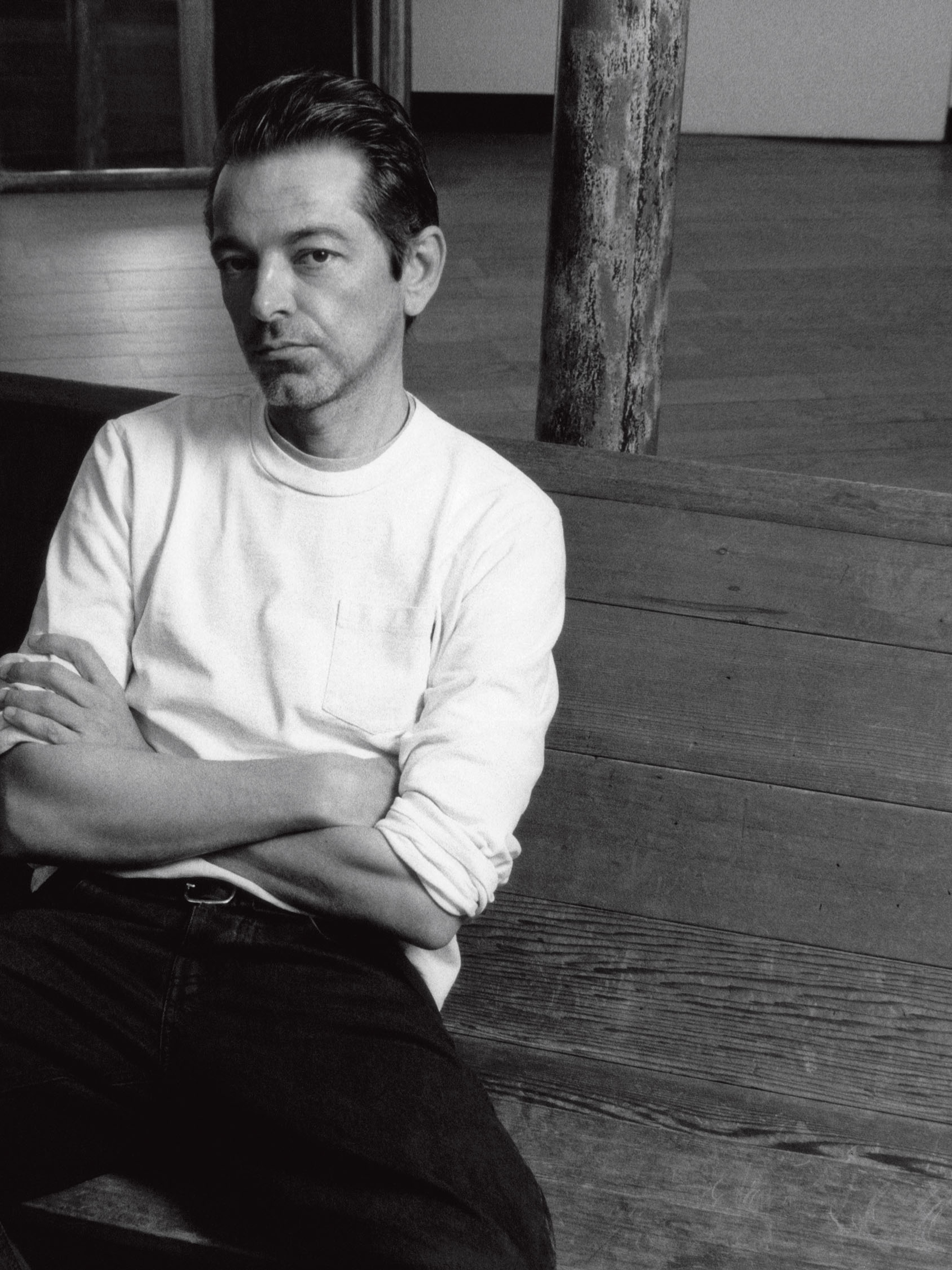
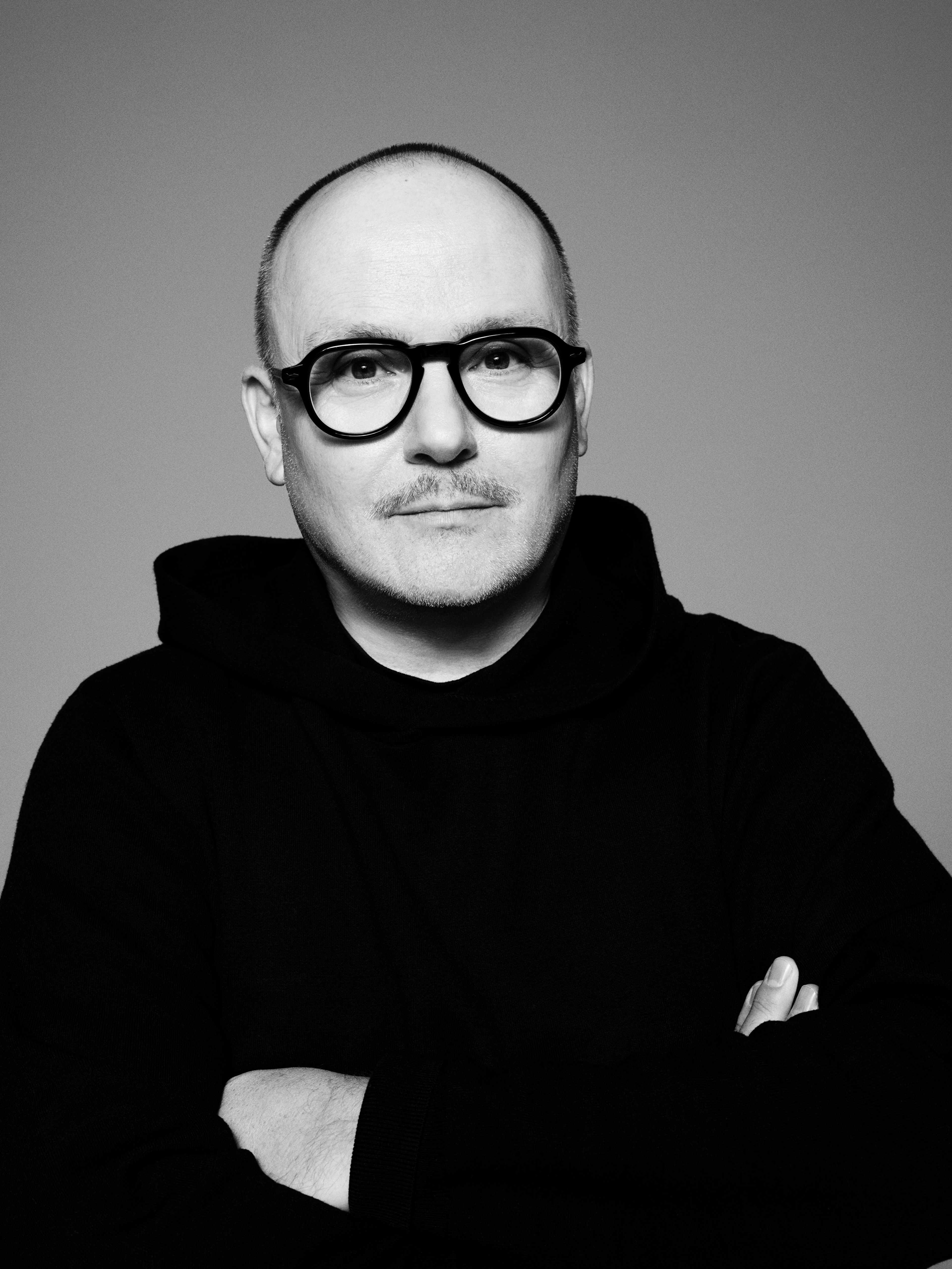
Peter Philips, Creative and Image Director for Dior Makeup, joins Nedda El-Asmar IN her studio to discuss their lineage from students in the early ’90s to now.
By James Parkes and Ryan White
Behind an unassuming black door in Antwerp’s busy Seefhoek neighborhood, Nedda El-Asmar’s studio is a little oasis of calm. Or perhaps ‘little’ is the wrong word. A short walk from the Royal Academy of Fine Arts, the school she recently became head of. Parts of the former hair salon feel more akin to a grand museum than a studio. The towering wood-paneled walls stretch up to the ceiling’s exposed beams and detailed plasterwork. A manicured garden appears behind the stained glass windows. Pieces of Nedda’s metal and glasswork sit on different surfaces throughout the space.
It’s here that Nedda meets makeup artist Peter Philips, globally renowned makeup artist and the Creative and Image Director for Dior Makeup. Peter and Nedda were both students at the Royal Academy around the same time, graduating in ’93 and ’91, respectively, but in different departments. Now, over 30 years later, each has a deep appreciation for what they learned during that time, and the freedom that came before technology and its atomizing qualities began reshaping design, education, and youth. With Peter working with Willy Vanderperre, another esteemed graduate of the school, for this issue of Beyond Noise, it seemed only right to discuss the school, Antwerp, the ’90s, and how the confluence of these things changed fashion forever.
BEYOND NOISE: So, Peter and Nedda, you both studied at the Academy around the same time.
NEDDA EL-ASMAR: I graduated in 1991.
PETER PHILIPS: I graduated in 1993. Back then, the departments were separate. We were in what is now the sculpture building. In my last year, we weren’t allowed on the top floor because it was collapsing. I remember in the first year, we made an experimental dress out of cardboard, an evening gown from recycled materials, and an experimental bathing suit. In the second year, a historical collection based on fashion history classes, mine was for the Dulle Griet. Stiena Van Beirendonck was my model, Walter’s niece. Willy Vanderperre started in the first year of the fashion course with us, but then he switched to photography. Olivier Rizzo was in the same class. We sat next to each other at the entrance exam, and [the stylist] David Vandewal was on the other side. Olivier wasn’t accepted immediately and had to go elsewhere first. I doubled my second year and ended up back in class with him. I wasn’t lazy, but I had no money and worked in restaurants.
NE: I worked 20 hours a week during my studies, minimum.
PP: I worked at Lenny’s in the kitchen. In my doubled year, some students had financial support. They could invest in fabrics and research. It was frustrating for those of us without money, but it pushed creativity. I learned at the Academy that I wasn’t a strong designer. I loved fashion but didn’t have the same passion for clothing as some. I realized I had to find another way into the industry. My graduation collection was black and white with some silver, made from old tablecloths from my grandmother’s attic. I made cardboard jewelry. And I passed! What I learned was, sometimes, the storytelling is a bit more interesting than the actual clothes. It was storytelling about recycling and in 1993 it was new as a concept. It was not an amazing collection, but it did the job.
After graduating, I told Willy and Olivier, okay, I’m gonna test myself in makeup. I made a little portfolio. I did some little shoots left and right. Made enough money on the side to be able to survive one year, paying rent and all that. I went to an agency in Brussels. Someone said, “Oh, it’s interesting. Somebody from fashion wants to do makeup.” Because I worked in restaurants, I remember there was this one guy I worked with and he was in his 30s or maybe 40s already. He studied photography, but he got caught in the easy money in restaurants, and he used to party. He realized he missed this window of opportunity to work on his photography, and he got stuck. I thought, okay, make a choice, you have to be available a hundred percent, and from 1995 I said, “Okay, I’m available.”
BN: Peter, after studying graphic design, then fashion, how did you come to makeup?
PP: I’m a kid from the ’80s. We did makeup and hair on friends before going out. That was the most fun part of the evening. Even at the Academy, during shoots, I had strong opinions about makeup. When flipping through magazines, my fellow students analyzed clothing; I would go straight to the face. The big eye-opener was doing work outside of fashion. Doing makeup in a salon with women who won a makeover, that’s when I had to step back and really think about skin and confidence. You become almost like a psychologist. I remember this one girl had a birthmark on her face that she hid with her hair. With the little skills that I already had, I said okay, let’s have a chat. I opened up her hair and said, “well, I can give you advice about which products to use if you want, but you have great, beautiful eyes”. We did a makeover, and she walked out of that salon reborn. That’s where I started appreciating, also, the more day-to-day elements of beauty, and not just catwalk and covers. That helped me a lot when I got approached to start creating.
NE: I wish I could do it, but I never have time for makeup. A friend suggested spending a day learning how to do it properly.
PP: I mean, it’s fun. That’s what I always say about makeup. For a lot of people, it’s something to hold on to. It can cover things and bring out what you think is the best in you. But at the same time, it’s just makeup. Thanks to social media, people are starting to appreciate the democratization of cosmetics. Products are available at reasonable prices. There’s so much choice. You can play, experiment, and have fun. And there’s gender fluidity, it’s not just women, and not just movie stars versus people who don’t wear makeup.
NE: But on the other hand, with social media, there’s also so much pressure. Girls spend so much time on it. That’s the negative part. It has positives and negatives.
PP: People have to be clever enough to analyze it and not get lost in that trap.
NE: That’s it. We’re older and we know that. It’s easier for us not to fall into that trap. But for the younger generation…
PP: It’s going to be tricky. They’re already fixing themselves before they even have wrinkles.
NE: It’s the same as having gray hair.
PP: At least you have hair. You just have to embrace what you have.
NE: During Covid, I stopped dyeing my hair. I was fed up with it. At one point, it was half and half, and I loved it. I had really gone through the whole process. My hairdresser refused to dye it again. She said no, that it would break my hair. I just had to let it grow out.
PP: It’s a long process. How long did it take?
NE: Four years. After four years everything was out.
PP: So when was the moment you cut off the last dark part?
NE: It was long at that point. I can show you. Here, you see, there’s still a little bit of black. That was the last part.
PP: It reminds me of Agnès Varda when she let it grow out, it faded almost like a sunburst.
BN: Nedda, compared with Peter, how do you feel about leaving school and where you are now?
NE: For me it was different. I did silversmithing and I knew I wanted to make objects. I focused on silverware. But after four years at the Academy I thought, “Who is going to buy a contemporary silver teapot? How am I going to live?” I didn’t know enough about the real world. My professor told me there were two schools for silversmithing: Stockholm and London. Stockholm accepted six people, London accepted 10. I chose London. I didn’t even know how prestigious the RCA was, I just applied. There was a project called “batch production.” You had to design something and make a small production. In the first year you made the sample. In the second year, two people would produce it for you. You might think you’ll make ten pieces and sell them for £100, but you end up with six pieces and have to double the price. I made an oxidized silver object. It looked black. It was a condom holder shaped like a sperm entering an egg. This was 1993, during the AIDS crisis.
That was my response. Through that project I realized I could design without producing everything myself. After that, I went to Paris with my portfolio, presented to companies, and that’s how I started working for Hermès.
PP: That’s sometimes the weakness of the Academy. I love it, but back then you didn’t leave fully prepared for the real world.
NE: There’s also too little time now. In our time we had no computers. I learned to solder everything by hand. CAD came later. Now students have to do manual work, digital rendering, product photography, everything at once. How can you do that in four years? Art schools are shortening programs. The RCA is now 12 months instead of two years. When I started, it had just gone from three years to two. Now it’s one year. Everything is becoming faster. Teachers have almost no holidays. We need to slow down.
PP: Because you lose detail. You lose quality. It becomes fast food.
NE: Exactly. To design something timeless you need time, to look at details and find balance. When you’ve done that many times, it becomes faster. But when you’re learning, you need time. Those four years at the Academy are the only period in which you can be completely free. The industry also has to invest in people. Internships shouldn’t just be temporary labor. Companies should train and develop young designers. If you immediately think about commercial viability, your creativity is limited. First, you need to go to the extreme, and then after that you can break it down into something commercial. Those four years allow you to go to that extreme.
PP: It’s about building your own mind.
NE: Yes. You’re 18 when you start. That’s very young. There’s so much to learn.
PP: You build your foundation there. You make mistakes, and because you don’t know everything, you do unconventional things. Mistakes can lead to something beautiful. And you build a reserve of ideas that you draw from later. I love libraries. I love the satisfaction of finding an idea myself, even if it existed before. The process is mine. AI is interesting, but it makes your brain lazy. The satisfaction of creating something yourself, nothing compares.
NE: AI makes everything faster. But you need time to develop. I tell students: Go to the library. You’ll discover things by coincidence. You open one book and find another. That serendipity is different from online search. You can use both, but please go to libraries.
PP: The younger generation has a very short attention span. It’s not a criticism, just an observation. I feel it in myself too. I remember when a movie came out like The Last Emperor, or Amadeus, or something like that, it was mind-blowing, and you would just sit and enjoy it. I watched The Last Emperor again recently, and after 30 minutes I felt restless. That worries me. I don’t even have a computer at home. I check emails once a week at the office. I need to keep my mind clear. Even working in a commercial context, I need that purity to keep the creative part alive. Because if you just follow trend books, you’re only repeating what already exists. I always come back to this argument. When I started doing makeup, I was very avant-garde. I was booked to work with photographers on material for trend books, and I remember there was no guidance. It was just play. Then I’d go straight from that to a commercial client, a campaign, a beauty campaign, whatever, and there would be a mood board with at least six pictures I’d worked on. They’d explain to me what the picture was ‘about.’ I’d think, ‘No. I was there.’ There’s nothing like that. It’s a gut feeling. You play and try to make great images.
NE: There’s something about the fact that young people aren’t allowed to experiment and fail anymore. It has to be right immediately, and it has to go on Instagram. But before you could make shit and it didn’t matter. That’s what helps you further. When I think about things I’ve made, I think, “Oh my God.” But I learned from that.
PP: You learn, you move on, and you grow in a direction you might never have imagined if you hadn’t had that “failure.” It’s not even a failure.
NE: No, it’s not a failure, it’s seen as a failure. That’s the whole thing. In fact, you’re experimenting. You used the word “play.” You need to play, you need to have fun. Creating should be fun, not a pain. You need to wake up in the morning and say, “Yes, I’m going to work on it.” Even if it’s not easy.
PP: You can suffer, of course. But you work toward something, and then at the end, when it’s done, it’s so satisfying. I’m not even talking about a makeup look. I like making things too. If I have time, I make masks and embroidery and things like that. I can be up until 2 a.m. after work, doing little embroideries that I might use one day in a shoot. It’s very satisfying. I’m still happy I have that, and that I’m not only on commercial jobs. The commercial job allows me to do that, and it allows me to reach a lot of people. It’s a shame we’re losing a lot. AI is fascinating and very interesting, but I think people like us can find it fascinating because we knew the world before.
BN: With the backlash against AI among young people, can you see a growing trend for crafts?
NE: That world is definitely coming back. People are starting to knit and do all that kind of stuff. I have faith that it’s coming back.
PP: I’ve been shooting recently with photographers who shoot film, young kids.
NE: No digital. My children as well, they just use film.
PP: They own the image they’re taking. There aren’t 50 people judging it and saying, “Okay, we have it.” It’s an adaptation again.
NE: We don’t have to be scared to slow down. People are so scared to slow down, scared they’ll miss something. I think it’s the opposite.
PP: You miss more by racing.
NE: The last couple of years I’ve been working on a research project, dematerializing the value of gold. Gold is the most recycled material. Since the Romans, it has been recycled. Everyone keeps every tiny drop, and we don’t need gold. Gold isn’t essential. Water is essential. We should take care of water, not gold. Now I’m working with pure gold, which is an amazing material. You usually don’t do that, because pure gold equals money. But I dropped the money side. I borrow jewelry from people, jewelry they no longer have a sentimental connection with. I get it refined, and they get back the amount of pure gold that was in the jewelry. I work with it, experiment with it, and really play with it. At the end, there will be an exhibition, and then we’ll see, what is the value of my work? The value of the gold is just the daily price, there’s no discussion. But what is my value? Is it the time I spent? The design? The concept? Some people say it’s not possible because it’s gold, so it’s only the value of gold, and what you’ve done has no value. It’s very interesting to figure that out. I might sell some pieces. With that money, I’ll buy gold to give everyone back their gold; they won’t get back money. And if I can’t sell enough, I’ll have to melt the pieces down and give everything back. So that’s also part of it. Will I melt it down, or does it become something else? That’s the whole question.
PP: In a bizarre way, it represents the basis of our society. When you started the project, the value of gold wouldn’t have been what it is today.
NE: It’s all about, ‘What is the value of stuff?’ For me, the Academy also has a value. Its patrimony, its heritage. But it’s difficult. It has to do with the place as well, because it was a convent, it’s naturally closed, inward. And the way it used to be, people going to smoke and sitting together in the big hall, that doesn’t happen anymore. It’s a smokeless campus, you have to be 10 meters outside. So we need a new way of gathering people. I was thinking, maybe bring back the break from 11 to 11:20, everyone outside, forced socializing.
PP: I was going to say, a nice place to finish on, part of what I loved about uni was the experiences and friendships, and how that fulfilled my mind. And those times being shortened doesn’t help you expand your world, and that can affect your career. Those years at school are an investment. In your new role, and in the context of gold in our society, it’s an investment in the future of each individual. It’s a very important investment. That time and liberty never come back.
NE: As long as you’re in school, you need to be as free as possible, because afterward you’ll learn reality anyway.
“If you just follow trend books, you’re only repeating what already exists.”
CREATIVE DIRECTOR + EIC
SARAH RICHARDSON
PHOTOGRAPHER
WILLY VANDERPERRE
BEAUTY DIRECTOR
LUCIA PIERONI
Beyond Noise 2026
CREATIVE DIRECTOR + EIC
SARAH RICHARDSON
PHOTOGRAPHER
WILLY VANDERPERRE
BEAUTY DIRECTOR
LUCIA PIERONI
Beyond Noise 2026