Noise
ISSUE NO. 05: OUTRAGEOUS COUTURE

OUTRAGEOUS COUTURE
Words: 2411
Estimated reading time: 13M
The popularity of haute couture extends far beyond its small, rarefied clientele. In the age of AI, optimization, and automation, perhaps that’s no surprise.
By Liam Freeman
Haute couture and its improbable survival are, in many ways, to fashion what the bird of paradise is to the animal kingdom: a phenomenon whose defining characteristics might appear maladaptive to the times in which it exists. Just as a bird’s extravagant plumage, particularly the male’s, increases its vulnerability to predators while demanding immense energy to grow, technological advances can now superficially imitate couture hand techniques at a fraction of the roughly $65,000 starting price of a single piece. Like a bird’s elaborate courtship dances, displays that prioritize beauty over efficiency, couture demands extraordinary investments of labor.
Yet the bird of paradise has not vanished from the evolutionary landscape. Nor, despite decades of predictions to the contrary, has haute couture. In fact, the world appears more captivated by it than ever. At a moment defined by AI, digital saturation, and accelerating consumption, couture – slow, handmade, bespoke, and exorbitantly expensive – is experiencing a renewed feeling of cultural urgency.
There are estimated to be around 4,000 haute couture clients worldwide today, a figure that, according to Pulitzer Prize-winning fashion critic Robin Givhan, has remained relatively consistent over the decades. Much about this clientele remains deliberately opaque – identities guarded, appointments private, transactions rarely disclosed – reinforcing couture’s aura of exclusivity. Yet as Givhan notes, the system is fundamentally client-driven. “It’s funny that the part of fashion that is perhaps the least accessible is actually the most geared toward clients,” she says. “Ready-to-wear shows are filled with editors and influencers, but couture audiences include people who came to shop.”
A changing of the guard at some of couture’s most storied maisons thrust the discipline back into the spotlight recently, with debut collections from Jonathan Anderson at Dior and Matthieu Blazy at Chanel – the house’s first significant external creative reset in decades. Meanwhile, off the runway, the market has also been sending powerful signals of couture’s enduring value. Dior Masterpieces: The Mouna Ayoub Haute Couture Collection, a sale of 95 Dior couture looks amassed over decades by French-Lebanese socialite and businesswoman Mouna Ayoub, offered a rare glimpse into the private world of one of couture’s most devoted clients. Spanning creative directors from Marc Bohan and Gianfranco Ferré to John Galliano, Raf Simons, and Maria Grazia Chiuri, the sale, held at Le Bristol, the sale totaled more than $7.19 million. The event underscored couture’s shifting status from clothing to collectible artifact, commanding attention traditionally reserved for fine art and jewelry.
“With couture you get the ingenuity of the creative director combined with the incredible skill of the petit mains, and together they produce something that is not just a dress, but a masterpiece,” says Kerry Taylor, an auctioneer who worked on the sale. “For clients like Mouna, these pieces are part of their lives. When they go back into the world it is wonderful, but it is emotional, because they carry memories and stories with them. It’s also a moment when fashion history moves into new hands.”
Couture remains one of the most tightly controlled disciplines in fashion, regulated by the Fédération de la Haute Couture et de la Mode (FHCM), whose origins trace back to the Chambre Syndicale de la Haute Couture founded in 1868. The organization coordinates the official Paris Fashion Week schedules while safeguarding the standards associated with haute couture, a legally protected designation since 1945 that can only be granted, or revoked, by an FHCM commission under the French Ministry of Industry. To qualify, houses must produce made-to-measure garments for private clients in Paris ateliers employing at least 15 full-time staff and 20 technical workers, and present biannual collections of at least 25 original designs per season requiring multiple fittings.
Today, only 13 houses, including Chanel, Dior, Margiela, and Schiaparelli, hold official haute couture status. Yet the system is not entirely closed: corresponding FHCM international members adhere to the criteria but operate without a studio in Paris, while guest designers are invited each season, offering a pathway for new voices to enter what might otherwise be an impenetrable world. For executive president Pascal Morand, this balance between preservation and evolution is essential. “Haute couture cannot be a museum,” he says. “It must remain a living laboratory of creativity. The FHCM is both a guardian of tradition and a facilitator of innovation.”
The history of haute couture can be traced not simply to Paris but to a specific address: 7 rue de la Paix, where in 1858 Charles Frederick Worth, an Englishman, established his eponymous house and what would become the nascent couture system. Situated at the epicenter of luxury consumption in Second Empire France, an era marked by rapid industrialization and expanding wealth, Worth transformed dressmaking from skilled trade into artistic authorship. Rather than executing garments to a client’s instruction, he designed collections in advance for customers to select, positioning the couturier as creative authority rather than servant. He was also a shrewd marketer, introducing branded labels into garments, presenting designs on live models, and turning visits to his salon into social events. By the 1870s his atelier employed more than 1,000 workers and served European royalty as well as patrons from India, Japan, and Russia.
Many of couture’s early pioneers defined the shape of modern fashion. To this day, several of their houses continue to operate. Worth rendered the crinoline obsolete with his bustle silhouette. Madeleine Vionnet developed the bias cut, in which fabric is cut at a 45-degree angle to its weave, imbuing garments with fluid drape. Cristóbal Balenciaga’s exploration of volume and commitment to the chemise line paved the way for the pared-back sheath shapes that would dominate the 1960s. Gabrielle Chanel prioritized freedom and comfort, introducing materials such as jersey and tweed, previously associated with menswear or daywear, in line with her philosophy that “simplicity is the keynote of all true elegance.” Meanwhile, her rival Elsa Schiaparelli embraced imagination and theatricality, reflecting her belief that “in difficult times, fashion is always outrageous” through surrealist motifs and angular padded shoulders.
Couture’s cultural authority was perhaps most dramatically reaffirmed in the years immediately following the Second World War, when Paris sought to reassert its position as the global capital of fashion. In 1947, Christian Dior provided the catalyst. His debut collection, quickly dubbed the “New Look” by Harper’s Bazaar editor Carmel Snow, rejected wartime austerity in favor of unapologetic abundance: rounded shoulders, cinched waists, and sweeping mid-calf skirts cut from as much as 20 yards of cloth. Fabric rationing had only recently ended, and to some the silhouette appeared regressive, even politically troubling – a return to restrictive ideals of femininity; protests reportedly broke out in Paris and Chicago over its symbolism and extravagance. Yet, for many others, the New Look symbolized renewal – a declaration that scarcity could give way to beauty and prosperity – or, as Dior himself put it: “A golden age seemed to have come again… When hearts were light, mere fabrics could not weigh the body down.”
Dior’s success also marked a structural turning point for couture. Alongside private commissions, he expanded into international licensing, ready-to-wear, and accessories. When he died unexpectedly in 1957, just 11 years after founding his house, his successor was a 21-year-old designer named Yves Saint Laurent. Couture was functioning as a crucible for the next generation of designers who would go on to establish influential houses of their own.
Still, that’s not to say we’re experiencing the first couture renaissance. The ‘90s were also a golden era, when Galliano and McQueen arrived at Dior and Givenchy, respectively, and Jean Paul Gaultier branched into couture, transforming the runway into a grand spectacle. Their collections drew on references ranging from Greek mythology to science fiction. Galliano’s Dior has held a particularly vivid place in the collector’s imagination, with several dresses exceeding half a million euros. Why have they surpassed their original made-to-measure prices so dramatically? “Well, there are a lot of bored billionaires out there,” Taylor says. “And there are more women with enormous independent wealth now than in previous decades, which expands the couture client base.”
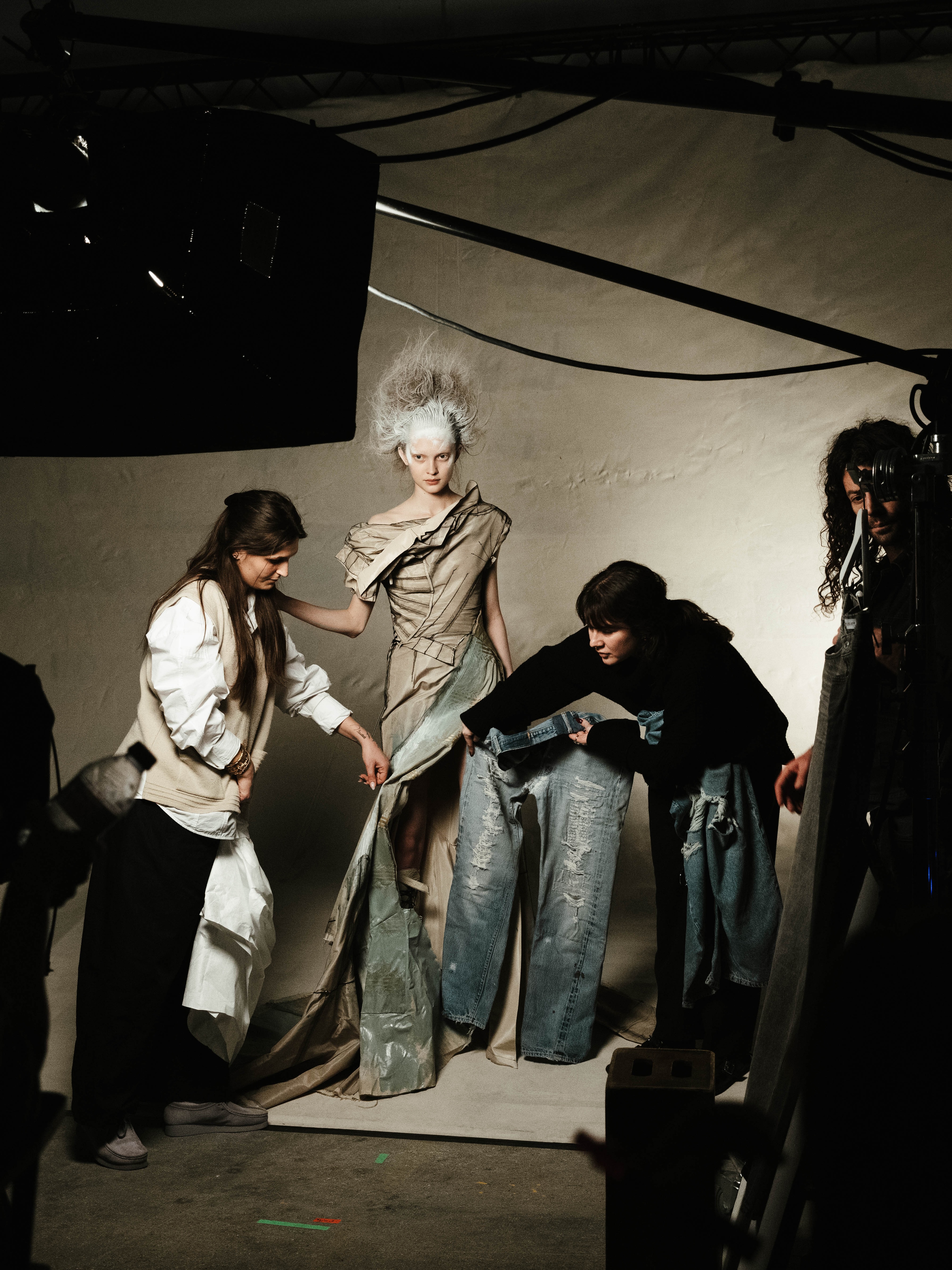
But the ultra wealthy are not the only ones these garments are for. Sure, most of us will never commission a bespoke ballgown, but couture exerts influence far beyond its rarefied clientele. Givhan likens it to automotive concept cars – objects designed less for direct consumption than for the ideas they generate. “You don’t drive the concept cars that are introduced at the big auto shows,” she says. “But elements of them eventually trickle down to the car you drive every day.” Increasingly, it’s also likely to happen in reverse. “Something a designer sees on the street ends up trickling up into the atelier,” she says, “and then becomes a luxury version of something that began at a grassroots level.” Consider Blazy’s trompe-l’oeil silk Chanel “jeans,” Daniel Roseberry’s Schiaparelli gown studded with acrylic nails, or the skirt suit from Demna Gvasalia’s final Balenciaga couture collection inspired by his grandmother’s tablecloth.
Once confined to salon presentations, collections now circulate instantly, where audiences engage through commentary, reaction videos, and communal viewing, bridging physical and digital worlds. A more cynical reading might suggest couture’s heightened visibility simply reflects an era in which everything becomes content. Yet the dynamic is more complex. The very technologies that disseminate couture globally also heighten awareness of what distinguishes it: the human hand.
Couture’s periodic resurgences are not accidental but structurally embedded within cultural history, says Morand. “When you have a technological revolution there is always a movement back toward craft,” he says, drawing parallels with the 19th-century Arts and Crafts movement. Today, he argues, a similar dynamic is unfolding in response to digital technologies and AI. Couture’s longevity, and its viability as a business model, lies in what he describes as a framework of “bespoke, craftsmanship, slowness, and uniqueness,” operating as a counterforce to the dematerialization of contemporary life. Bespoke reflects a direct relationship between creator and client; craftsmanship restores what sociologist Richard Sennett calls “tactile intelligence,” the knowledge embedded in the hand; slowness resists the acceleration of modern time; and uniqueness affirms both the singular object and the individuality of its maker.
While creative directors provide the authorship and point of view that drive couture forward, their tenure is ultimately ephemeral. What endures is the atelier. Couture is impossible without the artisans whose expertise is built over decades, mastering techniques that can take as long to learn as those of a brain surgeon. It is these hands that give ideas form, a reality designers themselves often rediscover when they turn to the workrooms for inspiration. After all, couture’s permanence resides not in spectacle but in the continuity of human skill – craftsmanship grounded in history and reality that, at its most powerful, generates an entire world of fantasy for the rest of the industry to feed on.
CREATIVE DIRECTOR + EIC
SARAH RICHARDSON
ARTWORK
LILY TOUITOU
Beyond Noise 2026
CREATIVE DIRECTOR + EIC
SARAH RICHARDSON
ARTWORK
LILY TOUITOU
Beyond Noise 2026