Noise
ISSUE NO. 05: ENTANGLED REALITIES
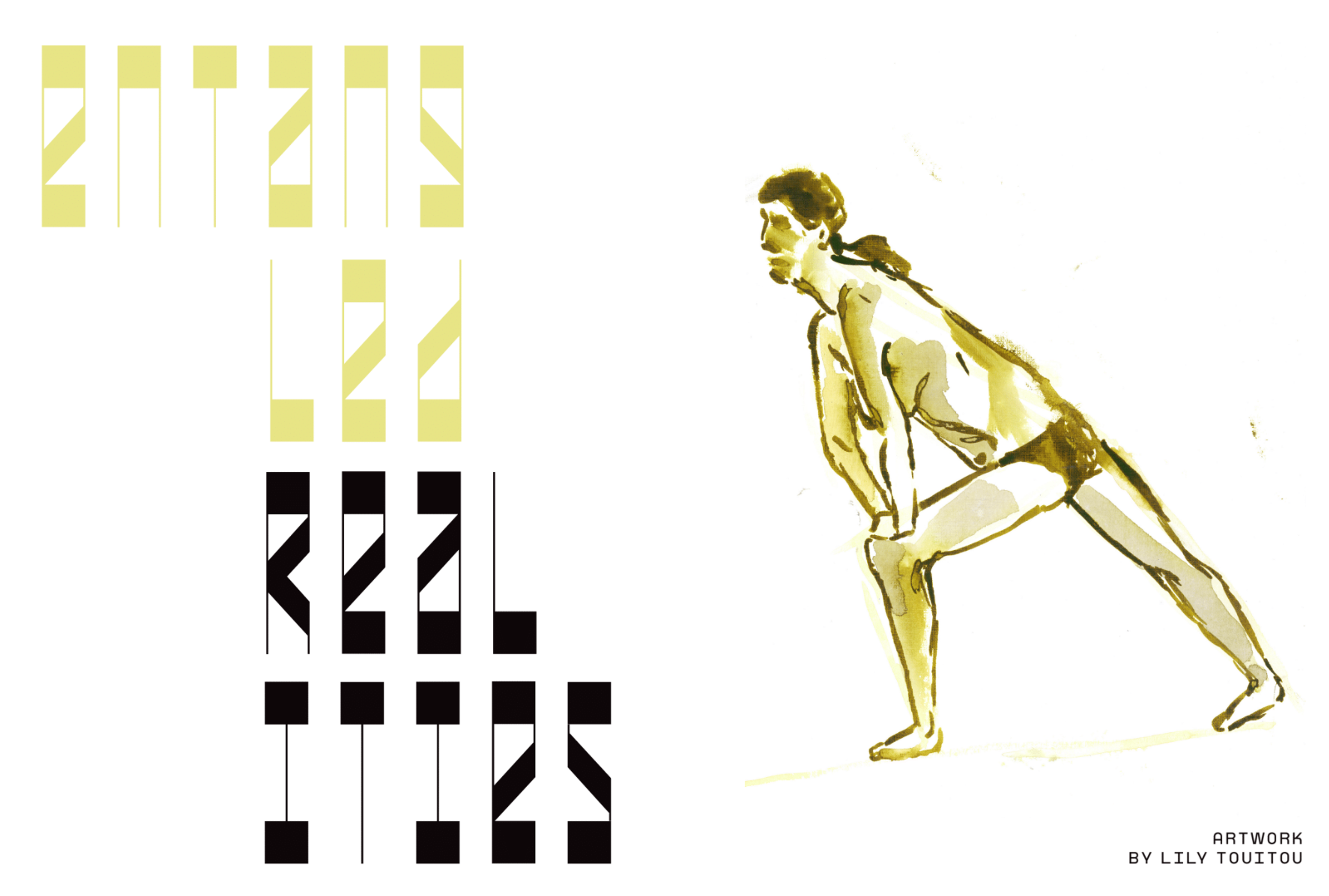
ENTANGLED REALITIES
Words: 2128
Estimated reading time: 12M
CAN QUANTUM THEORY HELP US MAKE SENSE OF OUR EVER-SHIFTING CURRENT MOMENT?
By Günseli Yalcinkaya
There is a clip you can find easily on YouTube from the scientist Carl Sagan’s legendary 1980s television series, Cosmos. In the video, titled 4th Dimension, Sagan describes a two-dimensional character living in a two-dimensional world, who one day realizes a third dimension exists beyond his perception. Inspired by the Victorian novella Flatland, Sagan’s thought experiment introduces a hypothetical fourth dimension, drawn directly from the book. In Sagan’s theory, this only exists in our world as a three-dimensional projection. This geometrical hypercube – or tesseract – is the closest approximation of the fourth dimension that we can perceive within our three-dimensional world. The rest of reality is simply outside our limits of perception.
Sagan’s theory can also serve as a useful framework to think through the unresolved strangeness of quantum theory. Rejecting the mechanistic and fragmented worldview, quantum sits outside the strict confines of classical physics. As humans, we process the world classically – or, to put it another way, through binary systems, which are but one fragment of an expansive reality – a reality that we cannot perceive. This ‘quantum’ reality beyond our perception is in constant flux; it is hyperdimensional, meaning that many different perspectives and timelines exist all at once. Much like the inhabitants of Flatland, we see the world as a series of stable, static objects with definite properties, while quantum reality remains an invisible, imperceptible force, much like the tesseract – which reveals that particles are fluid and relational, at least on a sub-atomic scale. As Werner Heisenberg, the German physicist and founding father of quantum physics, points out: “What we observe is not nature herself, but nature exposed to our method of questioning.” By highlighting the limits of our ‘method of questioning’, Heisenberg points us toward a more holistic view of the world, outside of the contemporary Western paradigm. This view resists being broken down neatly into separate pieces.
Breaking things down into parts can make them easier to understand. The development of science in the West drew on Western philosophy rather than Eastern, perhaps in part because the latter saw everything as a whole, making it more difficult to measure and shovel into objective categories. Ever since Descartes first declared, “I think, therefore I am”, the rationalist assumption of man as separate from nature has rested on the assumption that reality is something easily calculable through empirical means. This creates a clear divide between subject and object, space and time, cause and effect – in contrast to earlier periods of history, which followed an oral tradition that was ever-evolving, collective, and collaborative. Like Leonardo da Vinci’s Vitruvian Man, the Renaissance situated humans at the centre of the universe, while simultaneously throwing them off their axis with the era’s scientific breakthroughs, such as the Copernican revolution. This necessarily shaped how we organized and experienced the world, spawning new artistic traditions. These traditions included one-point perspective, which positioned the viewer outside of the image, rendering a painting as a linear narrative to be read from frame to vanishing point.
This epistemological unmooring can be felt most profoundly with the rise of the printing press and the subsequent fall of oral culture, reshaping our notions of space-time from non-linear to linear. As Marshall McLuhan explains, “The line, the continuum – this sentence is a prime example – became the organising principle of life.” Irrational and unverifiable knowledge systems were deprioritized, giving way to modern science and reason – the notion of reality being fixed, unchangeable, permanent. This is a stark contrast to the medieval times, where texts and images were free representations of the imaginary – from mythological bestiaries featuring compendiums of fantastical creatures to icon paintings communing with the divine.
At a time of accelerating technologies, environmental crisis, and societal upturn, we find ourselves in another paradigm shift. Reality has increasingly felt less fixed, less coherent. Language no longer feels adequate to account for the collapsing narratives and competing truths that define today’s AI slop society, conjuring images of an epistemological Tower of Babel trembling at its foundations. We see this in the explosion of visual and sonic absurdisms flooding our screens through incoherent yet vibey phrases and soundbites: chungus, sticking out your gyatt for the rizzler, 6-7, to name a few. In this second-order oral culture, knowledge is passed freely, link by link, click by click – remixed, remade, and reimagined in ways that recall older, folkloric traditions. Online, we exist less as singular, bounded individuals and more as shifting constellations of data: profiles, transient connections, meme accounts, and alter egos. Our identities fragment and multiply across platforms. Our presence is distributed across networks. Our actions ripple outward in ways that can’t be reduced to simple cause and effect. In these spaces, meaning emerges not from isolated entities, but from the relationships between them. This hints at a way of being that feels more quantum and relational – fluid, networked, and entangled – rather than what the Newtonian model would have us believe, with its focus on stable, separate units.
As LLMs rewrite reality in real-time through the superposition of a limitless number of competing realities, all playing out at once, the Renaissance myth that images directly represent the physical world no longer resonates as it used to. The URL unfolds in a dream logic reminiscent of oral culture, where the content isn’t literal; its real meaning is revealed in the hidden subtext. This is echoed in the principles of quantum entanglement, which precedes the ‘thing’ entangled, which is to say, the signs and symbols we use aren’t real, but illusory tools for communication. We exist in a classical world, but the digital mediation of everyday life through these technologies has warped the categories and systems that have long defined what counts as knowledge or truth – no doubt exacerbated by the explosion of algorithmic forces standardizing human behavior into mechanical and mimetic gestures, 0s and 1s.
From multiverse films to sci-fi novels and memes, there’s a quiet consensus that reality isn’t what it appears to be. This echo reverberates across pop culture, bolstered by a fascination for otherworlds and speculative futures that eschew real-world rules in place of liminal, non-human realms, where fiction melts into fact. Wrapped in a pseudo-mystical packaging, these magical narratives – think of the Marvel multiverse or viral TikTok trends such as reality shifting – inform how quantum moves across culture.
A radical departure from Western scientific traditions, quantum theory has long been associated with a fascination for Eastern philosophies such as Daoism. From its earliest beginnings 100 years ago, some of the most prolific Western thinkers and scientists – from Niels Bohr to Werner Heisenberg to Wolfgang Pauli – have been drawn to holism as an alternative framework to make sense of scientific theory. Quantum principles such as non-locality – once described by Einstein as “spooky action at a distance” – are given as scientific proof of the entangled nature of reality (for example, the quantum erasure experiment). For this reason, quantum ideas – or, at least their cultural appropriation – resonate most clearly in New Age communities; its associations with spiritual, mystical and metaphysical traditions first emerged in Western counterculture through popular texts such as Fritjof Capra’s The Tao of Physics (1975) and Gary Zukav’s The Dancing Wu Li Masters (1979). The era’s cultural institutes such as the Esalen in California, too, hosted lectures and seminars on quantum theory, along with a host of high-vibrational topics ranging from extrasensory perception, Eastern mysticism, to consciousness studies, most notably in Richard Feynman’s famous lecture series, Quantum Mechanical View Of Reality. Even the CIA caught on, recruiting members of the Fundamental Fysiks Group, a group of countercultural scientists in the ‘70s, to research remote viewing at the Stanford-affiliated SRI International, where official documents describe consciousness as a “pool of limitless, timeless perception,” with human awareness framed as only a fragment of a larger reality.
Given the trippy mix of Western countercultural and state power, it’s easy to see how quantum theory, along with the rest of the era’s mystical exports, has channeled its way into the mainstream, as both a cultural barometer and a scientific theory. Subsequent media adaptations depart from the scientific theory, yet their ongoing popularity hints at a deeper dissatisfaction with the current time, pulling us away from the version of reality constructed under modern science and technology. Writing in 1975, the scientist Fritjof Capra was an early adopter of quantum principles. In The Tao of Physics, he warns of the importance of understanding quantum theory’s “philosophical, cultural, and spiritual implications” as a way to restore balance across the ecological, social, and spiritual crises he saw emerging. Two decades on, the French philosopher Bruno Latour echoed this sentiment through his paradox of modernity, highlighting the false division between “nature (the realm of objective, impersonal truth) and culture (the realm of subjective belief).” He wrote, “The modern constitution allows the expanded proliferation of the hybrids whose existence, whose very possibility, it denies.”
For all its liberatory implications – cultural, social and political – quantum theory remains at odds with the current late capitalist system, which remains metaphysically locked into the Newtonian model. The notion of space-time as something embodied and interconnected does however suggest ways of being that bring us closer to nature and our surroundings. As Karan Barad writes, “The entanglements we are a part of reconfigure our beings, our psyches, our imaginations, our institutions, our societies.” But, as technology pushes us further into imaginal realms, rewiring our sense of reality to see beyond language might reveal older strands of knowledge, where ideas are not fixed but ever-changing, to point us towards a brighter future.
CREATIVE DIRECTOR + EIC
SARAH RICHARDSON
ARTWORK
LILY TOUITOU
Beyond Noise 2026
CREATIVE DIRECTOR + EIC
SARAH RICHARDSON
ARTWORK
LILY TOUITOU
Beyond Noise 2026